
More on this book
Community


Kindle Notes & Highlights


Minority voters did not just refuse to show up; Republican legislatures and governors systematically blocked African Americans, Hispanics, and Asian Americans from the polls.
The devices the Republicans used are variations on a theme going back more than 150 years. They target the socioeconomic characteristics of a people (poverty, lack of mobility, illiteracy, etc.) and then soak the new laws in “racially neutral justifications—such as administrative efficiency” or “fiscal responsibility”—to cover the discriminatory intent.
in 1890 when the Magnolia State passed the Mississippi Plan, a dizzying array of poll taxes, literacy tests, understanding clauses, newfangled voter registration rules, and “good character” clauses—all intentionally racially discriminatory but dressed up in the genteel garb of bringing “integrity” to the voting booth. This feigned legal innocence was legislative evil genius.
the poll tax, which all eleven states of the former Confederacy had adopted.
Key to the white primary’s effectiveness was the fact that from Reconstruction until 1968 the South was a one-party system—only Democrats needed apply, so despised was the party of Lincoln. Several of the states, therefore, began to discern that one way to skirt around the Fifteenth Amendment was to tinker with the primary election, during which the Democratic candidate was chosen. This seemed foolproof for two reasons. First, because the South was a one-party region, whoever won in the spring would certainly be the victor in November.
What the states could not accomplish by law, they were more than willing to achieve by violence. The wholesale slaughter of African Americans in Colfax, Louisiana (1873), Wilmington, North Carolina (1898), and Ocoee, Florida (1920), resulted in the loss of hundreds of lives simply because whites were enraged that black people had voted.64
The tools of Jim Crow disfranchisement worked all too well. In 1867, the percentage of African American adults registered to vote in Mississippi was 66.9 percent; by 1955, it was 4.3 percent.
The crisis “brought Jim Crow violence to vivid life in world media” and led Secretary of State John Foster Dulles to exclaim that “this situation was ruining our foreign policy.”
The Civil Rights Act (1957), while seemingly a landmark piece of legislation, was actually a paper tiger that had no ability to protect the right to vote.
In the twenty-first century, the geography of voter suppression had clearly changed. It was no longer only a phenomenon of the Jim Crow South.
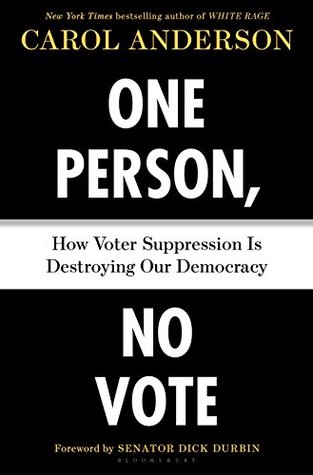
The subtle but destructive tinkering with the very sinews of the nation’s elections has shredded the constitutional logic of “one person, one vote.”3 Whether it was reconfiguring congressional district boundaries, removing polling stations from minority neighborhoods, reducing the dates for early voting, or ratcheting up the standards for those conducting voter registration drives, all those little, virtually unnoticeable-until-it’s-too-late bureaucratic tricks had major consequences.
the Electoral Integrity Project, using a number of benchmarks and measurements, was stunned to find that when it applied those same calculations in the United States as it had in Egypt, Yemen, and Sudan, North Carolina was “no longer considered to be a fully functioning democracy.” Indeed, if it were an independent nation, the state would rank somewhere between Iran and Venezuela.
The deft art of gerrymandering, “the nastiest form of politics that there is,” is key to understanding the decline of democracy in America.
Two distinct types of gerrymandering emerged on the American landscape. One was racial; the other, partisan.
Gerrymandering has a horrific effect on voter behavior. Those in competitive districts are more likely to vote; those in safe, uncompetitive districts stay home more often on Election Day.
Unfortunately, the assault on democracy is not only about the way congressional and legislative district lines are drawn. The undermining of democracy is also achieved in the way long, seemingly interminable lines at the voting booth have been artificially created.
In short, rigging the rules to suppress or dilute the vote of millions of citizens to affect the outcome of an election has come almost naturally to many of these politicians and public officials.
the Russians, frankly, were merely piggybacking on the years of work done by the GOP to stigmatize, disfranchise, and suppress the votes of African Americans and other minorities.
