
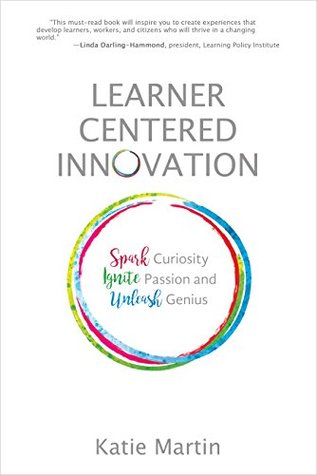
More on this book


Kindle Notes & Highlights

by
Katie Martin
Read between
July 8 - July 8, 2019

Most educators know in their hearts, however, that there is far more to teaching than success on a test, which puts them at odds with what is measured and how they are held accountable.
It’s safe to stay within the comfort zone of compliance—to cover the curriculum and stay in line with colleagues.
But is this the best approach for authentic learning?
That isn’t negative unless we mindlessly move through the prescribed content without focusing on desired learning and the impact on the learners.
The standards, pacing guides, and curriculum can serve as tools for educators to design the authentic learning experiences that empower learners to develop the skills addressed in the standards, but they should not be a checklist of content to cover.
to explain
My motivation for truly understanding this concept suddenly changed when I had an authentic purpose and
If we truly value learners as individuals and want students to be able to find and solve problems, communicate effectively, and develop other necessary skills, we can no longer simply prepare kids for a test or the next grade, we need to empower them to learn how to learn, not just memorize.
We need to equip them with skills that they can use to solve real problems—not
What if teachers did less, not more?
In fact, I know we would all be better off if our students understood where they are in relation to the desired learning target and how they can close the gap. That is the essence of personalized learning.
We are conditioned to create perfectly structured learning experiences, but we must consider what we are taking away from the learners by doing this.
When we can connect learners to ideas and questions that they are passionate about and motivated to solve, they amaze us with their capabilities and imaginations.
Too often, however, universities prepare, and schools perpetuate the expectations of teachers to fill the pail rather than light the fire.
When you as the teacher do all the work, you also do ...
This highlight has been truncated due to consecutive passage length restrictions.
“What decisions am I making for students that they could make for themselves?”52
it’s a clear indicator that I have missed the mark in designing the learning experience.
These questions are not usually a sign of someone owning their learning and are generally a function of a performance orientation—doing
These questions rarely signify intrinsic motivation. I understand that, at times, we all definitely need to do things a certain way and that not everything we learn is intrinsically motivating, but if these types of learning experiences consume the majority of learning time in schools, what are we really teaching?
Is our ultimate goal as educators for students to get the answers right on the test, or is it to help them understand the process of developing and improving their ideas so they can communicate and share with the world?
When learners are empowered and embrace the work because it’s meaningful to them, they ask questions like: How can I make this better? Did I accurately communicate my ideas? Is there another
way to solve this problem? What is the impact that my w...
This highlight has been truncated due to consecutive passage length restrictions.
In spite of our understanding that no two people are the same, we have set up a system that prioritizes and demands overly structured lessons for every student to meet the same objective at the same time in the year, regardless of the individual’s unique strengths, interests, or questions.
The content was based on what the students wanted to learn, but the student, regardless of their chosen topic, was learning and practicing the skills to be better writers, communicators, and collaborators.
Move from Scaffolds to Agency
Now I believe it’s important to plan and necessary to scaffold sometimes,
but I also wonder if we guide learners every step of the way, how might the structures and scaffolds we put in place actually inhibit the learning process?
Learner agency is about moving students from passively responding to acting with purpose to reach a desired goal or outcome.
learning and had autonomy and purpose throughout
The important thing here is that choice and purpose naturally empowers learners to move at their own pace and path and to seek support based on their needs from peers, online resources, and the
teacher. Learner agency is about moving students from passively responding to acting with purpose to reach a desired goal or outcome.
While this is a good start,
We need to prioritize learning experiences that not only develop knowledge but also attend to the skills, interactions, and mindsets we know are critical for students to develop to be successful in our evolving world.
More importantly, they saw themselves as authors.
They had an authentic purpose to apply the skills we were learning; they sought feedback, revised their work, and, as a result, they built their confidence and excitement for reading, writing, and sharing their ideas.
As Steven Covey notes, we manage things but lead people.
The reality is, our current approach is leaving many students behind, and if we are really focused on what’s best for kids and if our goal is to ensure success in work, life, and citizenship, we need to be nimble and create learning experiences that reflect the context and the resources to best meet the needs of all learners.
intentionally
Pedagogy Trumps Curriculum
Great teachers teach the learner rather than teaching a curriculum and trying to make the learners adapt.
We know that curriculum is just a guess. The
Prioritize the Learners
but the reality is that, to meet the needs of the learners in our classrooms, we need to utilize a variety of approaches depending on the learners and the learning objectives.
If we truly want to see different outcomes for learners in our education system and develop the whole child, we need to prioritize relationships with individuals and invite learners to show up as who they are and be seen.
co-constructed
To stay current, she needs to continually evolve based on her own learning, the identities of her learners, and the context.
Supporting versus Supplanting the Role of Teachers
Our world needs people who can think differently, solve problems, and thrive in a...
This highlight has been truncated due to consecutive passage length restrictions.
unpredictable ...
This highlight has been truncated due to consecutive passage length restrictions.
“Thinking of education as a preparation for something that happens later can overlook the fact that the first sixteen or eighteen years of a person’s life are not a rehearsal. Young people are living their lives now.”
