
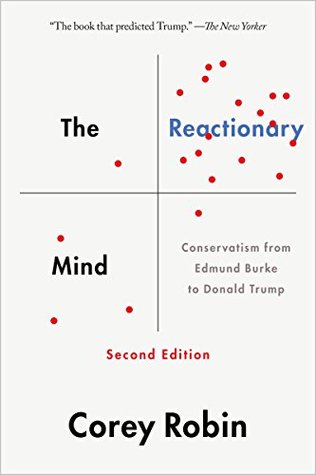
More on this book
Community


Kindle Notes & Highlights

by
Corey Robin
Read between
November 21 - December 14, 2017

In virtually every instance, their superiors have resisted them, violently and nonviolently, legally and illegally, overtly and covertly. That march and demarche of democracy is the story of modern politics, or at least one of its stories.
They always have been, at least since they first emerged as formal ideologies during the French Revolution, battles between social groups rather than nations; roughly speaking, between those with more power and those with less. To understand these ideas, we have to understand that story. For that is what conservatism is: a meditation on—and theoretical rendition of—the felt experience of having power, seeing it threatened, and trying to win it back.
Sometimes their lot is freely chosen—workers contract with their employers, wives with their husbands—but its entailments seldom are.
What contract, after all, could ever itemize the ins and outs, the daily pains and ongoing sufferance, of a job or a marriage?
Until 1980, for example, it was legal in every state in the union for a husband to rape his wife.
Implicit consent was a structural feature of the contract that neither party could alter. With the exit option of divorce not widely available until the second half of the twentieth century, the marriage contract doomed women to be the sexual servants of their husbands.
They cease to be servants or supplicants and become agents, speaking and acting on their own behalf. More than the reforms themselves, it is this assertion of agency by the subject class—the appearance of an insistent and independent voice of demand—that vexes their superiors.
During the Seattle general strike of 1919, workers went to great lengths to provide basic government services, including law and order. So successful were they that the mayor concluded it was the workers’ independent capacity to limit violence and anarchy that posed the greatest threat.
Conservatism is the theoretical voice of this animus against the agency of the subordinate classes. It provides the most consistent and profound argument as to why the lower orders should not be allowed to exercise their independent will, why they should not be allowed to govern themselves or the polity. Submission is their first duty, and agency the prerogative of the elite.
What the conservative sees and dislikes in equality, in other words, is not a threat to freedom but its extension. For in that extension, he sees a loss of his own freedom.
If women and workers are provided with the economic resources to make independent choices, they will be free not to obey their husbands and employers.
For the conservative, equality portends more than a redistribution of resources, opportunities, and outcomes—though he certainly dislikes these, too.14 What equality ultimately means is a rotation in the seat of power.
G. A. Cohen, one of contemporary Marxism’s most acute voices, made the case that much of the left’s program of economic redistribution could be understood as entailing not a sacrifice of freedom for the sake of equality, but an extension of freedom from the few to the many.
Far from being a sleight of the progressive hand, however, this synthesis of freedom and equality is a central postulate of the politics of emancipation.
One of the reasons the subordinate’s exercise of agency so agitates the conservative imagination is that it takes place in an intimate setting.
Politicians and parties talk of constitution and amendment, natural rights and inherited privileges. But the real subject of their deliberations is the private life of power.
The consequences of this proximity were felt not just by the slave but by the master as well. Living every day with his mastery, he became entirely identified with it. So complete was this identification that any sign of the slave’s disobedience—much less her emancipation—was seen as an intolerable assault upon his person.
Because the master put so little distance between himself and his mastery, he would go to unprecedented lengths to keep his holdings. Throughout the Americas slaveholders defended their privileges, but nowhere with the intensity or violence of the master class in the South. Outside the South, wrote C. Vann Woodward, the end of slavery was “the liquidation of an investment.” Inside, it was “the death of a society.”
Still, the more profound and prophetic stance on the right has been Adams’s: cede the field of the public, if you must, but stand fast in the private. Allow men and women to become democratic citizens of the state; make sure they remain feudal subjects in the family, the factory, and the field. The priority of conservative political argument has been the maintenance of private regimes of power—even at the cost of the strength and integrity of the state.
Neither is conservatism a makeshift fusion of capitalists, Christians, and warriors, for that fusion is impelled by a more elemental force—the opposition to the liberation of men and women from the fetters of their superiors, particularly in the private sphere.
conservative position stems from a genuine conviction that a world thus emancipated will be ugly, brutish, base, and dull. It will lack the excellence of a world where the better man commands the worse.
This recalibration is no easy task, for such challenges tend by their very nature to disprove the principle. After all, if a ruling class is truly fit to rule, why and how has it allowed a challenge to its power to emerge? What does the emergence of the one say about the fitness of the other?49 The conservative faces an additional hurdle: How to defend a principle of rule in a world where nothing is solid, all is in flux?
what distinguishes conservatism from traditionalism—the universal “vegetative” tendency to remain attached to things as they are, which is manifested in nonpolitical behaviors such as a refusal to buy a new pair of pants until the current pair is shredded beyond repair—is that conservatism is a deliberate, conscious effort to preserve or recall “those forms of experience which can no longer be had in an authentic way.” Conservatism “becomes conscious and reflective when other ways of life and thought appear on the scene, against which it is compelled to take up arms in the ideological
...more
Made and mobilized to counter the claims of emancipation, such statements do not disclose a dense ecology of deference; they open out onto a rapidly thinning forest. Conservatism is about power besieged and power protected. It is an activist doctrine for an activist time. It waxes in response to movements from below and wanes in response to their disappearance, as Hayek and other conservatives admit.
Unlike the feudal past, where power was presumed and privilege inherited, the conservative future envisions a world where power is demonstrated and privilege earned: not in the antiseptic and anodyne halls of the meritocracy, where admission is readily secured—“the road to eminence and power, from obscure condition, ought not to be made too easy, nor a thing too much of course”101—but in the arduous struggle for supremacy. In that struggle, nothing matters: not inheritance, social connections, or economic resources, but rather one’s native intelligence and innate strength.
Though most early conservatives were ambivalent about capitalism,104 their successors would come to believe that warriors of a different kind can prove their mettle in the manufacture and trade of commodities. Such men wrestle the earth’s resources to and from the ground, taking for themselves what they want and thereby establishing their superiority over others.
For that is what the capitalist is: not a Midas of riches but a ruler of men. A title to property is a license to dispose, and if a man has the title to another’s labor, he has a license to dispose of it—to dispose, that is, of the body in motion—as he sees fit.
Far from yielding a knee-jerk defense of an unchanging old regime or a thoughtful traditionalism, the reactionary imperative presses conservatism in two rather different directions: first, to a critique and reconfiguration of the old regime; and second, to an absorption of the ideas and tactics of the very revolution or reform it opposes.
What conservatism seeks to accomplish through that reconfiguration of the old and absorption of the new is to make privilege popular, to transform a tottering old regime into a dynamic, ideologically coherent movement of the masses. A new old regime, one could say, which brings the energy and dynamism of the street to the antique inequalities of a dilapidated estate.
Nothing so disturbs the idyll of inheritance as the sudden and often brutal replacement of one world with another. Having witnessed the death of what was supposed to live forever, the conservative can no longer look upon time as the natural ally or habitat of power.
The second element we find in these early voices of reaction is a surprising admiration for the very revolution they are writing against.
Beyond these simple professions of envy or admiration, the conservative actually copies and learns from the revolution he opposes.
Pioneers of the Southern Strategy in the Nixon administration, to cite a more recent example, understood that after the rights revolutions of the sixties they could no longer make simple appeals to white racism. From now on, they would have to speak in code, preferably one palatable to the new dispensation of color blindness.
conservatism adapts and adopts, often unconsciously, the language of democratic reform to the cause of hierarchy.
What the conservative ultimately learns from his opponents, wittingly or unwittingly, is the power of political agency and the potency of the mass. From the trauma of revolution, conservatives learn that men and women, whether through willed acts of force or some other exercise of human agency, can order social relationships and political time.
Where their predecessors in the old regime thought of inequality as a naturally occurring phenomenon, an inheritance passed on from generation to generation, the conservatives’ encounter with revolution teaches them that the revolutionaries were right after all: inequality is a human creation. And if it can be uncreated by men and women, it can be recreated by men and women.
From revolutions, conservatives also develop a taste and talent for the masses, mobilizing the street for spectacular displays of power while making certain power is never truly shared or redistributed. That is the task of right-wing populism: to appeal to the mass without disrupting the power of elites or, more precisely, to harness the energy of the mass in order to reinforce or restore the power of elites.
Whether one subscribed to the first or second school of thought, the master class believed that democratic feudalism was a potent counter to the egalitarian movements then roiling Europe and Jacksonian America. European radicals, declared Dew, “wish all mankind to be brought to one common level. We believe slavery, in the United States, has accomplished this.”
Far from being an invention of the politically correct, victimhood has been a talking point of the right ever since Burke decried the mob’s treatment of Marie Antoinette. The conservative, to be sure, speaks for a special type of victim: one who has lost something of value, as opposed to the wretched of the earth, whose chief complaint is that they never had anything to lose.
People who aren’t conservative often fail to realize this, but conservatism really does speak to and for people who have lost something. It may be a landed estate or the privileges of white skin, the unquestioned authority of a husband or the untrammeled rights of a factory owner. The loss may be as material as money or as ethereal as a sense of standing. It may be a loss of something that was never legitimately owned in the first place; it may, when compared with what the conservative retains, be small. Even so, it is a loss, and nothing is ever so cherished as that which we no longer
...more
The chief aim of the loser is not—and indeed cannot be—preservation or protection. It is recovery and restoration.
Onstage, the conservative waxes Byronic, moodily surveying the sum of his losses before an audience of the lovelorn and the starstruck. Offstage, and out of sight, his managers quietly compile the sum of their gains.
But should the self of The Sublime and the Beautiful be assured of his attachments and familiars, he would quickly find himself confronting the specter of his own extinction, more than likely at his own hand.
One can see in these descriptions of social hierarchy lineaments of the sublime: annihilated from above, aggrandized from below, the self is magnified and miniaturized by its involvement in the practice of rule.
Burke’s intimations about the perils of long-established rule reflect a surprising strain within conservatism: a persistent, if unacknowledged, discomfort with power that has ripened and matured, authority that has grown comfortable and secure.
One of the more arresting—though I hope by now intelligible—features of conservative discourse is the fascination, indeed appreciation, one finds there for the conservative’s enemies on the left, particularly for their use of violence against the conservative and his allies.
Hobbes saw in the overthrow of the monarchy a zealous (and, to his mind, toxic) yearning for democracy, a firm desire to redistribute power to a greater number of men. That, for Hobbes, was the essence of the revolutionary challenge; and so it has remained ever since—whether in Russia in 1917, Flint in 1937, or Selma in 1965.
The challenge Hobbes faced was intricate: how to preserve the thrust of the theory (unquestioning submission to absolute, undivided power) while ditching its anachronistic premises. With his theory of consent, in which individuals contract with one another to create a sovereign with absolute power over them, and his theory of representation, in which the people are impersonated by the sovereign without his being obliged to them, Hobbes found his solution.
The people created him; he represented them; to all intents and purposes, they were him. Except that they weren’t: the people may have been the authors of Leviathan—Hobbes’s infamous name for the sovereign, derived from the Book of Job—but like any author they had no control over their creation.
Beneath the constitutionalist conception of political liberty lay a distinction between acting for the sake of reason and acting at the behest of passion. The first is a free act; the second is not.
