
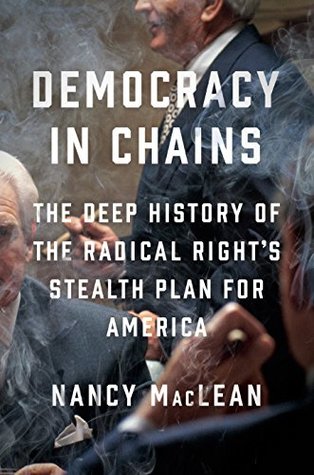
More on this book
Community


Kindle Notes & Highlights
Read between
July 10, 2019 - May 17, 2021

interested not so much in fighting big government, per se, as in elevating that branch of government they can best control
“planters saw threats to their ‘property’ in any political action they did not control,
“The anti-government rhetoric that continues to saturate our political life is rooted in [support for] slavery rather than liberty.”
set out to alter understanding of the U.S. Constitution.
It did not shackle the people’s power sufficiently—even
they were practicing a type of capitalism that would not pass democratic scrutiny
How he disciplined his labor force to keep his enterprise profitable should be no one else’s business.
He feared, as his successors today do, a government that his band of like-minded property supremacists could not control.
South’s educated elite, those who cherished a mythical version of the War Between the States (as they called the Civil War) and portrayed it more as a quest to preserve liberty than a defense of slavery.
the notion of unwarranted federal intervention has been inseparable from a desire to maintain white racial as well as class dominance.
aim was to insulate government from citizen pressure
It did that by punishing dissent.
if they put out “the word” on someone, that was enough to shutter a busi...
This highlight has been truncated due to consecutive passage length restrictions.
preoccupied with manipulating the rules for voting and representation.
created a perverse incentive to lock men up for petty offenses so the state could rent them out to coal companies as dirt-cheap labor to take the jobs of free miners,
They would ennoble the scorned Confederate cause even if, as their correspondence reveals, it took willful blindness, outright falsification, and the highly strategic demeaning of African
Americans to achieve it.12
“the totalitarian state”

They wouldn't know a totalitarian state if they saw it in a mirror.
whereas government action was intolerable coercion, simply no longer corresponded to the facts of American life.
individual liberty”
Unconstrained
immorality of debt
Forcing people into debt produces its own moral justification.
government must defer entirely to business owners to run the economy while balancing its own budgets like a prudent household.
Kilpatrick had “opened the way” for a South-led “battle of the nation” to arrest “the drift” toward “centralized, one-state, socialist government of the European type.”
It was fighting Washington that mattered.
“No one in a democratic society has a right to have his private prejudices financed at public expense.”
the whole mess” stemming from Brown had not been based on racism. “The transcendent issue,” he instructed his former teacher, was “whether the federal government shall dictate the solutions.”
I.e., democracy.
Was the problem for those who promoted economic liberty majority rule itself?
Faced with majority opinion as expressed in votes, politicians could not be counted on to stand by their stated commitments.
self-interest in reelection.
Power of the ballot.
it would be nearly impossible to achieve his vision of radical transformation without changing the constitution.
Local black youth remained schoolless from 1959 to 1964, when a federal court intervened to stop the abuse.40
calling Mitchell “a long-time joiner of all ‘soft-headed,’ ‘liberal’ causes,” and lied that his critic had made “no notable contributions” as a scholar.
some set out to take the shine off those who had achieved these victories—to deglorify the social movements that had won them, to recast the motivations of the government officials who rewrote the laws, and to question the
value of the changes in society that these victories would produce.
a “solidly Midwestern conservative” household that “hated Roosevelt.”
shared mission: to expose the foibles of government as the best way to protect the market (and property) from popular interference (the majority).
offering guidance on “protecting capitalism from government.”19 It might more aptly be depicted as protecting capitalism from democracy.
representative government had shown that it would destroy capitalism by fleecing the propertied class—unless constitutional reform ensured economic liberty, no matter what most voters wanted.
recognition of “the overriding importance of the intellectuals and scholars in forming a libertarian cadre.” Economists, the most reliable advocates of unlimited liberty, could lead in building that hard core for the future.
faculty who spoke up in defense of public education “were openly ridiculed” by the economists who commanded the
Lincoln Steffens after his trip to the USSR: “I’ve seen the future, and it works.”
extremism in the defense of liberty is no vice!”
the John Birch Society, known for its bellicose anti-Communism
Actually pro communist.
Hundreds of critics signed a petition, started by Leon Dure, against “any rule that would dictate to groups or persons where they may or may not go,” on the grounds that “individual liberty is a higher good than racial equality.”
inequality?
Buchanan and his fellows trumpeted “the free society,” yet they brooked no dissent from their assumptions.
Doctrinalism tends to breed authoritarianism,” he warned. “And absolute doctrinalism breeds absolute authoritarianism absolutely.”
right-wing corporate donors funding an academic program to
advance their political agenda.
It was a sad circumstance for an enterprise founded “to preserve liberty” to be tarred with the “closed society” label then used for totalitarian states.
American Economic Association, was blunt about the laissez-faire economics his generation aimed to supplant. “This younger political economy,”
