
More on this book
Community


Kindle Notes & Highlights

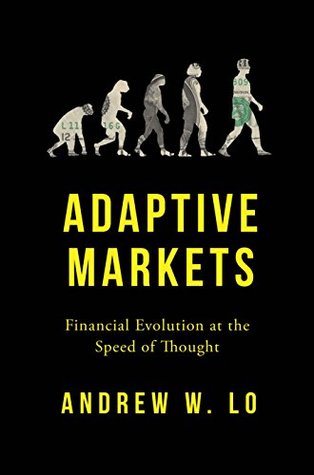
Adaptive Markets Hypothesis is based on the insight that investors and financial markets behave more
From the adaptive markets perspective, the Efficient Markets Hypothesis isn’t wrong—it’s just incomplete. It’s like the parable of the five blind monks who encounter an
Markets do look efficient under certain circumstances, namely, when investors have had a chance to adapt to existing business conditions, and those conditions remain relatively
human behavior, we need to understand the different environments that
from the Atlantic Ocean, and holding several public hearings, the
bad, and the market will incorporate the news into the prices of publicly
let’s try a thought experiment. Suppose you happen to be an investor in a coffee-machine manufacturer, Koffee Meister, which has just released a new state-of-the-art compact cappuccino maker, the ’Cino Bambino. Now suppose you also happen to be an expert in coffee-machine design, and you decide to take the ’Cino Bambino out for a spin. After considerable testing and engineering analysis, you conclude that this new
Efficient Markets Hypothesis follows a simple chain of economic logic to its counterintuitive conclusion. Cardano’s martingale, Bachelier’s random walk, Samuelson’s proof, and Fama’s statistics all lead to the same place: prices must fully reflect all available information. The Efficient Markets Hypothesis didn’t appear in a vacuum, however. It was part of a new quantitative movement in financial economics, along with Harry Markowitz’s optimal portfolio theory; William Sharpe’s Capital Asset Pricing Model (which we’ll come back to in chapter 8); and Fischer Black, Myron Scholes, and Robert C.
...more
around 4,000 BC, to the 1800s; faster growth since the Industrial Revolution, which ushered in the Industrial Age; and the fastest growth over the last century, which might be called the “Digital Age.” In 1900, the world population was estimated to be approximately 1.5 billion individuals. The most recent estimate puts the current world population at over 7.4 billion. Within the space of a century, we’ve more than quadrupled the number of Homo sapiens on this planet. This dramatic increase in human population is no accident. It’s a direct consequence of technological advances that have allowed
...more
competition, and natural selection. Many evolutionary biologists have proposed powerful theoretical
trait of an individual. The starting point for most economic analysis is the
in the same generation both pick b, a single coin toss will determine the number of offspring they both produce, so they’ll experience identical outcomes—rather than two separate
WAYLAID

No definition found
understand that economics and physics could share
However, the Adaptive Markets Hypothesis suggests
2008, just 10 months before all his schemes came crashing down, Madoff flew down to Palm Beach, Florida, to celebrate the ninety-fifth birthday of his mentor, friend, and business associate,
People whispered that Madoff, a Wall Street figure of note, was responsible for turning Shapiro’s sizable fortune into something even grander.
