
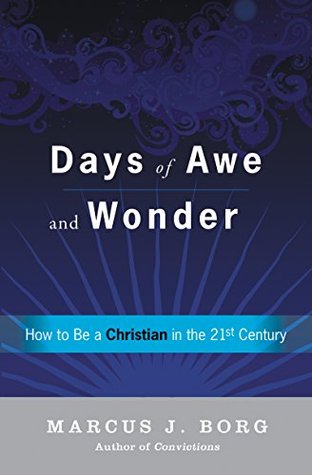
More on this book
Community


Kindle Notes & Highlights

Read between
May 9 - July 29, 2017

Depending upon which of these ways of imaging God’s character is emphasized, the character of God is seen very differently, and the Christian life is seen very differently. Is it about meeting requirements so that we might be saved someday, or is it about a relationship in the here and now with God as lover? The ethical imperative that goes with each is quite different. For the monarchical model the ethical imperative is, “Be good, because you will be called to account. There will be a judgment.” For the divine-lover model the ethical imperative is, “Love what God loves.” So what is the
...more
Life is short, and we do not have too much time to gladden the hearts of those who travel the way with us. So be swift to love, and make haste to be kind.
So much of what passes for orthodoxy today is really the product of the conflict between the Enlightenment and Christianity and the hardening of notions like infallibility and inerrancy, which were not part of the premodern Christian past at all.
“What are you passionate about? What’s the passion of your life?” My suggestion is that we ask, “What is God’s passion? What is God passionate about? What is God’s dream for the earth?”
Most premodern societies from the invention and growth of large-scale agriculture, so from about 3000 BCE, onward, were economically exploitative. The wealthiest 1 to 2 percent of the population typically acquired half to two-thirds of the wealth in these societies. These were preindustrial societies, so that wealth came from agricultural production. The powerful elites set the system up in such a way that wealth from agriculture flowed into their coffers.
The Law is the Torah (the Pentateuch), the first five books of the Bible. At the center of the Torah is ancient Israel’s story of the exodus. You all know this, but we need to help people understand the significance of this. The story of the exodus is what the Old Testament scholar Walter Brueggemann calls Israel’s primal narrative—its originating narrative—and also its most important story. And what is that story about? It’s about liberation from economic and political bondage and the creation of an alternative community marked by no monarchy, no elites, and a passion for economic justice as
...more
The second main portion of the Jewish Bible, the Prophets, speaks very concisely about the rise, failure, and fall of the monarchy.
The Bible doesn’t know about racism, partly because racism was not an issue in the ancient world. The Bible doesn’t know about democracy. The Bible doesn’t know about sexism; generally speaking, it legitimates patriarchy. The central justice issue is economic justice, or distributive justice: that everybody should have enough, not as a function of charity but as the product of justice.
My point is, God’s dream for a world of peace is a world in which everybody has what they need for a good life. Then the last phrase of the Micah passage: “And no one shall make them afraid” (4:4). I can’t resist the footnote that we live in a culture that plays the fear card again and again and again.
So what’s the dream of God according to the Jewish Bible? Very simply, a world of compassion, justice, and peace.
The passion of God is revealed in Jesus. My springboard here is that for Christians Jesus is the decisive revelation or disclosure of what can be seen of God in a human life. So for Christians Jesus is the decisive revelation of the passion of God. What was Jesus’s passion? It’s twofold: God and the kingdom of God.
The phrase “kingdom of God” is both a political and religious metaphor in the first-century world. Religious: it is the kingdom of God. Political: the heirs of Jesus lived under other kingdoms. A “kingdom” was the most common form of political and social organization. People knew about the kingdom of Herod, they knew about the kingdom of Rome. Rome did not refer to itself as an empire, but as a kingdom. When people heard Jesus talking about the kingdom of God, they knew it must have been something different from the kingdom of Herod or the kingdom of Rome.
Jesus was executed by established authority. Christians live in the only major religious tradition whose founder was executed by established authority. We ought to be taken aback by that.
A simple summary: for Christians, God’s passion is that we center in God as known in the Bible and Jesus, that we be compassionate, and that we seek justice.
I owe two of these terms to the subtitle of an important book by the theologian Dorothee Soelle, who died in April 2003. It’s a book I really commend to you. The main title is The Silent Cry. The subtitle is Mysticism and Resistance. The central claim in this book is that mysticism, far from being otherworldly or escapist, has often been the source of Christian political resistance throughout the centuries.
Nonecstatic mysticism I would define as union with the will of God, ecstatic mysticism as communion with the sacred. What these two forms of mysticism have in common is a deep centering in God.
I think the single most divisive issue in American Christianity today concerns the nature of the Bible. Many Christians, perhaps even a majority—I don’t mean 98 percent, but more than half—are parts of Christian communities that affirm that the Bible is the inerrant Word of God, the infallible Word of God, and therefore factually and literally true in everything it says.
Now, why is that? Is it because of invincible ignorance or the utter failure of our public school system? No, it’s because a good number of Christians belong to churches that teach biblical inerrancy or infallibility, and they think you’ve got to deny science whenever it conflicts with something in the Bible.
It’s important to remember that the notion of biblical inerrancy—that it’s free from errors—is not the ancient teaching of the church. Biblical inerrancy and biblical infallibility are both mentioned for the first time in the second half of the 1600s and became relatively common in a stream of Protestantism only in the last century.
Fundamentalism, as a specifically named movement, began around 1910. I mention that because a good number of Christians as well as non-Christians think that believing in biblical inerrancy is orthodox Ch...
This highlight has been truncated due to consecutive passage length restrictions.
To be Christian means to accept that this is our primary collection of documents, but it does not mean believing that they’re inerrant, infallible, or to be interpreted literally.
Here German novelist Thomas Mann’s definition of “myth” is wonderful. Thomas Mann says, “A myth is a story about the way things never were but always are.”
So when people talk about biblical inerrancy, they might be genuinely coming from a place of utter sincerity. They might think taking the Bible seriously means saying it’s inerrant, but, ironically, to affirm biblical inerrancy and biblical literalism often involves not taking the Bible seriously at all.
When I say the post-Easter Jesus is a spiritual reality, I mean that he has all the qualities of God. He is “one with God,” in the language of the New Testament.
One final shorthand way of putting it is, Christians are those who live out their lives with God within the framework of the Christian tradition. Muslims are those who live out their lives with God within the framework of Islam. Jews are those who live out their lives with God within the framework of the Jewish tradition.
For me personally—and this is not about the superiority of Christianity at all; this is just why I am so deeply committed to the Christian journey—I think the Christian message, the Christian gospel, speaks to the two deepest yearnings of most human beings. One of those yearnings is for a fuller connection to what is.
I also think that most people yearn for the world to be a better place. These two yearnings are at the heart of the Christian message. The first is the yearning for God. The second is the yearning for a better world that is expressed in the second great commandment, to love your neighbor as yourself.
First: at the heart of Christianity is a robust affirmation of God or the sacred or Spirit—terms that I use synonymously and interchangeably.
So I want to stress that God should not be thought of as a problematic reality who may or may not exist. As Paul Tillich remarked half a century ago, “If, when you use the word ‘God,’ you are thinking of a being who may or may not exist, then you are not thinking of God.”
Second main point: How do we know about God? What are the sources of revelation that are at the heart of Christianity? For Christians, there are two primary sources of revelation, both of them referred to as the “Word of God”: the Word of God as known in the Bible and the Word of God as known in Jesus. Finding the decisive sources of revelation in the Bible and Jesus is what makes Christians Christian and not Jewish or Muslim and so forth.
So we have the Word of God in human words, and the Christian tradition has declared these human words—the Bible—to be sacred revelation. But those words must always be understood as pointing beyond themselves, not as the absolute themselves.
One of the insights that I owe to Huston, and it’s one of those things that, as soon as you hear it, you think, “Of course! Should have thought of that myself,” is that Christianity is the only major religion that finds the decisive revelation of God in a person. That’s not a claim to superiority; it’s a marker of difference.
What can be seen of God in a human life is the character of God—what God is like—and the passion of God—what God is most passionate about. I suppose the older language for the character and passion of God is the nature and will of God. For Christians, Jesus is the decisive disclosure of God’s character and of passion. And when Jesus and the Bible conflict, as they sometimes do, Jesus is decisive. I sometimes express this colloquially by saying orthodox Christianity affirms that Jesus trumps the Bible. And it’s been so from the beginning.
To use a phrase from a contemporary Roman Catholic theologian, David Tracy, from the University of Chicago, a metaphorical reading enables us to get at “the surplus of meaning that the text carries.”
Third main point: Christianity is “the way.” I don’t mean that in the sense of Christian exclusivism, but that, for Christians, Christianity is “the way”—it is a path.
Once one sees Christianity as a way, it means that practice—which means paying attention to the reality of God and our relationship with God—practice, not believing, is central.
A last comment as I leave the third point: the way is symbolized within Christianity preeminently by the cross. The cross is a symbol of the path of personal transformation—“I have been crucified with Christ; and it is no longer I who live, but it is Christ who lives in me,” words from Paul (Gal. 2:19–20)—and also the symbol of confrontation with the powers that rule this world. The cross is both personal and political.
I leave you with two very brief definitions of how I would characterize what a Christian is. First, at the center of the Christian life is a transforming relationship with God as known decisively in Jesus. If I were defining Jewish life, I would say that at its center is a transforming relationship with God as known decisively in Torah. The same applies to other religions. Finally, a Christian is somebody who lives the way within the framework of the Christian tradition, just as living within the Jewish tradition makes one Jewish and doing so within the Islamic tradition makes one Muslim, and
...more
in the middle 1950s, a scholar named Bill Herberg wrote a very well known book for the time about religious diversity in America. What’s interesting is the title of the book, Protestant, Catholic, and Jew.
First statement about religions: Religions are cultural-linguistic traditions.
What it means is that each religion originates within a particular culture and thus uses the language and symbols of that culture. Moreover, if a religion survives for any length of time, and all of the major religions have, it becomes a cultural-linguistic tradition in its own right.
Thus being Christian, or Jewish, or Muslim is a little bit like being French or Italian.
Second statement about religions: Religions are human constructions. Religions are human constructions, or human products.
Those first two statements both stress the human origins of religion, but the third statement brings God back into the picture. Religions are responses to the experience of the sacred—or God or the Spirit, terms I use synonymously and interchangeably.
Fourth statement: Religions are wisdom traditions. I owe this statement to a man I’m honored to call my friend, Huston Smith.
Wisdom in both religion and philosophy is concerned with the question, “How shall I live? What is life about?”
Fifth statement: Religions are means of ultimate transformation.
Religions are means in the sense that they have a very practical purpose, and that practical purpose is ultimate transformation.
And sixth and finally: Religions are sacraments of the sacred.
A sacrament is a mediator of the sacred, or a sacrament is a mediator of the Spirit. A sacrament is anything finite and visible through which the Spirit becomes present to us.
