
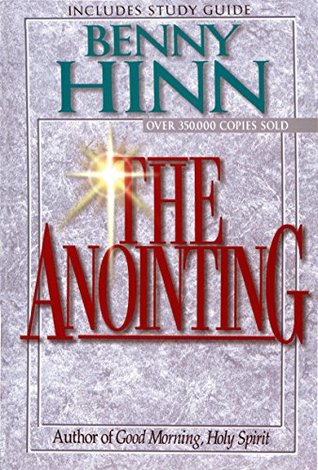
More on this book


Kindle Notes & Highlights

by
R.T. Kendall
Read between
November 10 - November 22, 2022

after which the Israelites went through the Red Sea on dry groun...
This highlight has been truncated due to consecutive passage length restrictions.
The anointing is what enabled Peter, who had denied Christ to a servant girl seven weeks before, to preach to thousands of Jews on the day of Pentecost when three hundred were suddenly converted (Acts 2:14-41), and why he could say to a lame beggar, “Silver or gold I do not have, but what I have I give...
This highlight has been truncated due to consecutive passage length restrictions.
The anointing is the reason Martin Luther could turn the world upside down in the sixteenth century. He stood alone in his claims that we are justified (declared righteous) before God by faith alone. The Western world was never to be the same again.
The anointing is what gave courage to the Marian martyrs. During the reign of Mary Tudor (“Bloody Mary”, who reigned 1553-58) men gave their lives for their faith. As the flames came up over the bodies of Bishop Hugh Latimer and the young Bishop Nicholas Ridley, Latimer shouted back to Ridley, “Fear not, Master Ridley, and play the man; we shall this day light such a candle in England that I trust shall never be put out.” A year later the martyr John Bradford could say to his friend as the flames were about to encircle their bodies, “Be of good cheer, brother, we shall have a merry supper with
...more
The best way I have been able to describe it, therefore, is that it is when our gift functions easily. It comes with ease. It seems natural. No working it up is needed. It is either there or it isn’t. If one has to “work it up” one has probably gone outside one’s anointing. If one goes outside one’s anointing the result is often fatigue—that is, weariness or spiritual lethargy that has been described as “dying inside.”
Some years ago there was a best-seller called The Peter Principle. The idea in the book is that every person is promoted to the level of his or her incompetence.
Another way of putting it is: they have moved outside their anointing.
The difficulty is, ambition gets into the picture and some don’t like it if their own anointing does not result in a high profile. Paul compared these grace-gifts, which I am calling anointings, to the parts of the human body.
Some people have an anointing with no apparent profile at all—like the kidneys or intestines, which are indispensable (1 Cor. 12:23ff.). God’s design is that there should be “no division in the body, but that its parts should have equal concern for each other” (1 Cor. 12:25). Paul draws a conclusion: “Now you are the body of Christ, and each one of you is a part of it” (1 Cor. 12:27). There are those with the high profile, as apostles, prophets, and teachers; some have an anointing (not listed in 1 Corinthians 12:8-10) which the King James Version merely calls “helps”—those able to help others
...more
“How can you believe if you accept praise from one another,
yet make no effort to obtain the praise that comes from the only God?” (John 5:44).
We all have an anointing. We even had an anointing before we became Christians. God had His hand on each of us e...
This highlight has been truncated due to consecutive passage length restrictions.
This is why a person may be a genius even though he or she is not a Christian. God gave Albert Einstein his IQ of 212 (100 is regarded as being average, 130 or more being a genius).
can say I had an anointing to sell vacuum cleaners as Paul had an anointing in making tents (Acts 18:3). Perhaps Paul never knew
For this reason, every person has an anointing. It does not in itself prove one’s spirituality since even the non-Christian has his own gift.
benefit to the Church and the world, as when God saves an Athanasius or Augustine, but that genius was already there before he or she became a Christian. It is common grace.
But the Holy Spirit often incorporates our natural abilities and superimposes great grace upon them so that they appear supernatural to others but seem natural to those who have them.
This not only helps us to understand ourselves a little better, it will help us to see that a talent may have nothing to do with a fresh anointing of the Spirit that comes from walking in the light after we have been saved (1 John 1:7).
All Christians have the Holy Spirit (Rom. 8:9; 1 Cor. 12:13), but not all Christians have the same measure of faith. “For by the grace given me I say to every one of you: Do not think of yourself more highly than you ought, but rather think of yourself with sober judgment, in accordance with the measure of faith God has given you” (Rom. 12:3). The measure, or limit, of our faith is our anointing. What may be my anointing may not be yours; what may be yours may not be mine. The question is, will you and I accept— with cheerfulness—the anointing God has given us?
is sometimes hard to admit one does have an anointing.
only thing we can do is get our approval from God who made us as we are and put us where we are, unworthy though we are.
You have an anointing sovereignly given to you by God. You can discern exactly what it is—if you will be true to yourself.
In a word: the anointing is what comes easily.
Your actual anointing is an easy operation when you function without fatigue.
My favorite story in the Bible is that of Joseph (Gen. 37-50).
statement he read in God Meant It for Good: “God’s time has come when someone pleads your case (and knows all the facts) without your opening your mouth.”
Sometimes the hardest thing in the world is to accept yourself.
God never promotes us to the level of our incompetence. What He truly calls us to do, we can do. As
was in his heart” (2 Chron. 32:31). But burnout is what we bring on ourselves by taking on what God did not command.
Although not all of us have Jeremiah’s anointing, as surely as we have been put into the body of His Son we have this in common: “Before I formed you in the womb I knew you, before you were born I set you apart” (Jer. 1:5).
The chief way we grieve the Spirit seems to be bitterness. Because right after Paul said, “And do not grieve the Holy Spirit of God, with whom you were sealed for the day of redemption” (Eph. 4:30), he added, “Get rid of all bitterness, rage and anger, brawling and slander, along with every form of malice. Be kind and compassionate to one another, forgiving each other, just as in Christ God forgave you” (Eph. 4:31-32). I
deposit account in heaven, however, does not merely include how much we give in terms of money to the Kingdom. It also includes our forgiving one another. The greater the offense we have to forgive, the greater the credit to our account! In fact
Baptists, Presbyterians, and Methodists, for example, did not feel the need to argue with one another over the differences that had previously divided them. They just rejoiced in God and His Son. What mattered, all felt, was that they were Christians—nothing more. But, lo and behold, a leader in the Cane Ridge Revival came up with the idea of starting a “Christian” church! And what do you suppose happened? A new denomination began—they called it the Christian Church! The revival was virtually over. It became yesterday’s anointing overnight.
We also like to think we have a “special” relationship with God that means we do not always have to come under His Word. This feeling stems from a self-love principle that is deceiving and deadly. It would be a long time before Saul came to terms with
what Samuel knew and told him. Much later on he said, “Surely
I have acted like a fool and have erred greatly” (1 Sam. 26:21). He eventually admitted, “God has turned away from me. He no...
This highlight has been truncated due to consecutive passage length restrictions.
Jonah was exposed by the sailors on the ship when he was trying to run from God (Jonah 1:9ff.), but mercifully God came to him “a second time” (Jonah 3:1). So we must not understand yesterday’s man or woman to be in that sad state permanently. Saul was, Jonah wasn’t. One can be put on the shelf and come back. But Saul didn’t.
The obvious question is, What determines the difference? The answer, in a word: our attitude towards His rebuke. Saul was defensive and unteachable. Jonah and Samson prayed with all their hearts for another chance—and God gave it.
This was not a very pleasant thing to hear. But David’s immediate reaction was what Saul came up with too late. For David said, “I have sinned against the LORD” (2 Sam. 12:13).
“So you’re not going to continue preaching on the life of David?” I had decided not to do so because I didn’t have the stomach to deal with the “down” side of David’s extraordinary life—when so many bad things happened and he had so little to look forward to. But 55 God continued to speak: “Don’t you know that that is where most of your people are?” I wasn’t prepared for this. I wanted to assume most of our people were godly and blameless and would find 2 Samuel 13 to 24 quite irrelevant to them. I still don’t know (and am not sure I want to know) what God knew about my church, but I continued
...more
The way we can become yesterday’s man or woman is by losing touch with God. This was Saul’s error. He lost touch with God by putting himself above the word.
us that the task of every generation is to discover in which direction the Sovereign Redeemer is moving, then move in that direction.
We may assume God is with us today just because He was with us yesterday. God of course promised never to leave us or forsake us. But His special presence that flows from His approval is not necessarily guaranteed.
Another indication that one is yesterday’s man or woman may be that success has come too soon. Everybody wants success, but it can be dangerous, even leading to our becoming yesterday’s man or woman—especially if it has come too soon.
I assured him God was going to use me—powerfully and internationally! I had been given visions from the Lord that showed me clearly that I would see great revival.
Dr. Lloyd-Jones once said to me, “The worst thing that can happen to a man is to succeed before he is ready.”
have sincerely prayed that God will not bless me with great success until he sees that I am not taking myself too seriously.
The man or woman who takes himself or herself too seriously is a ripe candidate for becoming yesterday’s man or woman.
I am so thankful God is still peeling away those layers of arrogance and presumption. I’d rather not be greatly used at all than be given a greater anointing that I would abuse.
Success is dangerous.
