
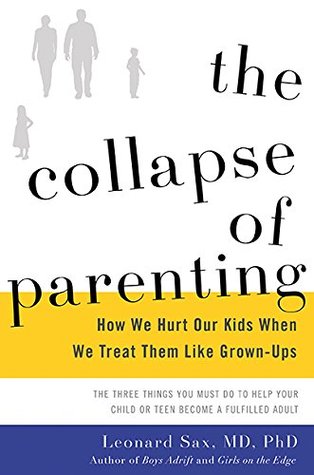
More on this book
Community


Kindle Notes & Highlights

by
Leonard Sax
Read between
December 4 - December 11, 2017

Read your job description. Your job as a parent is to raise your child to be the best person she or he can be. Your reward comes from knowing that you have done your job well. As wonderful as it is to receive a loving hug or a spontaneous and unasked-for “I love being with yo...
This highlight has been truncated due to consecutive passage length restrictions.
It’s confusing to everybody involved if one moment you are trying to be the affectionate “cool” parent and the next moment you are trying to be
the “Just Right” parent. The most common result is that parents slip from being “Just Right” into being “Too Soft,” because they don’t want to jeopardize the affection they hope to gain from their child.
If you are doing your job as a parent, then sometimes you will have to do things that will upset your child. If you are concerned that your child won’t love you anymore, that concern may keep you from doing your job. Do your job.
the first job of the American parent has to be to teach humility.
Humility simply means being as interested in other people as you are in yourself. It means that when you meet new people, you try to learn something about them before going off on a spiel about how incredible your current project is. Humility means really listening when someone else is talking, instead of just preparing your own speechlet in your head before you’ve really heard what the other person is saying. Humility
means making a sustained effort to get other people to share their views before trying to inundate them with yours.
I recently took another photo at an American public school of a flowery poster with the words “Dream until your dreams come true.” That’s bad advice. That advice cultivates a self-righteous sense of entitlement. Better advice might be, Work until your dreams come true.
A truer statement, possibly suitable for framing, would be, Work in pursuit
of your dreams, but realize that life is what happens while you are making other plans. Tomorrow may never come or ...
This highlight has been truncated due to consecutive passage length restrictions.
Put bluntly, the culture of self-esteem leads to a culture of resentment. If I am so wonderful, but my talents are not recognized and I’m still nobody at age 25, working in a cubicle—or not working at all—then I may feel envious and resentful of those who are more
successful than me. How come that other young writer got her novel published, and she was on the TODAY Show and I can’t even get an agent?
Taking appropriate risks requires courage, first and foremost. Again, many parents confuse self-esteem with courage, just as some parents tend to confuse humility with timidity and cowardice.
The culture of humility leads to gratitude, appreciation, and contentment. The key to lasting happiness is contentment.
Gratitude and humility. These are key virtues that American kids today are unlikely to possess after years of indoctrination in their own awesomeness. These are the virtues you want to teach your child or teen before disappointment comes.
How do you do it? How do you teach your kid to walk humbly in an era when every other parent you know is trying to boost their kids’ self-esteem? My first answer is: chores. Require your kids to make their beds. Wash the dishes. Mow the lawn. Feed the pets. Set the table. Do the vacuuming.
Some parents, especially affluent parents, have told me that they are happy to hire a housekeeper or a landscaping service, or both. They would rather have their child devote their time to schoolwork or extracurricular activities rather than household chores. I think those parents are making a mistake. You can hire a landscape service, I suppose, if you must and if you can afford it, but you must still require your child to do some household chores. By exempting your child from all chores, as many affluent American families now do, you are sending the message, “Your time is too valuable to be
...more
that unintended message puffs up the bloated self-esteem that now characterizes many American kids. I see it often.
Spending fun time together with your child is not an optional elective to be squeezed in after the day’s required work is done. It’s essential. You have to plan for it. You have to insist on it. You must make time for it.
One photo shows a mom in the front passenger seat, looking back and beaming at her two children in the rear seats. Both children are wearing headsets and watching a video. The mom seems to be saying, “Isn’t this great! We can drive for hours, and I never have to talk with my kids at all!” Everybody’s in a rush. Take advantage of every moment you can. The time in the car should be a time for kids and parents to talk. Don’t permit your child to separate herself or himself from you by putting on a headset or earbuds in the car or anywhere that you are together.
What’s the point of school? I ask. Why bother? To get into a good college—that’s the answer I most often hear from American high school students. So what’s the purpose of college? I ask. To get a good job, to earn a living, the students answer. This dialogue is the basis for what I have come to call “the middle-class script.” The script reads as follows: 1. Work hard in school so you can get into a good college.
2. Get into a good college so you can get a good job. 3. Get a good job and you will make a good living and have a good life. There are several problems with this script. The first problem is that every line in it is false. 1. Working hard in school is no guarantee of admission to a top college. We all know stories of kids who worked hard, earned good grades, and didn’t get into any of their top choices. 2. Getting into a good college is no guarantee of a good job. The media and the blogosphere are full of stories
of young people who have earned bachelor’s degrees from Princeton and Harvard and who are now waiting tables or simply unemployed.1 3. Getting a good...
This highlight has been truncated due to consecutive passage length restrictions.
What is school for?
The primary purpose of education should be to prepare for life, not for more school.
If you are working 80 hours a week at a job which shrivels your soul, then you are a slave. I don’t care whether you are earning $600,000 a year or more. Life is precious. Each minute is a priceless gift. No amount of money can reclaim lost time. If you are wasting your time on work you detest, you may come to feel resentful about the time you are losing. If you are a physician, you may come to resent your patients. I have learned to recognize such physicians, and I try to steer my patients away from them.
Empower your daughter or your son to take risks and congratulate them not only when they succeed but also when they fail, because failure builds humility. And the humility born of failure can build growth and wisdom and an openness to new things in a way that success almost never does.
I said, “OK, preparation for life. So what’s the purpose of life?” Dr. Wright responded without hesitation: 1. Meaningful work
2. A person to love 3. A cause to embrace
Many parents are twisting themselves in knots trying to be the cool peer one moment and the authoritative parent the next. My advice is, Don’t do that. Your job is to be the authoritative parent, not the cool peer.
there is no greater responsibility between human beings than that of a parent to a child. It is the parent’s responsibility not only to feed, clothe, and shelter the child but also to acculturate the child, to instill a sense of virtue and a longing for integrity, and to teach the meaning of life according to the parent’s best understanding.
Raising your child to know and care about virtue and character is not a special extra credit assignment reserved for the superior parent. It is mandatory for all parents. And when you are given a mandatory assignment, you must do your best, regardless of your own short-comings.5 Regardless of whether your peers—other parents—are paying attention to the assignment or not.
Felicia Eth has been my agent for more than a decade. This is our fourth book together. I am grateful for her patience, her guidance, and her advocacy.
I thank the whole team at Basic Books, but most especially Lara Heimert, publisher, for believing in the book and my ability to write it, and for her editorial insights and suggestions, which have greatly improved it.
Finally, I want to remember my late mother, Dr. Janet Sax, who, as a pediatrician, devoted her professional life to teaching parents how to guide their children. In the years before her death, she and I had countless conversations about the topics I address here. She had a vast depth and breadth of firsthand experience with children and adolescents acquired in more than 30 years of clinical practice. Throughout the book, I have often wondered, What would Mom have said? Wherever you are, Mom, I hope you like the book.
