
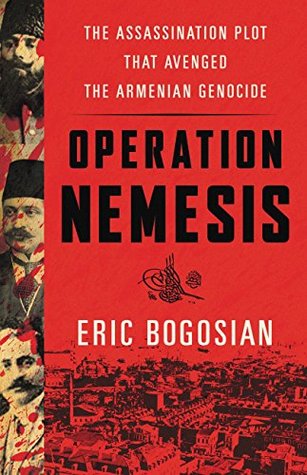
More on this book


Kindle Notes & Highlights

Read between
May 13 - May 25, 2021

The stories would always end the same way. My grandfather would instruct me, “If you ever meet a Turk, kill him.”
Mehmet Talat Pasha, a leader of the Ottoman Empire (which became the modern Republic of Turkey) during World
Then I discovered Resistance and Revenge, a dense monograph published in France in the 1980s by the journalist Jacques Derogy, which explained that in fact, the young Armenian was not an engineering student at all. Nor, as it turns out, had he been a witness to the massacre of his family in the desert. At the time of their deportation he hadn’t even been living in Turkey.
Derogy laid out an even more remarkable, almost unbelievable story: A small group of Armenian conspirators with headquarters in the United States, calling themselves “Operation Nemesis,” had successfully organized the assassination not only of Talat but also of most of the Turkish leaders responsible for the genocide.
Tehlirian and his cohorts were not simply avengers. They were a small group of men, including a Boston newspaper editor, a Syracuse CPA, and a Washington diplomat, who, through their actions, tried to offset in some way the anonymous deaths of hundreds of thousands of innocent civilians who died in the deserts and in their homes and in mountain wastelands.
Because the first Christians in Armenia were converted by original apostles, Armenians named their form of Christianity “Apostolic.”
Saint Gregory “the Illuminator” would assume the role of chief bishop4 and leader of the new Armenian Christian faith.
But Armenian churches celebrated the liturgy in Greek or Syriac, not Armenian. The priesthood and various educational institutions widely used Greek and Syrian.
The task of creating a new alphabet was assigned to a scholar-monk named Mesrob Mashtots, who invented the Armenian alphabet of thirty-six letters (two more were added later) in 405.
In 430 the Bible was translated into the Armenian language from copies imported from Constantinople and Edessa.
The introduction of a written language unique to the Armenians triggered a cultural renaissance. More than that, it unified a people and permanently forged a bond between literacy and religion that has survived to this day.
Of particular importance to the history of the Armenian Church was the Council of Chalcedon, convened in 451, at which a key point of theology was debated. The gist of the argument came down to whether God/Jesus possessed two “natures” (godly and human) or only one.
The Armenians, distracted by their war with the Persians, were not represented at Chalcedon.
Perhaps because they did not participate in deciding the issue, the Armenians did not agree with the outcome.
The Armenians (and other “schismatic” churches), by contrast, opted for one nature. God was holy and that was that. That is why the Armenians are labeled “monophysite.”
This position would now set the Armenians in contrast to their fellow Christians as well as the Islamic empire in which they lived.
If you visit Cappadocia today, you can tour a vast collection of manmade caves, in some places descending twenty stories underground, where temporary tunnel cities once housed thousands of Christians hiding from the Arab raiders.
Muhammad (570–632)
The Islamic Turkish invasion of Byzantium
and the Holy Lands prompted the Byzantines to ask for assistance from the Christians of Europe proper.
Themselves at odds with the Byzantines, Armenians sided with the Crusaders (commonly known as
“Franks”),12 who arrived on the scene at the dawn of the second millennium.
By the Fourth Crusade in 1202, the knights, motivated by treasure and glory, had become a powerful political body in their own right. In this Crusade, they never got as far as the Holy Land but instead attacked Constantinople, where the Christian Byzantines, no longer on friendly terms with the Catholics, ruled. The Catholic French and Venetian knights ransacked the holy Byzantine city.
The Greeks were convinced that even the Turks, had they taken the city, would not have been as cruel as the Latin
Christians.”
Islamic historians would later cite the actions of the Crusaders (as well as the Catholic conquistadors in the Americas) as evidence that Christians were as bloody as any Muslim army.
One tribe in particular flourished. It was founded by a man named Osman (1258–1326). In time his descendants, the Osmanlis, controlled all of Anatolia to the east and as far as the Balkans to the west. Europeans called the Osmanlis “Ottomans.”
In one of the most famous battles in history, Mehmed ordered Turkish warships physically lifted out of the water, carried overland, and dropped into the harbor on the other side of the Golden Horn. He then attacked from two sides at once and succeeded in taking the city, ending a thousand years of Christian rule.
Perhaps the most remarkable thing about the Ottoman system was how successfully it incorporated the conquered peoples into its highest levels, enriching its cultural infrastructure. A slave girl from the most remote corner of the empire could become mother to a sultan. A Christian Bosnian could rise up through the ranks to the position of Grand Vizier.
Suleiman, the longest-reigning sultan, was intelligent and brave, instituting vast reforms in law, taxation, and education. A great patron of the arts, Suleiman oversaw the golden age of Ottoman architecture. His court was as complex and as sophisticated as any in Europe.
Ironically, in the middle of the sixteenth century, as the Ottomans were reaching their imperial apex under Suleiman, European kingdoms continued to fight tooth and nail amongst themselves.
For over a hundred years, as Europeans wasted energy on hostilities, the Ottoman Empire loomed like a massive wall at one end of the continent,
an enigmatic foe constantly threatening invasion. The Ottomans had been stopped at Vienna, but for how long?
The Ottomans had no access to the treasure from across the Atlantic that was transforming Europe from a cluster of warring principalities into an interlocking quilt of very wealthy kingdoms.
The Industrial Revolution dawned and manufacturing exploded, making Europe dominant in the art of war. The Ottomans, by contrast, remained mired in the old ways, leaving themselves at a distinct disadvantage.
The Islamic view that divided the world into the House of War and the House of Islam made war making a primary function of government.
In the early years of the empire, the most exalted legions of the Ottoman military were the Janissaries (from yeni ceri, meaning in Turkish “new force”). These were crack military units composed mostly of Christian youths harvested from villages of the realm, usually in eastern Europe.
These young men were converted to Islam and divided into units for intensive training.
The most impressive candidates were selected to enter the elite military devoted to the sultan, the Janissaries.
The Janissaries were the first standing
army originated in Europe, slave soldiers whose lives were dedicated to war, and who were prepared to fight at any time.
In 1826 the reigning sultan, Mahmud II, after patiently planning the destruction of the Janissaries for some eighteen years, secretly created a new army and, with no warning, trapped the Janissaries and destroyed them.
In Ottoman history, this mass killing of the Janissaries is called “the Auspicious Event.”
The history of the Ottoman Empire parallels the history of the royal line. For all intents and purposes, the story begins with Osman and ends with Abdul Hamid II. (The last two sultans following Abdul Hamid were no more than figureheads representing the Young Turks and the British, respectively.) For centuries, the royal line was generated in the royal harem. It was here that the “politics of reproduction” were played out.
The seraglio was guarded by black and white eunuchs, who in turn were under the command of the kizlar agasi, the chief black eunuch. The kizlar agasi was one of the most powerful people in the realm.
Under Islamic law, Muslims cannot be slaves to other Muslims, so these women were almost entirely Christian.
Prisoners of the harem, when concubines were no longer useful they could be put to death, their bodies placed in sacks and thrown into the Bosphorus.
Over the
centuries, the sultan became something like a queen bee, sequestered at the center of a massive hive, protected and pampered and not really in charge of anything.
When the sultan wished to select a girl,
