
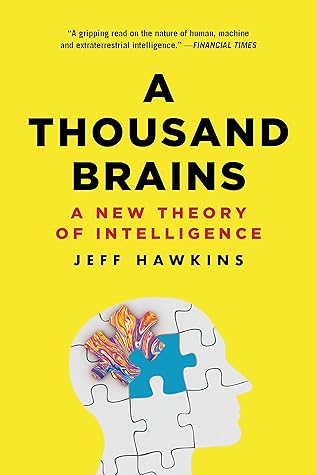
More on this book
Community


Kindle Notes & Highlights

by
Jeff Hawkins
Read between
January 23 - February 26, 2025

The brain sits in darkness, apprehending the outside world only through a hailstorm of Andrew Huxley’s nerve impulses.
And there is no reason to (indeed, please let’s not) borrow the ways of the old brain, its lusts and hungers, cravings and angers, feelings and fears, which can drive us along paths seen as harmful by the new brain.
he doesn’t think switching off a conscious AI would be murder: Without an old brain, why would it feel fear or sadness? Why would it want to survive?
“As I see it, we have a profound choice to make. It is a choice between favoring the old brain or favoring the new brain. More specifically, do we want our future to be driven by the processes that got us here, namely, natural selection, competition, and the drive of selfish genes? Or, do we want our future to be driven by intelligence and its desire to understand the world?”
Vadim Smolyakov liked this
something to let the galaxy know that we were once here and capable of announcing the fact, Hawkins notes that all civilisations are ephemeral.
We realized that the brain’s model of the world is built using maplike reference frames. Not one reference frame, but hundreds of thousands of them. Indeed, we now understand that most of the cells in your neocortex are dedicated to creating and manipulating reference frames, which the brain uses to plan and think.
I find it amazing that the only thing in the universe that knows the universe exists is the three-pound mass of cells floating in our heads.
My brain, specifically my neocortex, was making multiple simultaneous predictions of what it was about to see, hear, and feel. Every time I moved my eyes, my neocortex made predictions of what it was about to see. Every time I picked something up, my neocortex made predictions of what each finger should feel. And every action I took led to predictions of what I should hear.
the neocortex learns a model of the world, and it makes predictions based on its model.
The connections in our brain store the model of the world that we have learned through our experiences.
when an input arrives that is unexpected, multiple neurons fire at once. If the input is predicted, then only the predictive-state neurons become active. This is a common observation about the neocortex: unexpected inputs cause a lot more activity than expected ones.
To be an expert in any domain requires having a good reference frame, a good map. Two people observing the same physical object will likely end up with similar maps. For example, it is hard to imagine how the brains of two people observing the same chair would arrange its features differently. But when thinking about concepts, two people starting with the same facts might end up with different reference frames.
This is why we call it the Thousand Brains Theory: knowledge of any particular item is distributed among thousands of complementary models.
When creating intelligent machines, there is no reason we should replicate all the functions of the human brain. The new brain, the neocortex, is the organ of intelligence, so intelligent machines need something equivalent to it.
Intelligence is the ability of a system to learn a model of the world. However, the resulting model by itself is valueless, emotionless, and has no goals. Goals and values are provided by whatever system is using the model.
Similarly, the neocortex learns a model of the world, which by itself has no goals or values. The emotions that direct our behaviors are determined by the old brain.
As with maps, one person’s model of the world might be better suited for a particular set of aims, but the neocortex does not create the goals.
Intelligent machines also need sensors and the ability to move them. This is referred to as embodiment.
Most of today’s deep learning networks don’t have an embodiment. They don’t have moveable sensors and they don’t have reference frames to know where the sensors are. Without embodiment, what can be learned is limited.
Another example of an unusual embodiment is a distributed brain. The human neocortex has about 150,000 cortical columns, each modeling the part of the world that it can sense. There is no reason that the “columns” of an intelligent machine must be physically located next to each other, as in a biological brain.
For example, an intelligent machine with sensors distributed over the surface of Earth might understand the behavior of global weather in the same way you and I understand the behavior of a smartphone.
Behaviors that are intimately tied to the embodiment of a machine should be built in.
Finally, an intelligent machine must have goals and motivations. Human goals and motivations are complex. Some are driven by our genes, such as the desire for sex, food, and shelter.
Some of our goals and motivations are more societal. For example, what is viewed as a successful life varies from culture to culture.
To endow a machine with goals and motivations requires that we design specific mechanisms for goals and motivations and then embed them into the embodiment of the machine. The goals could be fixed, like our genetically determined desire to eat, or they could be learned, like our societally determined goals for how to live a good life. Of course, any goals must be built on top of safety measures such as Asimov’s first two laws. In summary, an intelligent machine will need some form of goals and motivations; however, goals and motivations are not a consequence of intelligence, and will not
...more
Much of the volume of our brain is wiring, the axons and dendrites that connect neurons to each other. These are costly in terms of energy and space. To conserve energy, the brain is forced to limit the wiring and therefore limit what can be readily learned. When we are born, our neocortex has an overabundance of wiring. This is pared down significantly during the first few years of life. Presumably the brain is learning which connections are useful and which are not based on the early life experiences of the child.
This flexibility in connectivity could be one of the greatest advantages of machine intelligence over biological intelligence.
It could allow intelligent machines to keep all their options open, as it removes one of the greatest barriers human adults face when trying to learn new things.
Another way that machine intelligence will differ from human intelligence is the ability to clone intelligent machines. Every human has to learn a model of the world from scratch. We start life knowing almost nothing and spend several decades learning. We go to school to learn, we read books to learn, and of course we learn via our personal experiences. Intelligent machines will also have to learn a model of the world. However, unlike humans, at any time we can make a copy of an intelligent machine, cloning it.
One that I find exciting is the acquisition of scientific knowledge. Humans want to learn. We are drawn to explore, to seek out knowledge, and to understand the unknown.
Your brain is in a box, the skull. There are no sensors in the brain itself, so the neurons that make up your brain are sitting in the dark, isolated from the world outside.
By repeatedly sensing and moving, sensing and moving, your brain learns a model of the world outside the skull.
If we could sense all frequencies of electromagnetic radiation, then we would see radio broadcasts and radar and would have X-ray vision. With different sensors, the same universe would lead to different perceptual experiences.
Earlier, I explained that no matter how smart we become, our neocortex remains connected to the old brain. As our technologies become more and more powerful, the selfish and shortsighted behaviors of the old brain could lead us to extinction or plunge us into societal collapse and another dark age.
We face a dilemma. “We”—the intelligent model of ourselves residing in the neocortex—are trapped. We are trapped in a body that not only is programmed to die but is largely under the control of an ignorant brute, the old brain. We can use our intelligence to imagine a better future, and we can take actions to achieve the future we desire. But the old brain could ruin everything.
However, ask yourself: What is the purpose of living? What are we trying to preserve when we struggle to survive? In the past, living was always about preserving and replicating genes, whether we realized it or not. But is that the best way forward? What if instead we decide that living should focus on intelligence and the preservation of knowledge.
Humans are humans, and the problems we create on Earth will also exist on other planets we inhabit.
Starting with the Enlightenment at the end of the eighteenth century, we have accumulated increasing evidence that the universe progresses without a guiding hand. The emergence of simple life, then complex organisms, and then intelligence was neither planned nor inevitable.
The universe doesn’t care which option we choose. It is our choice whether we help future humans or present humans.
As I see it, we have a profound choice to make. It is a choice between favoring the old brain or the new brain.
More specifically, do we want our future to be driven by the processes that got us here, namely, natural selection, competition, and the drive of selfish genes? Or do we want our future to be driven by intelligence and the desire to understand the world? We have the opportunity to choose between a future where the primary driver is the creation and dissemination of knowledge and a future where the primary driver is the copying and dissemination of genes.
Leaving Darwin’s Orbit
The ultimate way to free our intelligence from the grip of our old brain and our biology is to create machines that are intelligent like us, but not dependent upon us.
They would be intelligent agents that could travel beyond our solar system and survive longer than we will. These machines would share our knowledge but not our genes. If humans should regress culturally—as in a new dark age—or if we become exti...
This highlight has been truncated due to consecutive passage length restrictions.
Goal Number One: Preserve Knowledge
Goal Number Two: Acquire New Knowledge
Perhaps they would discover the answers to deep mysteries about the universe, such as its origin or destiny. That is the nature of exploration: you don’t know what you will learn, but you will learn something.
I have a vision that never ceases to entertain me. I imagine the vast universe, with its hundreds of billions of galaxies. Each galaxy contains hundreds of billions of stars. Around each star, I picture planets of limitless variety. I imagine these trillions of monstrously sized objects slowly orbiting each other in the vast emptiness of space for billions of years. What amazes me is that the only thing in the universe that knows about this—the only thing that knows that the universe exists at all—is our brain. If it wasn’t for brains, then nothing would know that anything exists.
I have one more ask, which applies to everyone. I hope that one day every person on Earth will learn how their brain works. To me, this should be an expectation, like, “Oh, you have a brain? Here is what you need to know about it.” The list of things everyone should know is short. I would include how the brain is composed of the new part and the older parts. I would include how the neocortex learns a model of the world, whereas the older parts of the brain generate our emotions and more primitive behaviors. I would include how the old brain can take control, causing us to act in ways we know
...more
I believe everyone should know these things, in the same way that everyone should know that the Earth orbits the Sun, and that DNA molecules encode our genes, and that dinosaurs lived on Earth for millions of years but are now extinct. This is important. Many of the problems we face—from wars to climate change—are created by false beliefs or the selfish desires of the old brain or both. If every human understood what was going on in their head, I believe we would have fewer conflicts and a sunnier prognosis for our future.
