
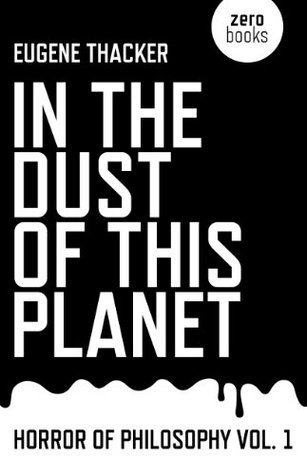
More on this book
Community


Kindle Notes & Highlights
Read between
March 28 - April 4, 2018

The world is human and non-human, anthropocentric and non-anthropomorphic, sometimes even misanthropic. Arguably, one of the greatest challenges that philosophy faces today lies in comprehending the world in which we live as both a human and a non-human world – and of comprehending this politically.
On the one hand, we are increasingly more and more aware of the world in which we live as a non-human world, a world outside, one that is manifest is the effects of global climate change, natural disasters, the energy crisis, and the progressive extinction of species world-wide. On the other hand, all these effects are linked, directly and indirectly, to our living in and living as a part of this non-human world.
When the world as such cataclysmically manifests itself in the form of a disaster, how do we interpret or give meaning to the world? There are precedents in Western culture for this kind of thinking. In classical Greece the interpretation is primarily mythological – Greek tragedy, for instance, not only deals with the questions of fate and destiny, but in so doing it also evokes a world at once familiar and unfamiliar, a world within our control or a world as a plaything of the gods. By contrast, the response of Medieval and early modern Christianity is primarily theological – the long
...more
the mythological has become the stuff of the culture industries, spinning out big-budget, computer-generated films and merchandise; the theological has diffused into political ideology and the fanaticism of religious conflict; and the existential has been re-purposed into self-help and the therapeutics of consumerism.
In short, when the non-human world manifests itself to us in these ambivalent ways, more often than not our response is to recuperate that non-human world into whatever the dominant, human-centric worldview is at the time. After all, being human, how else would we make sense of the world?
The view of Cosmic Pessimism is a strange mysticism of the world-without-us, a hermeticism of the abyss, a noumenal occultism. It is the difficult thought of the world as absolutely unhuman, and indifferent to the hopes, desires, and struggles of human individuals and groups. Its limit-thought is the idea of absolute nothingness, unconsciously represented in the many popular media images of nuclear war, natural disasters, global pandemics, and the cataclysmic effects of climate change. Certainly these are the images, or the specters, of Cosmic Pessimism, and different from the scientific,
...more
We have to entertain the possibility that there is no reason for something existing; or that the split between subject and object is only our name for something equally accidental we call knowledge; or, an even more difficult thought, that while there may be some order to the self and the cosmos, to the microcosm and macrocosm, it is an order that is absolutely indifferent to our existence, and of which we can have only a negative awareness.
Schopenhauer’s pessimism is less about a human pessimism (e.g. the all-too-human despair of an identity crisis or a lapse in faith), and more about the way in which thought in itself always devolves upon its own limits, the hinge through which positive knowledge turns into negative knowledge. To find an equal to Schopenhauer, one would have to look not to philosophy but to writers of supernatural horror such as H.P. Lovecraft, whose stories evoke a sense of what he termed “cosmic outsideness”:
One way of doing this is to understand the demon less in a strictly theological sense, in which the demon is the relation between the supernatural and natural, and to understand it in its cultural function as a way of thinking about the various relationships between human individuals and groups. In short, the figure of the demon, though it may not be accepted literally today, can be understood in an anthropological framework, as a metaphor for the nature of the human, and the relation of human to human (even when this relation is couched in terms of the boundary between human and non-human).
If the demon is taken in this anthropological sense as the relation of the human to the non-human (however this non-human is understood), then we can see how the demon historically passes through various phases: there is the classical demon, which is elemental, and at once a help and a hindrance (“the demon beside me…”); there is the Medieval demon, a supernatural and intermediary being that is a tempter (“demons surround me…”); a modern demon, rendered both natural and scientific through psychoanalysis, and internalized within the machinations of the unconscious (“I am a demon to myself…”);
...more
we as human beings certainly have a panoply of ways of relating to the non-human, be it via science, technology, politics, or religion. But the non-human remains, by definition, a limit; it designates both that which we stand in relation to and that which remains forever inaccessible to us. This limit is the unknown, and the unknown, as genre horror reminds us, is often a source of fear or dread.
The demonic challenges the divine in its refusal to be organized at all.
the human can only understand the human by transforming it into an object to relate to (psychology, sociology), while the human can only relate to the objective world itself by transforming the world into something familiar, accessible, or intuited in human terms (biology, geology, cosmology).
Generally speaking, the Inferno is of interest not simply due to the panoply of monsters that inhabit its pages, but because of the way in which it carefully stratifies different types of demonic being and non-being. Within the paths, rivers, caverns, and fortresses of the Inferno all boundaries collapse: there are human bodies melting into dead trees, rivers flowing with blood, and entire cities populated with the living dead.
In cases where demonic possession cannot be distinguished from medical illness, on which side should one stand? To the 21st century mind, the question is absurd. But for an era in which the lines between magic, science, and witchcraft were blurry, such questions were not only religious and political, but philosophical too. To the culture of the early Renaissance, the demon presents a limit to the empiricism of the unknown, something that can only be verified through contradictions – an absent manifestation, an unnatural creature, a demonic malady.
In Agrippa’s philosophy, the nature of reality is divided into three worlds – the elemental world, the celestial world, and the intellectual world.
the context of Renaissance occult philosophy. By “elemental” Agrippa means the natural world, comprising as it does the spectrum of animate and inanimate entities, organic and inorganic nature, as well as the primary elements as inherited from classical thought
Agrippa calls the “celestial,” by which he means the sky, the stars, the firmament, and the planetary cosmos. This celestial domain is partially that a...
This highlight has been truncated due to consecutive passage length restrictions.
Finally, beyond the celestial is the “intellectual” world, and here Agrippa displays again the influence of Neoplatonism, referring to the supernatural world of intermediary beings (angels and demons) as well as the First Cause, the Neoplatonic “One,” or God. Hence “intellectual” has little relation to the modern, colloquial sense of the cognitive functions of the brain.
The strange effects of certain herbs or minerals, anomalies in the sky or the stars, the practice of necromancy or geomancy, even the existence of magic itself – all these are evidence of aspects of the world that refuse to reveal themselves, that remain hidden or occulted. As Agrippa notes, “they are called occult qualities, because their causes lie hid, and man’s intellect cannot in any way reach, and find them out.”
“So there are in things, besides the elementary qualities which we know, other certain innate virtues created by nature, which we admire, and are amazed at, being such as we know not, and indeed seldom or never have seen.”16
In some cases the hidden world is simply the world that does not bend to our will or to our desires, the differential between the world as the world-for-us and the world as the world-in-itself.
For Agrippa it is not only possible for humanity to gain knowledge of the world, but it is also possible for humanity to, by virtue of occult practices, obtain a higher “union” with the “Maker of all things.” Today, in an era almost schizophrenically poised between religious fanaticisms and a mania for scientific hegemony, all that remains is the hiddenness of the world, its impersonal “resistance” to the human tout court.
With Lovecraft, we see several transformations to the magic circle. First, as with the Electric Pentacle, the magic circle’s function is inverted – it now serves to focus and intensify the strange, enigmatic appearance of the “hiddenness” of the world. And it does so not through traditional magic, but through the modern sorcery of science; instead of referencing alchemy or necromancy, Lovecraft’s characters use the language of optics, physics, and the fourth dimension. There is also a second transformation to the magic circle, which is that science and technology are not just used to upgrade
...more
A third and final transformation to the magic circle has to do with the disappearance of the circle itself, while its powers still remain in effect. During
natural and supernatural blend into a kind of ambient, atmospheric no-place, with the characters bathed in the alien ether of unknowable dimensions. The center of the circle is, then, really everywhere…and its circumference, really nowhere.
The “hiddenness of the world” is another name for the supernatural, exterior to its assimilation by either science or religion – that is, exterior to the world-for-us. But these days we like to think that we are much too cynical, much too smart to buy into this – the supernatural no longer exists, is no longer possible…or at least not in the same way. In a sense, it is hard to escape the sense of living in a world that is not just a human world, but also a planet, a globe, a climate, an infosphere, an atmosphere, a weather pattern…a rift, a tectonic shift, a storm, a cataclysm. If the
...more
What if “horror” has less to do with a fear of death, and more to do with the dread of life? Not a very uplifting thought, that. Nevertheless, death is simply the non-existence after my life, in a sense akin to the non-existence before my life. These two types of non-existence (a parte post or after my life, and a parte ante or before my life) are mirrors of each other.
If horror – as we’ve been discussing it – is a way of thinking the world as unthinkable, and the limits of our place within that world, then really the specter that haunts horror is not death but instead life.

Consider in relation to Frankenstein.
So the question really is: Can there be a philosophy of “life” that does not immediately become a concern of either Being or God? To what extent is “life” as a concept always situated between a non-ontological “life itself” (the view of science) and an onto-theology of the life-beyond-the-living, or afterlife (the view of religion)?
What Lovecraft puts forth in his tales of cosmic horror is a form of blasphemy that is decidedly non-anthropomorphic and misanthropic.
At the center of blasphemous life is this idea of the living contradiction. Blasphemous life is the life that is living but that should not be living. This contradiction is not a contradiction in terms of medical science; the blasphemous life can often be scientifically explained and yet remain utterly incomprehensible. If it is a logical contradiction, it would have to be one in which the existence of true contradictions would not only be admitted, but would be foundational to any ontology.
Certainly nekros names the singularity of the departed life, or of life recently departed from the body, leaving behind a corpse. But this corpse retains something residual of that life, insofar as both the corpse and its armor are together set upon the grave. We might even say that nekros not only names the “dead man,” but also the thingness of the corpse. In a sense nekros oscillates between the body-minus-life and the thingness of the corpse, the latter approaching the domain of the purely non-living (e.g., the armor as the non-living body).
What is the relation between the creature and Creator, between the living and the divine Life that makes the living possible? Aquinas first sets up a dichotomy between two approaches, that of equivocity and that of univocity. In the first, there is no relation between creature and Creator, and the divine remains forever outside the possibility of being thought. In the second – univocity – there is a relation of continuity between creature and Creator, such that, in extreme cases, the latter can be said to be co-existent with the former. The problems with each, from Aquinas’ position, are easy
...more
Between no relation (equivocity) and pure relation (univocity), there is partial relation, or analogy. Thus the creature is analogous to the Creator, their difference articulated in the form of degrees of perfection (“proportion” and “proportionality”). The creature is the life that is less-than-divine, the Creator is the life that is more-than-the-living.
these examples of “extinction cinema” are dominated by biological themes. What is at issue is the survival of the species, and what is under threat is not just the life of the species, but its very existence. On the other hand, these films also reference, implicitly or explicitly, eschatological themes (the apocalypse, the messianic, the resurrection of the dead). These dual views of biology and theology are often one in the same.
As Cuvier provocatively notes, behind the revolutions of nations there lies another type of revolution, that of the planet itself: “The ancient history of the globe, the definitive term towards which all research tends, is also in itself one of the most curious objects to have captured the enlightened mind; and, if one allows oneself to follow, in the infancy of our species, the nearly invisible traces of so many extinct nations, one will also find there, gathered in the shadows of the Earth’s infancy, the traces of revolutions anterior to the existence of all nations.”102
Any postulation about the state of the world after the end can only be speculative – and, for Kant, this means that any speculation about the end of all things can only be based on our moral assumptions and prejudices about the world as a human-centric world, a world-for-us. All that remains will be “those principles we have found ruling in ourselves during the course of our life,” which will inevitably determine any speculation about the afterlife, “without our having the slightest ground to assume that they will alter in the future.”104 Extinction is always speculative.
even the principle of sufficient reason slips through our grasp, putting us in the difficult position of not even being able to assume a reason for the world as such. This leads Kant to ask, somewhat wryly, “why do human beings expect an end to the world at all? And if this is conceded to them, why must it be a terrible end?”106
Eriugena puts forth a notion of “divine darkness,” in which the divine is nihil precisely because of its superlative nature: “For everything that is understood and sensed is nothing else but the apparition of what is not apparent, the manifestation of the hidden, the affirmation of the negated, the comprehension of the incomprehensible...”
To what extent can we say that Life is nihil in this sense? Once the ontological difference between “Life” and “the living” is collapsed, life subtracts from itself any possibility of an affirmation. What remains is a kind of negative theology, or better, a negative theo-zoology, whereby life always displays some relation to the negation of life. Hence the after-life is not about the dichotomy between life and death, but about a more fundamental relation – that between Life and Being.
Again, compare to Frankenstein.
Thus the problem of non-Being is not simply that of a fear of nothingness or the vacuum. Rather, it is the quite gothic fear of a something whose thingness is under question.
Certainly, as a way of thinking and as a set of contemplative practices, mysticism is today no longer as relevant. This is not only due to the dominance of applied scientific thinking in our globalized, convergence cultures, but it is also due to the hegemony of orthodox, religious extremism in dictating the contours of what may or may not legitimately count as mystical experience.
Consider in relation to Star Wars’ presentation of the Force: in the original trilogy it is entirely mystic, within; in the prequels it is scientifically explained as cellular, without.
