
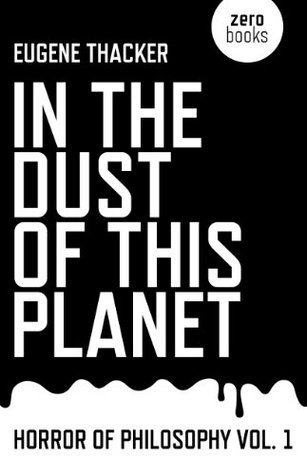
More on this book
Community


Kindle Notes & Highlights

Read between
May 9 - June 3, 2020

The world is increasingly unthinkable – a world of planetary disasters, emerging pandemics, tectonic shifts, strange weather, oil-drenched seascapes, and the furtive, always-looming threat of extinction. In spite of our daily concerns, wants, and desires, it is increasingly difficult to comprehend the world in which we live and of which we are a part. To confront this idea is to confront an absolute limit to our ability to adequately understand the world at all – an idea that has been a central motif of the horror genre for some time.
the horror of philosophy: the isolation of those moments in which philosophy reveals its own limitations and constraints, moments in which thinking enigmatically confronts the horizon of its own possibility
On the one hand, we are increasingly more and more aware of the world in which we live as a non-human world, a world outside, one that is manifest is the effects of global climate change, natural disasters, the energy crisis, and the progressive extinction of species world-wide. On the other hand, all these effects are linked, directly and indirectly, to our living in and living as a part of this non-human world. Hence contradiction is built into this challenge – we cannot help but to think of the world as a human world, by virtue of the fact that it is we human beings that think it.
When the world as such cataclysmically manifests itself in the form of a disaster, how do we interpret or give meaning to the world?
mythological
theological
existential
the mythological has become the stuff of the culture industries, spinning out big-budget, computer-generated films and merchandise; the theological has diffused into political ideology and the fanaticism of religious conflict; and the existential has been re-purposed into self-help and the therapeutics of consumerism.
modern existential framework, with its ethical imperative of choice, freedom, and will, in the face of both scientific and religious determinisms, ultimately constricts the entire world into a solipsistic, angst-ridden vortex of the individual human subject.
Let us call the world in which we live the world-for-us. This is the world that we, as human beings, interpret and give meaning to, the world that we relate to or feel alienated from, the world that we are at once a part of and that is also separate from the human. But this world-for-us is not, of course, totally within the ambit of human wants and desires; the world often “bites back,” resists, or ignores our attempts to mold it into the world-for-us. Let us call this the world-in-itself. This is the world in some inaccessible, already-given state, which we then turn into the world-for-us.
...more
The discussions on the long-term impact of climate change also evoke this reminder of the world-in-itself, as the specter of extinction furtively looms over such discussions.
world-without-us.
By contrast, the world-without-us cannot co-exist with the human world-for-us; the world-without-us is the subtraction of the human from the world. To say that the world-without-us is antagonistic to the human is to attempt to put things in human terms, in the terms of the world-for-us.
the world-for-us is simply the World, the world-in-itself is simply the Earth, and the world-without-us is simply the Planet.
“the Earth” is simply a designation that we’ve given to something that has revealed itself or made itself available to the gathering of samples, the generating of data, the production of models, and the disputes over policy.
In addition to the interpretive frameworks of the mythological (classical-Greek), the theological (Medieval-Christian), and the existential (modern-European), would it be possible to shift our framework to something we can only call cosmological?
Scientists estimate that approximate ninety percent of the cells in the human body belong to non-human organisms (bacteria, fungi, and a whole bestiary of other organisms). Why shouldn’t this also be the case for human thought as well? In a sense, this book is an exploration of this idea – that thought is not human.
horror be understood as being about the limits of the human as it confronts a world that is not just a World, and not just the Earth, but also a Planet (the world-without-us).
Horror is about the paradoxical thought of the unthinkable.
“horror” is a non-philosophical attempt to think about the world-without-us philosophically.
what genre horror does do is it takes aim at the presuppositions of philosophical inquiry – that the world is always the world-for-us – and makes of those blind spots its central concern,
The demon is as much a philosophical concept as it is a religious and political one. In fact, the “demon” is often a placeholder for some sort of non-human, malefic agency that acts against the human (that is, against the world-for-us).
Demons abound in popular culture, and yet we longer believe in demons – at least, this is the story we tell ourselves.
metal. Black metal is not just a music genre, but also a subculture and a way of thinking about demons and the demonic in a world of religious extremes. While black metal bands rarely put forth anything like a systematic philosophy of horror, the music, lyrics, and iconography of black metal are relevant for the ways in which they look back to earlier concepts of demons and the demonic – in all their ambiguity.
Of all these associations, there is one thing that sticks out, and that is the association of black metal to Satanism and the figure of the Devil. In fact, it would seem that this equation is the defining factor of black metal: Black = Satanism.
In its oppositional mode, the equation black = Satanic means “against God,” “against the Sovereign,” or even “against the divine.”
it is not the threat of not believing at all, but the threat of believing in the “wrong” way.
This more formalized, “poetic” Satanism operated not only by opposition, but also by inversion,
A key aspect of this poetic Satanism is the infamous Black Mass, deliriously portrayed in Joris-Karl Huysmans’ novel Là-bas (1891; Down There) – which is purportedly based on a real Black Mass the author had attended.
On the contrary, it is obvious to any listener of black metal that not all black metal bands ascribe to this equation of black = Satanic.
is: Black = pagan.
paganism denotes less a negative or reactive mode, than an entirely different, and ultimately pre-Christian outlook.
Instead of demonic invocations and the Black Mass, there may be images of animistic nature, elemental and earth powers, astral lights and astral bodies, the metamorphoses of human and animal, human and plant, and human and nature itself.
Whereas both the Satanic and pagan variants retain an anthropocentric thread, a third position, which we can call “cosmic,” attempts to relinquish even this.
The view of Cosmic Pessimism is a strange mysticism of the world-without-us, a hermeticism of the abyss, a noumenal occultism.
Hence another possible meaning of the term “black”: Black = Cosmic. Or better, Black = Cosmic Pessimism.
We have to entertain the possibility that there is no reason for something existing; or that the split between subject and object is only our name for something equally accidental we call knowledge; or, an even more difficult thought, that while there may be some order to the self and the cosmos, to the microcosm and macrocosm, it is an order that is absolutely indifferent to our existence, and of which we can have only a negative awareness.
knowledge. To find an equal to Schopenhauer, one would have to look not to philosophy but to writers of supernatural horror such as H.P. Lovecraft, whose stories evoke a sense of what he termed “cosmic outsideness”:
the figure of the demon, though it may not be accepted literally today, can be understood in an anthropological framework, as a metaphor for the nature of the human, and the relation of human to human
Indeed, the core problematic in the climate change discourse is the extent to which human beings are at issue at all. On the one hand we as human beings are the problem; on the other hand at the planetary level of the Earth’s deep time, nothing could be more insignificant than the human.
