
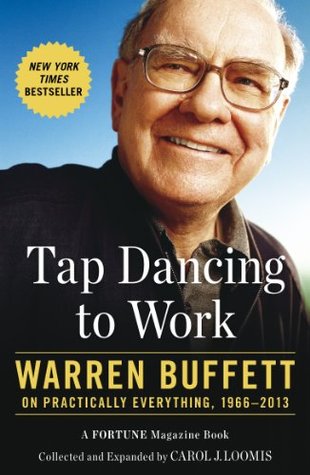
More on this book
Community


Kindle Notes & Highlights
Started reading
September 29, 2017

(“Hmm, forty-seven years,” Buffett would be inclined to say. “That’s a long time—almost one-fifth of the years the U.S. has existed.”)
To those investors who regard short selling with suspicion, Jones would simply say that he is using “speculative techniques for conservative ends.”
Forecasts usually tell us more of the forecaster than of the future.
If you feel you can dance in and out of securities in a way that defeats the inflation tax, I would like to be your broker—but not your partner.
Before this year, Berkshire seemed impervious to such pressures. Pro-life activists had picketed its annual meetings and boycotted it for years.
“The market, like the Lord,” Buffett writes, “helps those who help themselves. But, unlike the Lord, the market does not forgive those who know not what they do.”
In applying EMH to Warren Buffett, Charles Munger, William Ruane, and Walter Schloss, you would have three difficulties:(1) all have outperformed the market over long periods; (2) they have generally done so in both bullish and bearish environments, so it’s hard to argue that their higher returns simply reflect greater risk-taking; and (3) all are pursuing strategies that reflect the ideas of the late Benjamin Graham, so it’s hard to view their performance as a random event.
“Things aren’t right just because they are unpopular,” Buffett says with a chuckle, “but it is a good pond in which to fish. You pay a lot on Wall Street for a cheery consensus.”
The two major bond-rating agencies on Wall Street, Moody’s and Standard & Poor’s, have both refused to rate WPPSS 1, 2, and 3 bonds.
Naturally, Buffett does not impose any systems of management on the heads of the operating companies, who are free to be as loose or structured as they wish. Schey, 63, the chief executive of Scott Fetzer (1987 sales: $740 million), is a graduate of Harvard business school and uses the full panoply of management tools: detailed budgets, strategic plans, annual conclaves of his executives. A few hundred miles away at Fechheimer (1987 sales: $75 million), Robert Heldman, 69, and brother George, 67, sit down every morning in a cluttered conference room and go through all the mail that comes into
...more
Goldberg, whose ego has been put to the test, says it’s not easy. “I’ve had a chance to see someone in action who can’t be believed. The negative is: How do you ever think much of your own abilities after being around Warren Buffett?”
To read the 1997 story today and to realize how close Salomon came to bankruptcy in 1991—at least as Buffett saw it—is inevitably to think about Lehman Brothers, which many years later did go bankrupt.
We don’t go into companies with the thought of effecting a lot of change. That doesn’t work any better in investments than it does in marriages.”
So early on that Sunday, Buffett concluded that he would refuse election if bankruptcy ensued.
“How will you handle needing to be both here and in Omaha?” he was asked, and the answer popped right back: “My mother has sewn my name in my underwear, so it’ll be okay.”
Freddie had also made a big, unorthodox investment that Buffett didn’t like, and he wondered what else bad it was doing that he didn’t know about. “There’s never just one cockroach in the kitchen,” Buffett said.
“That’s like telling them what to invest in ten years after I die. I would rather have a smart, well-intentioned, high-grade person looking at the problems of the day through eyes that are open, not through my eyes that are in a coffin.
The size of the investor’s brain is less important than his ability to detach the brain from the emotions. “Rationality is essential when others are making decisions based on short-term greed or fear,” says Buffett. “That is when the money is made.”
For the ones who won’t, it will be because you get in your own way, not because the world doesn’t allow you.
So all you know is that you’re going to get one ball out of a barrel with, say, 5.8 billion balls in it. You’re going to participate in what I call the ovarian lottery. It’s the most important thing that will happen to you in your life, but you have no control over it. It’s going to determine far more than your grades at school or anything else that happens to you.
You’re going to want a system that keeps Bill Gates and Andy Grove and Jack Welch working long, long after they don’t need to work. You’re going to want the most able people working more than 12 hours a day. So you’ve got to have a system that gives them an incentive to turn out the goods and services.
That would all be funny if it weren’t tragic. In the first eight months of 1998, the fund lost nearly 50% of its capital, and in September it hemorrhaged still more, with the loss going to around 90%.
reminded Buffett of a favorite line that seems just about the perfect wrapup for Long-Term Capital: “You never know who’s swimming naked until the tide goes out.”
The absolute most that the owners of a business, in aggregate, can get out of it in the end—between now and Judgment Day—is what that business earns over time.
Frankly, I’m disappointed that the Buffett family was not short horses through this entire period. And we really had no excuse: Living in Nebraska, we would have found it super-easy to borrow horses and avoid a short squeeze.

Hahahahaha
Fortune merged its U.S. and “global” lists into one “world” list beginning in 2008. For the last sixteen years, 1997 through 2013, Berkshire is the only company that has always made the top ten.
They had a deal, negotiated by phone, in 24 hours and an announcement Dec. 20. That afternoon, Jerry Henry went before Manville’s Denver employees and announced, to cheers, “There is a Santa Claus. But he’s not located at the North Pole, my friends. He’s in Omaha.”
But a decade-by-decade look at per capita GNP [which is presented in the chart on the facing page] shows something remarkable: As a nation, we made relatively consistent progress throughout the century. So you might think that the economic value of the U.S.—at least as measured by its securities markets—would have grown at a reasonably consistent pace as well. That’s not what happened. We know from our earlier examination of the 1964-98 period that parallelism broke down completely in that era. But the whole century makes this point as well.
Ben Graham told us why: “Though the stock market functions as a voting machine in the short run, it acts as a weighing machine in the long run.”
“Did it ever bother you,” I ask him, “that people said you were a has-been, that you were through?” “Never,” he says in his folksy, gravelly voice. “Nothing bothers me like that. You can’t do well in investments unless you think independently. And the truth is, you’re neither right nor wrong because people agree with you. You’re right because your facts and your reasoning are right. In the end that’s all that counts. And there wasn’t any question about the facts or reasoning being correct.”
Calpine and AES, for instance, traded at $56 and $70, respectively, at their peaks. Today each sells for around $2. The origin of the utility bubble goes back to the Energy Policy Act of 1992, which lured companies into the seemingly sexy, unregulated end of the business. (Unregulated utilities produce power on a speculative basis, without guaranteed customers, but can sell that power at market rates. A regulated utility has guaranteed customers and regulated rates.) As more and more money streamed into unregulated businesses, Dave Sokol, CEO of MidAmerican, saw what he thought was a
...more
This, in part, has to reflect an underrated aspect of Buffett’s managerial prowess: his people skills. “He is the best judge of human talent there is,” says Rich Santulli, who heads up NetJets, a company that leases fractional shares of aircraft. “And people want to work for him.”
Remember that Warren Buffett line about how, if he taught business school, he’d ask every student to compute the value of an Internet company, and then flunk anyone who answered?
The losses Berkshire took on that oil investment roughly balanced what it had made on PetroChina.
In effect, Squanderville has been colonized by purchase rather than conquest.
The time to halt this trading of assets for consumables is now, and I have a plan to suggest for getting it done. My remedy may sound gimmicky, and in truth it is a tariff called by another name.
Because our exports total about $80 billion a month, ICs would be issued in huge, equivalent quantities—that is, 80 billion certificates a month—and would surely trade in an exceptionally liquid market.
Big ideas and often dismissed outright anyway. People fear they might break things.
But this unremarkable scene was about to take a surprising turn. “Brace yourself,” Buffett warned with a grin. He then described a momentous change in his thinking.
In my case, the ability to allocate capital would have had little utility unless I lived in a rich, populous country in which enormous quantities of marketable securities were traded and were sometimes ridiculously mispriced. And fortunately for me, that describes the U.S. in the second half of the last century.
If you think about it—if your goal is to return the money to society by attacking truly major problems that don’t have a commensurate funding base—what could you find that’s better than turning to a couple of people who are young, who are ungodly bright, whose ideas have been proven, who already have shown an ability to scale it up and do it right? You don’t get an opportunity like that ordinarily. I’m getting two people enormously successful at something, where I’ve had a chance to see what they’ve done, where I know they will keep doing it—where they’ve done it with their own money, so
...more
Wow
His music ain’t bad at all. I have some on my chill playlist.
Once his estate is closed, which he estimates will take three years, every dollar of his gifts must be used within ten years.
Having noted a few years ago that his guests were overwhelmingly male and having suspected some gender bias, Buffett has since required that each contingent be at least one-third female.
It’s very, very, very hard to regulate people. If I were appointed a new regulator—if you gave me 100 of the smartest people you can imagine to work for me, and every day I got the positions from the biggest institutions, all their derivative positions, all their stock positions and currency positions, I wouldn’t be able to tell you how they were doing.
So, yes, there’s been a history of terrible results, created most of all by the bet having started in the gut-wrenching year of 2008. Both contestants fell deep into the red then—with Buffett slammed the hardest. His index fund contender, Vanguard’s Admiral shares, lost 37 percent in 2008 versus a 24 percent drop, on the average, for investors in Protégé’s five funds of funds.
Just across a river from Hong Kong, Shenzhen is the biggest and fastest-growing city in the world that most Americans cannot find on a map.
BYD’s breakthrough came when Wang decided to substitute migrant workers for machines. In place of the robotic arms used on Japanese assembly lines, which cost $100,000 or more apiece, BYD actually cut costs by hiring hundreds, then thousands, of people.
Competitive advantage?
The train ride from the village where he grew up to Central South Industrial University of Technology, where he earned his chemistry degree, took him by Yellow Mountain, a popular destination for hikers and tourists, but he has never visited there. “I didn’t go then because we had no money,” he says. “I don’t go now because we have no time.”
By contrast, the last time BYD executives traveled to the Detroit auto show they rented a suburban house to save the cost of hotel rooms.
