
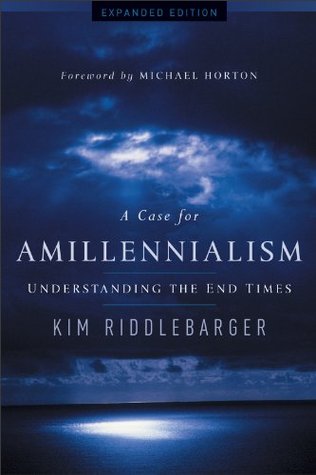
More on this book
Community


Kindle Notes & Highlights

Read between
April 2, 2022 - March 24, 2023

Israel’s possession of the land of promise, therefore, was part of a national covenant and was conditioned upon national obedience. The New Testament writers are clear (much to the dispensationalist’s dismay) that the everlasting land promise God made to Abraham is now fulfilled in Jesus Christ, who is the true Israel. This becomes clear when Paul universalizes the Abrahamic promise of a land in Palestine now extending to the ends of the earth (Rom. 4:13). Abraham is now depicted as heir of the world.
The difference of opinion between amillennial and postmillennial Christians centers on the starting point, character, and length of the millennial age.
The pattern of promise and fulfillment runs throughout the pages of Holy Scripture. Jesus Christ and his humble entrance into human history lie at the center of biblical eschatology, the last things, and the millennial age. This explains in part why Reformed theologians see the Old Testament in terms of promises about the Redeemer and the New Testament in terms of their fulfillment. This view preserves the redemptive-historical unity between the testaments. The Bible does not have two divergent testaments bound under one cover. Rather, the Bible is one book with one ultimate author and one
...more
As we look back from the perspective of New Testament fulfillment, we can see that the Epistle to the Hebrews was written to demonstrate that Israel’s priesthood was a provisional institution that prepared the way for the true High Priest, the one who was both sacrificing priest and sacrificial victim.
This use of the phrase “last days” as marking the dawn of the new age of redemption can be seen in Peter’s Pentecost sermon (Acts 2:16–17). Peter demonstrated that the coming of Christ and his resurrection clearly meant that the last days had arrived. “The words ‘in the last days’ (en tais eschatais hērmerais) are a translation of the Hebrew words ‘acharey khen,’ literally, ‘afterwards.’ When Peter quotes these words and applies them to the event which has just occurred, he is saying in effect, ‘We are in the last days now.’”
Neither Jesus nor Paul spoke of the future course of biblical history as entailing an earthly millennium.
By arguing for a new commemorative order based on Old Testament typology in the millennial age, dispensationalists see the future not as a consummation but as a return to the past. And this, of course, sadly obscures the person and work of Christ by seeing the ultimate reality not in him but in the types and shadows destined to perish when the reality entered the theater of redemption.
Premillennialists, who insist on a literal one thousand years in Revelation 20:2, do so even though the consequence of this exegetical decision is the revolt of the redeemed against the Redeemer in verses 7–10.
the differences between amillennialism and the more moderate form of postmillennialism can be difficult to pin down. As I noted earlier, many postmillennial writers often describe this matter as a debate between “optimistic” postmillenarians and “pessimistic” amillenarians,[29] while amillennial writers often locate the difference of opinion in the postmillennial confusion of the already (the present blessings of the kingdom of God) and the not yet (the eternal blessings of the consummation).[30] Most contemporary Reformed postmillennialists are of the more moderate variety.
When Pilate asked our Lord about the nature of this kingdom, Jesus said, “My kingdom is not of this world. . . . But now my kingdom is from another place” (John 18:36). Jesus’s kingdom was a spiritual kingdom, completely unlike the nationalistic kingdom Israel expected. This should also be a caution to those who would see Jesus’s kingdom in terms of nationalism or secular progress in economics, politics, and culture.
If the first resurrection of which John spoke is a spiritual resurrection, then in Revelation 20:6, John is not speaking of a future earthly reign of Christ but a present reign of Christ. This is further reinforced by Paul’s argument that Christians are already raised with Christ, and while their outer bodies are dying, their inner beings are being renewed.
It is Christ who made the two peoples, Jew and Gentile, into one. These two texts (Gal. 3:28; Eph. 2:11–14) are clear challenges to the dispensational notion of two distinct peoples of God with separate redemptive economies.[20]
This raises serious questions about how postmillenarians interpret the last two thousand years of the church’s history and the spread of the gospel into the four corners of the earth without a corresponding “Christianizing of the nations.” This point, taken by itself, does not refute postmillennialism. It merely demonstrates that postmillennial expectations have not been realized and that the millennium is future. Problematic? Yes. Refutation? No.
What separates amillenarians from postmillenarians is the fact that amillenarians do not necessarily believe that things will get better for God’s people on a global scale. In fact, things may get worse.
The second obvious objection to postmillennial expectation is much more serious. Does the New Testament promise Christians that God will Christianize the nations and that glorious things lie ahead for God’s people in this present age? The answer to this question is no.[31] If postmillennialists are correct, you would expect Jesus to tell his church something like this: “Things will be rough in the beginning. But hang in there! All nations will come to faith in me, and there will be such cultural, economic, and political improvements that you wouldn’t believe me even if I told you.”
Over the interadvental period in its entirety, from beginning to end, a fundamental aspect of the church’s existence is (to be) “suffering with Christ”; nothing, the New Testament teaches, is more basic to its identity than that.[35]
If the church is to suffer with Christ until his return, this undercuts the triumphalism of postmillennialism. Amillenarians can explain how God’s kingdom advances while God’s people simultaneously “suffer with Christ” and endure the persecution of the world. Postmillenarians cannot.
The signs of Christ’s kingdom are an empty cross and an empty tomb. The church triumphs by suffering with Christ, not by taking dominion over the world and controlling its political institutions, economic resources, and cultural establishments.
Dispensationalists miss the point when they are preoccupied with investigating which forms of technology can be used to create body markings or a cashless society. They come closer to the truth when they warn us about government usurping its God-given role and seeking the adoration and worship owed to God by his people. The worship of the state or its leader is a real and pressing threat to all Christians. Statism can easily become false religion and idolatry whenever the state claims divine prerogatives and privileges for itself. This is the very essence of the beast. Anyone who confesses
...more
Both Daniel and Jesus spoke of one resurrection in which two distinct groups simultaneously participate—believers and unbelievers—each receiving the appropriate recompense. There is no hint anywhere in these two texts, implied or otherwise, that the resurrection of the righteous and the resurrection of the unrighteous are separated by a period of one thousand years, an essential feature of premillennialism.[1] Both Jesus and Daniel depicted the resurrection of the righteous and the unrighteous as occurring at the same time.
The literalistic interpretation of the Scriptures associated with dispensationalism is highly problematic. The dawn of the messianic age and the kingdom of God does not constitute a parenthetical period in redemptive history until such a time when God is ready to deal with national Israel and finish his original plan of redemption. It is clearly prophesied in the Old Testament that God’s redemptive purposes include Gentiles (Gen. 12:3; 22:18; Isa. 49:6). Therefore, the church is not a “mystery” during this age because the mystical body of Jesus Christ, the church, is the fulfillment of God’s
...more
The insertion of a gap of at least two thousand years between the sixty-ninth and the seventieth week is a self-contradictory violation of the dispensationalist’s professed literal hermeneutic. Where is the gap found in the text? Dispensationalists must insert it. The failure to acknowledge the obvious covenantal context of the messianic covenant maker of verse 27, who confirms a covenant with many, leads dispensationalists to confuse Christ with antichrist. A more serious interpretive error is hard to imagine.[9]
An antichrist is anyone who either denies that Jesus is the Christ or claims to be Christ.
Instead of trying to connect the signs of the end to current events, the church is to be about its divinely commissioned task of preaching the gospel. Jesus has not called us to speculate about his coming. Instead, he has called us to persevere to the end during the calamity of nations, the groaning of the earth, the rise of false teachers, and in the face of persecution. He has called us to take the gospel to the ends of the earth. This is the task with which we must be concerned.
His coming will not be an isolated, secret, or local event but will be witnessed by the entire world. Every eye will see him. The disciples asked Jesus what the sign of his coming would be. And this was his answer: “As lightning that comes from the east is visible even in the west, so will be the coming of the Son of Man” (v. 27). His coming will be an unmistakable event, like lightning flashing across the sky, impossible to miss.
The reason Jesus did this was surely intentional. He set forth the tension between the signs that precede his coming and the suddenness of his coming so that his people would live every moment in light of the promise of his coming. Yet, not knowing the day or the hour when he will come again, we are to live every moment to the fullest, going about our divinely mandated tasks of fulfilling the cultural mandate—marrying, raising our families, fulfilling our callings, and taking the gospel to the ends of the earth. This is the same tension we find throughout the New Testament between the already
...more
Paul made no mention of the Jews returning to the Promised Land, nor do we find any reference to a millennial kingdom in which Jesus rules the earth as a Davidic king during an earthly millennium. Nor do we find any reference made by Paul to a postmillennial golden age in which the world will be largely Christianized.[24] One would certainly think that since Paul is addressing the subject of Israel’s future and if Israel’s future entailed the things dispensationalists and postmillenarians claim that it does, this would be the ideal time for Paul to mention them. But he does not.
in Romans 4:16, Paul spoke of all who believe, Jews and Gentiles, as “Abraham’s offspring.”[29]
In Romans 9, Paul established the principle of salvation based on divine election—not faith or good works—as well as the principle that there remains an elect remnant within ethnic Israel. Then in Romans 10, the apostle hammered home the point that there is but one gospel and that the believing remnant of Israel will be delivered from the guilt and power of sin in the same manner as believing Gentiles.
Furthermore, it should be clear to every Calvinist who has tried to defend a doctrine of particular redemption against a universal atonement that “all” oftentimes means something less than “all inclusive.” In the context of Romans 9–11, especially when viewed against the background of Jewish sources and the Old Testament, “all Israel” has a corporate “significance, referring to the nation as a whole and not to every single individual who is a part of the nation.”[64] “All Israel,” therefore, means something like the vast majority or a great number. Once the fullness of the Gentiles comes in,
...more
Hoekema argues that if “all Israel” is understood as ethnic Israel, the analogy of the olive tree breaks down, since this would seem to require two different olive trees—one for Israel and one for Gentiles—and two different methods of salvation.[65]
Is there a future for ethnic Israel? Paul’s answer was yes. And the presence of a believing remnant was proof. But the future salvation of Israel is not connected to a future millennial kingdom. It is connected to the end of the age. When all Israel is saved, the resurrection is at hand.
The key to understanding the writer’s interpretation of history is to understand the symbols he uses. John did not intend for us to understand them literally. Admittedly, this can be tough going for modern Americans, since the symbols John used were probably immediately understood by Jewish Christians living when the book was written toward the end of the first century. They knew the Old Testament much better than we, and they intuitively knew where to look for the wisdom for which John called.
To argue, as one popular dispensational writer has, that the locusts of Revelation 9:3 are a premodern depiction of Bell UH-1B Huey helicopters is surely to wrongly divide the Word of truth.[10] Rather, a Christian should look to Exodus 10:1–20 and Joel 1:2–2:11 for interpretive help with the meaning of the locusts in Revelation. In agrarian societies, nothing was more destructive than locusts, which destroyed everything in sight. The first-century reader knew that locusts were symbols of judgment, not pictures of an unknown future technology.
Rather than reading Revelation as though it was written to Christians living at the beginning of the twenty-first century, we need to understand what the symbols and numbers would have meant to the original audience. This is why we look to the Old Testament to see what these images meant there so that these symbols will have continued meaning for Christians in all ages. They continually point us to Jesus Christ and his saving work on our behalf.
Revelation contains a series of visions, each of which functions like a different camera angle looking at the same event. Therefore, the order in which the various visions contained in Revelation are recounted by John does not necessarily reflect the order of historical occurrence of the reality those visions symbolize.[20] This is what is known as “recapitulation,” in which the same basic pattern is repeated in a variety of formulations.[21] Put more simply, the visions were arranged topically, not chronologically.
If premillenarians are correct, Revelation 19:11–21 teaches that a great battle occurs at the second advent of Jesus Christ, followed by one thousand years of peace (Rev. 20:1–6), which, in turn, ends in yet another battle, which culminates in the final judgment. But this exposes one of the most serious weaknesses of premillennialism, namely, the presence of evil among the redeemed during the millennial age, provoking the final eschatological battle. Indeed, there are a number of reasons to believe that the two battles depicted in Revelation 19:11–21 and Revelation 20:7–10 are one and the same
...more
According to J. Marcellus Kik, “The term thousand years in Revelation twenty is a figurative expression used to describe the period of the messianic-Kingdom upon earth. It is that period from the first Advent of Christ until his Second Coming.”[48] Amillenarians generally agree with this assessment, seeing the thousand years as a symbolic number, spanning the entire church age.
The scene of the heavenly reign of Christ’s saints is important, given the historical situation in which Revelation was written. At the time when John wrote this epistle, Christians were under horrible persecution at the hands of the pagan Roman Empire.[60] John was writing largely to give them hope in the midst of their trials at a time when martyrdom was all too common. By the time Revelation was written, Stephen, James, Paul, and Peter had already died martyrs’ deaths. The seven letters to the churches in Revelation 2–3 describe a situation in which false doctrine and persecution were
...more
According to John, an antichrist is anyone “who [does] not confess the coming of Jesus Christ in the flesh” (2 John 7 ESV). In this strict sense, an antichrist is anyone who teaches falsely about the identity of Jesus Christ—who is God manifest in the flesh (cf. John 1:1–17). Elsewhere, John said, “Every spirit that does not confess Jesus is not from God. This is the spirit of the antichrist” (1 John 4:3 ESV).
The presence of wars and natural disasters serves to remind us that the dawn of the messianic age is not yet the end. In fact, the presence of these signs constitutes proof that a final consummation awaits until Jesus’s kingdom is fully realized with the resurrection and final judgment at the end of the age.
According to Beale, such “tribulation consists of pressures to compromise faith, these pressures coming both from within the church through seductive teaching and without from overt oppression.”
As Vos points out, “The trouble is that . . . certain types of post-millennialism leave too little room for eschatology.”[33] Given the reality of this category of signs of the end, I wholeheartedly concur with Vos’s assessment. The signs of the end do not point to a golden age for the church as a whole during the interadvental age but seem to indicate alternating periods of blessing and tribulation—the eschatological tension between the already and the not yet.
The one sign of the end Jesus gave, however, that falls into the realm of the church’s responsibility is that the gospel will be proclaimed to the nations before the Lord returns. If we truly desire the return of our Lord, then our energies should be devoted to missions and evangelism, not to undue speculation and date-setting, striving to discern the identity of the Antichrist, or claiming that specific natural disasters and wars were foretold by Jesus and the apostles.
The third sign of the end that signals the return of the Lord is a great apostasy among the ranks of professing believers, tied directly to the appearance of the man of sin (i.e., the Antichrist), who is the final eschatological enemy of the church.
Therefore, before the Lord returns, the gospel must be preached worldwide, there will be a massive conversion of Jews to faith in Jesus Christ, and the church will experience a time of great apostasy and satanic activity tied to the revelation of the final Antichrist, who appears only to be destroyed by Jesus Christ at his second advent.
We must constantly be watching for the Lord’s return and yet be about the business God has assigned to us (Matt. 24:42–44). At a practical level, this means God’s people should preoccupy themselves with fulfilling the Great Commission and not with how the Bible supposedly predicts specific wars, earthquakes, or natural disasters.
In light of the fact that specific signs of the end remain to be fulfilled (category 3) before the Lord’s return, Anthony Hoekema suggests that we not speak of our Lord’s return as “imminent” (i.e., as though it can occur at any moment) but as “impending.”[39] This, I think, is a wise approach. As the Lord of history, God alone ordains our days and final destinies. When the time of the end has come, it is reasonable to conclude that the events associated with our Lord’s return can come to pass in a very short period of time. But the fact remains that the signs of the end have not yet been
...more
Oftentimes, people become comfortable with one particular millennial position—usually the one they embraced when they first became a Christian—and then they dig in their heels when their view is challenged. This tendency is part of fallen human nature. We do not find it easy to objectively evaluate matters we feel strongly about with open minds and without prejudice.
If premillennialism is true, this means that Jesus Christ returns to judge the world in Revelation 19 and sets up his millennial reign in Revelation 20. But what happens at the end of Christ’s millennial rule over the earth? According to Revelation 20:7–10, Satan is released from the abyss and immediately goes out to the four corners of the earth to deceive the nations (those same nations that have already been judged, according to Revelation 19:15). Satan organizes them for battle against the camp of God’s people and the city God loves, i.e., Jerusalem. This revolt ends when fire comes down
...more
