
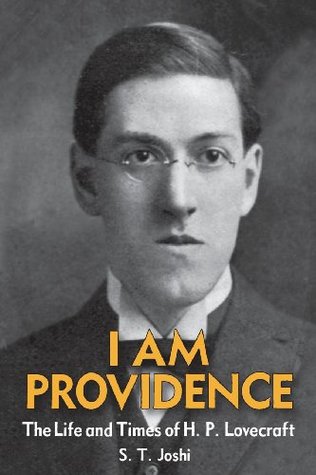
More on this book


Kindle Notes & Highlights

He also took to calling Gernsback “Hugo the Rat.”

Hmm. The "Hugo the Rat Awards" doesn't have quite the same ring to it... The award would probably look better as a sculpted rat than the present phallic space rocket, though. :)
Wandrei was a gaunt six-footer who, in some photographs of this period, seems to bear an uncanny resemblance to Boris Karloff’s portrayal of Frankenstein’s monster.
Lovecraft wrote: “This especial old bird, according to an anecdote recorded by George Sterling, parted from Bierce under the dramatic circumstance of having a cane broken over his head!” (The anecdote is found in Sterling’s introduction to the Modern Library edition of Bierce’s In the Midst of Life [1927].) Lovecraft then adds charitably: “When I saw his fiction I wondered why Ambrosius didn’t use a crowbar.”
I saw the ruinous, deserted old Randolph Beebe house where the whippoorwills cluster abnormally, and learned that these birds are feared by the rustics as evil psychopomps. It is whispered that they linger and flutter around houses where death is approaching, hoping to catch the soul of the departed as it leaves. If the soul eludes them, they disperse in quiet disappointment; but sometimes they set up a chorused clamour of excited, triumphant chattering which makes the watchers turn pale and mutter—with that air of hushed, awestruck portentousness which only a backwoods Yankee can assume—“They
...more
The social-political future of the United States is one of domination by vast economic interests devoted to ideals of material gain, aimless activity, & physical comfort—interests controlled by shrewd, insensitive, & not often well-bred leaders recruited from the standardised herd through a competition of hard wit & practical craftiness—a struggle for place & power which will eliminate the true & the beautiful as goals, & substitute the strong, the huge, & the mechanically effective.
And the orange, in the case of Trump.
At the Mountains of Madness, written in early 1931 (the autograph manuscript declares it to have been begun on February 24 and completed on March 22), is Lovecraft’s most ambitious attempt at “non-supernatural cosmic art”; it is a triumph in every way.
True.
At the Mountains of Madness, which avowedly presents itself as a scientific report, is the greatest instance of Lovecraft’s dictum that “no weird story can truly produce terror unless it is devised with all the care & verisimilitude of an actual hoax.”
The truly Semitic Jew is doubtless superior to the Mongoloid Jew in moral and cultural aspects,” Howard once opined
cringe
Lovecraft is entirely right in his assessment of Howard the man: There’s a bird whose basic mentality seems to me just about the good respectable citizen’s (bank cashier, medium shopkeeper, ordinary lawyer, stockbroker, high school teacher, prosperous farmer, pulp fictionist, skilled mechanic, successful salesman, responsible government clerk, routine army or navy officer up to a colonel, &c.) average—bright & keen, accurate & retentive, but not profound or analytical—yet who is at the same time one of the most eminently interesting beings I know. Two-Gun is interesting because he has refused
...more
Toward the end of his stay Whitehead caught a mottled snake, pickled it, and presented it to Lovecraft.
Nothing says "friendship" like a pickled snake. Amirite? :p
In the matter of your persistently unpaid revision bill—concerning which you so persistently withhold all explanations despite repeated inquiries—I have decided, at the risk of encouraging sharp practices, to forego the use of a collecting agency and make you a present of the amount involved. This is my first encounter with such a hopelessly bad bill, and I believe I may consider the sum ($7.50) as not ill spent in acquiring practical experience. I needed to be taught caution in accepting unknown clients without ample references—especially clients from a strident region which cultivates
...more
Rimel was also attempting to write poetry. In the summer of 1934 he sent Lovecraft the first sonnet in what would prove to be a cycle titled “Dreams of Yid”; evidently, Rimel was unaware that “Yid” was an opprobrious term for a Jew, so Lovecraft altered the title to “Dreams of Yith.”
I'm surprised that Lovecraft changed it.
he loathed Bolshevik Russia to the end of his days—because it had fostered a cultural destruction that was in no way necessary to the economic reform that its leaders were claiming as their paramount goals.
Democracy—as distinguished from universal opportunity and good treatment—is today a fallacy and impossibility so great that any serious attempt to apply it cannot be considered as other than a mockery and a jest. . . . Government “by popular vote” means merely the nomination of doubtfully qualified men by doubtfully authorised and seldom competent cliques of professional politicians representing hidden interests, followed by a sardonic farce of emotional persuasion in which the orators with the glibbest tongues and flashiest catch-words herd on their side a numerical majority of blindly
...more
As for the Republicans—how can one regard seriously a frightened, greedy, nostalgic huddle of tradesmen and lucky idlers who shut their eyes to history and science, steel their emotions against decent human sympathy, cling to sordid and provincial ideals exalting sheer acquisitiveness and condoning artificial hardship for the non-materially-shrewd, dwell smugly and sentimentally in a distorted dream-cosmos of outmoded phrases and principles and attitudes based on the bygone agricultural-handicraft world, and revel in (consciously or unconsciously) mendacious assumptions (such as the notion
...more
I agree that most of the motive force behind any contemplated change in the economic order will necessarily come from the persons who have benefited least by the existing order; but I do not see why that fact makes it necessary to wage the struggle otherwise than as a fight to guarantee a place for everybody in the social fabric. The just demand of the citizen is that society assign him a place in its complex mechanism whereby he will have equal chances for education at the start, and a guarantee of just rewards for such services as he is able to render (or a proper pension if his services
...more
The greatest peril to civilised progress—aside from an annihilative war—is some kind of basically reactionary system with enough grudging concessions to the dispossessed to make it really work after a fashion, and thus with the capacity to postpone indefinitely the demand of the masses for their real rights—educational, social, and economic—as human beings in a world where the great resources should be cornered by none. . . . Unsupervised capitalism is through. But various Nazi and fascist compromises can be cooked up to save the plutocrats most of their spoils while lulling the growing army
...more
Now we live in an age of easy abundance which makes possible the fulfilment of all moderate human wants through a relatively slight amount of labour. What shall be the result? Shall we still make resources prohibitively hard to get when there is really a plethora of them? . . . If “stamina” and “Americanism” demand a state of constant anxiety and threatened starvation on the part of every ordinary citizen, then they’re not worth having!
Hardy he considered overrated and sentimental—a rather surprising judgment (made, apparently, on the basis of Tess of the d’Urbervilles and Jude the Obscure) on a writer whose bleakness of vision Lovecraft might have been expected to appreciate.
Yep.Don't diss old Thomas.
Time, space, and natural law hold for me suggestions of intolerable bondage, and I can form no picture of emotional satisfaction which does not involve their defeat—especially the defeat of time, so that one may merge oneself with the whole historic stream and be wholly emancipated from the transient and the ephemeral.[63] There is no field other than the weird in which I have any aptitude or inclination for fictional composition. Life has never interested me so much as the escape from life.
“Generally speaking, the cinema always cheapens & degrades any literary material it gets hold of—especially anything in the least subtle or unusual.”[71] I believe that last utterance still carries a good deal of truth.
Adamsville contains the world’s only known monument to a hen—perpetuating the fame of the Rhode Island Red . . .”
It should also be stressed that one’s final picture of Lovecraft must be based largely upon the last ten or so years of his existence; for it was at this time that he shed many of the prejudices and dogmatisms that his early upbringing and seclusion had engendered, and when he produced his most characteristic work. In those ten years I see very little to criticise and very much to praise.
Lovecraft boldly challenged that most entrenched dogma of art—that human beings should necessarily and exclusively be the centre of attention in every aesthetic creation—and his defiance of the “humanocentric pose” is ineffably refreshing.
reviewer of Burleson’s Disturbing the Universe remarked pointedly: “It’s getting to where those who still ignore Lovecraft will have to go on the defensive.”
