
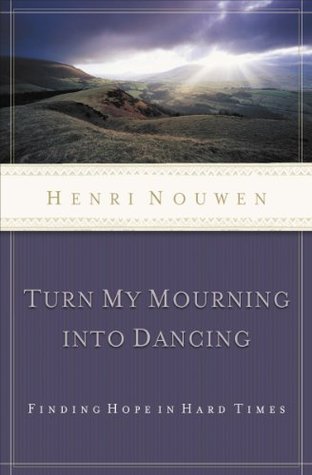
More on this book
Community


Kindle Notes & Highlights

Read between
September 2 - September 23, 2022

Henri was complex and unfinished; he knew it well and did not pretend otherwise.
We hear an invitation to allow our mourning to become a place of healing, and our sadness a way through pain to dancing. Who is it Jesus said would be blessed? “Those who mourn” (Matt. 5:4).
By inviting God into our difficulties we ground life—even its sad moments—in joy and hope. When we stop grasping our lives we can finally be given more than we could ever grab for ourselves. And we learn the way to a deeper love for others.
Ultimately mourning means facing what wounds us in the presence of One who can heal.
I realized that healing begins with our taking our pain out of its diabolic isolation and seeing that whatever we suffer, we suffer it in communion with all of humanity, and yes, all of creation. In so doing, we become participants in the great battle against the powers of darkness. Our little lives participate in something larger.
We are called to grieve our losses. It seems paradoxical, but healing and dancing begin with looking squarely at what causes us pain. We face the secret losses that have paralyzed us and kept us imprisoned in denial or shame or guilt.
I am less likely to deny my suffering when I learn how God uses it to mold me and draw me closer to him. I will be less likely to see my pains as interruptions to my plans and more able to see them as the means for God to make me ready to receive him. I let Christ live near my hurts and distractions.
For in our suffering, not apart from it, Jesus enters our sadness, takes us by the hand, pulls us gently up to stand, and invites us to dance. We find the way to pray, as the psalmist did, “You have turned my mourning into dancing” (Ps. 30:11), because at the center of our grief we find the grace of God.
Our glory is hidden in our pain, if we allow God to bring the gift of himself in our experience of it. If we turn to God, not rebelling against our hurt, we let God transform it into greater good. We let others join us and discover it with us.
Gratitude in its deepest sense means to live life as a gift to be received thankfully. And true gratitude embraces all of life: the good and the bad, the joyful and the painful, the holy and the not-so-holy. We do this because we become aware of God’s life, God’s presence in the middle of all that happens.
Grateful people learn to celebrate even amid life’s hard and harrowing memories because they know that pruning is no mere punishment, but preparation.
The more people you love, the more pain you may experience. For the great mystery of love is that while it can be received, it can also be rejected. Every time you love you enter into the risk of love.
When we mourn, we die to something that gives us a sense of who we are. In this sense suffering always has much to do with the spiritual life. We surrender our striving denial of our limitations. We release our hold on a piece of our identity as a spouse, a parent, as a member of church, as a resident of a community or nation. We may even suffer for our faith.
But whenever I choose other gods by making people or events the source of my joy, I find my sorrow only increases.
The suffering of affluent countries such as ours—our anxiousness and loneliness—comes as a hidden consequence of our ignoring those who are less fortunate. It accompanies our unjust extravagance.
We realize that joy is not a matter of balloons and parties, not owning a house, or even having our children succeed in school. It has to do with a deep experience— an experience of Christ. In the quiet listening of prayer, we learn to make out the voice that says, “I love you, whoever else likes you or not. You are mine. Build your home in me as I have built my home in you.”
The gospel calls us continually to make Christ the source, the center, and the purpose of our lives. In him we find our home. In the safety of that place, our sadnesses can point us to God, even drive us into God’s loving embrace. Here mourning our losses ultimately lets us claim our belovedness. Mourning opens us to a future we could not imagine on our own—one that includes a dance.
We are, after all, a little afraid of God. We want to love him, but we fence ourselves in and keep God at a distance. Our spiritual habits and customs become that fence.
Prayer, we may find, helps us see others as persons to be received, loved.
Our lives stay very full. And when we are not blinded by busyness, we fill our inner space with guilt about things of the past or worries about things to come. Perhaps part of our fear comes from the fact that an empty place means that something may happen to us that we cannot predict, that is new, that leads us to a place we might not want to go. I might not want to hear what God has to say.
Discipline is the concentrated effort to create some space in our lives where the Spirit of God can touch us, guide us, speak to us, and lead us to places that are unpredictable, where we are no longer in control. Many spiritual-life writers speak of “attentiveness” to God. Attentiveness helps us look fully at God, to invite God in more completely. It leads us into the depths of God’s healing mercies. This attention, writes Simone Weil,
Discipline, in the sense I mean, is to leave room in our hearts where we can listen to the Spirit of God in a life-changing way.
Anyone who believes, Jesus reminds us, has eternal life ( John 6:40). That is the enormous revolution, that in this fleeting, temporary world he comes to plant the seed of eternal life. In many ways that is what is meant by the term the spiritual life—the nurturing of the eternal amid the temporal, the lasting within the passing, God’s presence in the human family. It is the life of the divine Spirit within us.
Fatalism may make us dependent on routines, on actions that we would feel urgency to change if we examined them. We may settle for finding satisfaction in dysfunctional, painful places, growing attached to our complaints, symptoms, addictions. One of the most insidious aspects of fatalism has to do with how it leads us to resist healing.
Faith is the deep confidence that God is good and that God’s goodness somehow triumphs. Faith is that intimate, personal trust by which you say, “I commend myself into your strong, loving hands.”
No, hope does not come from positive predictions about the state of the world, anymore than does faith. Nor does hope depend on the ups and downs of our life’s particulars. Hope rather has to do with God. We have hope and joy in our faith because we believe that, while the world in which we live is shrouded in darkness, God has overcome the world.
Every time I try to trust, I realize how many little conditions I put on trust. Every time I trust more I see how deep is my resistance. And how many more levels I find that faith has not penetrated! We don’t know how many levels there are. But our lives are renewed every time we trust more. We take a leap of faith and trust only to see the next layer of possibility.
A person of faith learns to trust so much that the outcome of the trust is given into the hands of the One in whom the trust is placed. We let God work out some details that we feel tempted to know or control but ultimately cannot.
We see how the events of this year are not just a series of incidents and accidents, happy or unhappy, but the molding hands of God, who wants us to grow and mature.
Time has to be converted, then, from chronos, mere chronological time, to kairos, a New Testament Greek word that has to do with opportunity, with moments that seem ripe for their intended purpose.
We are part of a very impatient culture, however. We want many things and we want them quickly. And we feel that we should be able to take away the pains, heal the wounds, fill the holes, and create experiences of great meaningfulness—now.
Boredom also grows out of our fatalism, for it too reflects the disconnectedness of our experience. A day becomes just another day, a year another year. Everything has already been said, there is nothing new under the sun, and life becomes like a piece of wood drifting in near-motionless water.
Memory anchors us in the past and then makes us present here and now and opens us up for a new future.
Sometimes the words of the Bible do not seem important to us. Or they do not appeal to us. But in those words we hear Christ saying in effect, “I am waiting for you. I am preparing a house for you and there are many rooms in my house.” Paul the Apostle tells us, “Be transformed by the renewing of your minds” (Rom. 12:2). We hear a promise and an invitation to a life we could not dream of if all we considered were our own resources.
For even while we mourn, we do not forget how our life can ultimately join God’s larger dance of life and hope.
To live with compassion means to enter others’ dark moments. It is to walk into places of pain, not to flinch or look away when another agonizes. It means to stay where people suffer. Compassion holds us back from quick, eager explanations when tragedy meets someone we know or love.
In so many encounters we try to look away from the pain. We try to help our friends quickly process grief. We hastily look for ways to bring cheer to a child or ailing aunt. All the while, however, we act less out of genuine “suffering with” and more out of our need to stand back from the discomfort we fear we might feel.
A fair amount of our suffering comes from our loneliness, a loneliness intensified by our high needs.
Many things we think we do for others are in fact the expressions of our drive to discover our identity in the praise of others.
We compare ourselves to others and worry about what others think of us even when we are serving others. We wonder if we serve better than someone else. We import a drive to achieve into our works of mercy.
Compassion in its fullest sense can be attributed only to God. It is the central message of the gospel that God, who in no way is in competition with us, is the One who can be truly compassionate.
Real ministry starts taking place when we bring others in touch with more than we ourselves are—the center of being, the reality of the unseen—the Father who is the source of life and healing.
We can serve people only when we do not make our total sense of self dependent on their response.
What do you do when alone with God? Many of us think, talk, or ask. But when alone with God how vital also to listen! Solitude is the place where you can hear the voice that calls you the beloved, that leads you onto the next page of the adventure, that says, as God said to Jesus early in the Gospels, “This is my son, the Beloved, with whom I am well pleased” (Matt. 3:17).
It is hard for us to hear the voice that proclaims that we are loved in Christ, not for our reputation or impressive actions, but because God has loved us with an everlasting love.
Because no one can meet our deepest needs for love, so must we learn, in our solitude, to forgive.
We walk with (or bump into) people who always live and love imperfectly.
Community, then, cannot grow out of loneliness, but comes when the person who begins to recognize his or her belovedness greets the belovedness of the other. The God alive in me greets the God resident in you.
Our understanding of love is so strongly influenced by ideas from interpersonal human relationships—personal attraction, mutual compatibility, sexual desires, cultural understandings of sensitivity—that we have trouble realizing that the love of God goes far beyond these.
This is not easy, of course, largely because of the ways we continue to crave attention, affection, influence, power, even after hearing God’s word that we are his beloved. These needs are born from our wounds and never seem to be satisfied.
