
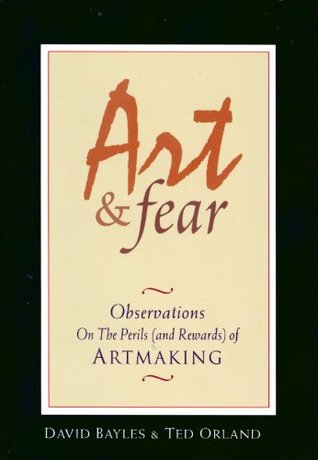
More on this book
Community


Kindle Notes & Highlights

by
David Bayles
Read between
April 5 - May 7, 2023

It is about committing your future to your own hands, placing Free Will above predestination, choice above chance.
MAKING ART IS DIFFICULT. We leave drawings unfinished and stories unwritten. We do work that does not feel like our own. We repeat ourselves. We stop before we have mastered our materials, or continue on long after their potential is exhausted. Often the work we have not done seems more real in our minds than the pieces we have completed. And so questions arise: How does art get done? Why, often, does it not get done? And what is the nature of the difficulties that stop so many who start?
Personally, we’ll side with Conrad’s view of fatalism: namely, that it is a species of fear — the fear that your fate is in your own hands, but that your hands are weak.
In large measure becoming an artist consists of learning to accept yourself, which makes your work personal, and in following your own voice, which makes your work distinctive.
Even talent is rarely distinguishable, over the long run, from perseverance and lots of hard work.
Something about making art has to do with overcoming things, giving us a clear opportunity for doing things in ways we have always known we should do them.
if artmaking did not tell you (the maker) so enormously much about yourself, then making art that matters to you would be impossible.
To all viewers but yourself, what matters is the product: the finished artwork. To you, and you alone, what matters is the process: the experience of shaping that artwork. The viewers’ concerns are not your concerns (although it’s dangerously easy to adopt their attitudes.) Their job is whatever it is: to be moved by art, to be entertained by it, to make a killing off it, whatever. Your job is to learn to work on your work.
The function of the overwhelming majority of your artwork is simply to teach you how to make the small fraction of your artwork that soars. One of the basic and difficult lessons every artist must learn is that even the failed pieces are essential.
The point is that you learn how to make your work by making your work, and a great many of the pieces you make along the way will never stand out as finished art. The best you can do is make art you care about — and lots of it!
Artists don’t get down to work until the pain of working is exceeded by the pain of not working. — Stephen DeStaebler
those who continue to make art are those who have learned how to continue — or more precisely, have learned how to not quit.
Quitting is fundamentally different from stopping. The latter happens all the time. Quitting happens once. Quitting means not starting again — and art is all about starting again.
Avoiding this fate has something to do with not letting your current goal become your only goal.
Making art can feel dangerous and revealing. Making art is dangerous and revealing.
Making art precipitates self-doubt, stirring deep waters that lay between what you know you should be, and what you fear you might be.
Art is a high calling — fears are coincidental. Coincidental, sneaky and disruptive, we might add, disguising themselves variously as laziness, resistance to deadlines, irritation with materials or surroundings, distraction over the achievements of others — indeed as anything that keeps you from giving your work your best shot.
What separates artists from ex-artists is that those who challenge their fears, continue; those who don’t, quit.
Lesson for the day: vision is always ahead of execution — and it should be. Vision, Uncertainty, and Knowledge of Materials are inevitabilities that all artists must acknowledge and learn from: vision is always ahead of execution, knowledge of materials is your contact with reality, and uncertainty is a virtue.
A piece grows by becoming specific.
The development of an imagined piece into an actual piece is a progression of decreasing possibilities, as each step in execution reduces future options by converting one — and only one — possibility into a reality. Finally, at some point or another, the piece could not be other than it is, and it is done.
That moment of completion is also, inevitably, a moment of loss — the loss of all the
other forms the imagined piece might have taken. The irony here is that the piece you make is always one step removed from what you imagined, or what else you can imagine, or what you’re right on the edge of being able to imagine.
Designer Charles Eames, arguably the quintessential Renaissance Man of the twentieth century, used to complain good-naturedly that he devoted only about one percent of his energy to conceiving a design — and the remaining ninety...
This highlight has been truncated due to consecutive passage length restrictions.
Small surprise. After all, your imagination is free to race a hundred works ahead, conceiving pieces you could and perhaps should and maybe one day will execute — but not today, not in the piece at hand. All you can work on today is directly in fr...
This highlight has been truncated due to consecutive passage length restrictions.
A finished piece is, in effect, a test of correspondence between imagination and execution.
the more common obstacle to achieving that correspondence is not undisciplined execution, but undisciplined imagination.
Stanley Kunitz once commented, “The poem in the head is always perfect. Resistance begins when you try to convert it into language.”
The artist’s life is frustrating not because the passage is slow, but because he imagines it to be fast.
But where materials have potential, they also have limits. Ink wants to flow, but not across just any surface; clay wants to hold a shape, but not just any shape. And in any case, without your active participation their potential remains just that — potential.
Materials are like elementary particles: charged, but indifferent. They do not listen in on your fantasies, do not get up and move in response to your idle wishes. The blunt truth is, they do precisely what your hands make them do.
Ben Shahn, “The painter who stands before an empty canvas must think in terms of paint.”
What counts, in making art, is the actual fit between the contents of your head and the qualities of your materials. The knowledge you need to make that fit comes from noticing what really happens as you work — the way the materials respond, and the way that response (and resistance) suggest new ideas to you. It’s those real and ordinary changes that matter. Art is about carrying things out, and materials are what can be carried out. Because they are real, they are reliable.
Art is like beginning a sentence before you know its ending.
The risks are obvious: you may never get to the end of the sentence at all-or having gotten there, you may not have said anything. This is probably not a good idea in public speaking, but it’s an excellent idea in making art.
In making art you need to give yourself room to respond authentically, both to your subject matter and to your materials.
Art happens between you and something — a subject, an idea, a technique — and both you and that something need to be free to move.
What’s really needed is nothing more than a broad sense of what you are looking for, some strategy for how to find it, and an overriding willingness to embrace mistakes and surprises along the way.
Simply put, making art is chancy — it doesn’t mix well with predictability.
Uncertainty is the essential, inevitable and all-pervasive companion to your desire to make art. And tolerance for uncertaint...
This highlight has been truncated due to consecutive passage length restrictions.
When you act out of fear, your fears come true.
Fears about artmaking fall into two families: fears about yourself, and fears about your reception by others. In a general way, fears about yourself prevent you from doing your best work, while fears about your reception by others prevent you from doing your own work.
The fear that you’re only pretending to do art is the (readily predictable) consequence of doubting your own artistic credentials.
You make good work by (among other things) making lots of work that isn’t very good, and gradually weeding out the parts that aren’t good, the parts that aren’t yours.
After all, someone has to do your work, and you’re the closest person around.
Artists get better by sharpening their skills or by acquiring new ones; they get better by learning to work, and by learning from their work.
expectations based on illusion lead almost always to disillusionment.
Conversely, expectations based on the work itself are the most useful tool the artist possesses. What you need to know about the next piece is contained in the last piece.
The lessons you are meant to learn are in your work. To see them, you need only look at the work clearly — without judgement, without need or fear, without wishes or hopes. Without emotional expectations. Ask your work what it needs, not what you need. Then set aside your fears and listen, the way a good parent listens to a child.
But for most art there is no client, and in making it you lay bare a truth you perhaps never anticipated: that by your very contact with what you love, you have exposed yourself to the world.
