
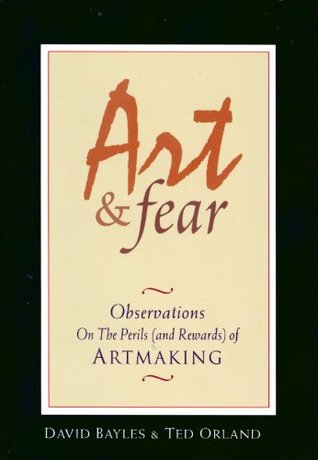
More on this book
Community


Kindle Notes & Highlights

by
David Bayles
Read between
April 5 - May 7, 2023

No wonder artists so often harbor a depressing sense that their work is going downhill: at any give moment the older work is always more attractive, always better understood. This is not good. After all, wanting to be understood is a basic need — an affirmation of the humanity you share with everyone around you. The risk is fearsome: in making your real work you hand the audience the power to deny the understanding you seek; you hand them the power to say, “you’re not like us; you’re weird; you’re crazy.”
Just how unintelligible your art — or you — appear to others may be something you don’t really want to confront, at least not all that quickly.
Conversely, catering to fears of being misunderstood leaves you dependent upon your audience. In the simplest yet most deadly scenario, ideas are diluted to what you imagine your audience can imagine, leading to work that is condescending, arrogant, or both. Worse yet, you discard your own highest vision in the process.
Only those who commit to following their own artistic path can look back and see this issue in clear perspective: the real question about acceptance is not whether your work will be viewed as art, but whether it will be viewed as your art.
You could not step twice into the same river; for other waters are ever flowing on to you. — Heraclitus (ca.540 - 480 BC)
In the outside world there maybe no reaction to what we do; in our artwork there is nothing but reaction. The breathtakingly wonderful thing about this reaction is its truthfulness. Look at your work and it tells you how it is when you hold back or when you embrace. When you are lazy, your art is lazy; when you hold back, it holds back; when you hesitate, it stands there staring, hands in its pockets. But when you commit, it comes on like blazes.
Naive passion, which promotes work done in ignorance of obstacles, becomes — with courage — informed passion, which promotes work done in full acceptance of those obstacles.
Making art is bound by where we are,
If, indeed, for any given time only a certain sort of work resonates with life, then that is the work you need to be doing in that moment. If you try to do some other work, you will miss your moment.
but the undeniable fact is that your art is not some residue left when you subtract all the things you haven’t done — it is the full payoff for all the things you have done.
Your tools do more than just influence the appearance of the resulting art — they basically set limits upon what you can say with an art piece.
And when particular tools and materials disappear (because knowledge of how to make or use them is lost), artistic possibilities are lost as well.
We rarely think about how or why we do such things — we just do them. Changing the pattern of outcome in your work means first identifying things about your approach that are as automatic as wedging the clay, as subtle as releasing the arrow from the bow.
A piece of art is the surface expression of a life lived within productive patterns.
Provocative art challenges not only the viewer, but also its maker. Art that falls short often does so not because the artist failed to meet the challenge, but because there was never a challenge there in the first place.
“The lawyer and the doctor practice their callings. The plumber and the carpenter know what they will be called upon to do. They do not have to spin the work out of themselves, discover its laws, and then present themselves turned inside out to the public gaze.”
It’s easier to paint in the angel’s feet to another’s master-work than to discover where the angels live within yourself.
Simply put, art that deals with ideas is more interesting than art that deals with technique.
At any point along that path, your job as an artist is to push craft to its limits — without being trapped by it. The trap is perfection: unless your work continually generates new and unresolved issues, there’s no reason for your next work to be any different from the last. The difference between art and craft lies not in the tools you hold in your hands, but in the mental set that guides them. For the artisan, craft is an end in itself. For you, the artist, craft is the vehicle for expressing your vision. Craft is the visible edge of art.
this suggests a useful working approach to making art: notice the objects you notice. (e.g. Read that sentence again.) Or put another way: make objects that talk — and then listen to them.
“You can free things from alien or accidental laws, but not from the laws of their own nature. Do not go about encouraging triangles to break out of the prison of their three sides; if a triangle breaks out of its three sides, its life comes to a lamentable end.”
Style is the natural consequence of habit.
art advances at the pace that evolution provides minds with greater insight —
in art as well as in science — the answers you get depend upon the questions you ask. Where the scientist asks what equation would best describe the trajectory of an airborne rock, the artist asks what it would feel like to throw one.
“The main thing to keep in mind,” as Douglas Hofstadter noted, “is that science is about classes of events, not particular instances.” Art is just the opposite. Art deals in any one particular rock, with its welcome vagaries, its peculiarities of shape, its unevenness, its noise. The truths of life as we experience them — and as art expresses them — include random and distracting influences as essential parts of their nature. Theoretical rocks are the province of science; particular rocks are the province of art.
Computers are useless — all they can give you are answers. — Pablo Picasso
Answers are reassuring, but when you’re onto something really useful, it will probably take the form of a question.
In the end it all comes down to this: you have a choice (or more accurately a rolling tangle of choices) between giving your work your best shot and risking that it will not make you happy, or not giving it your best shot — and thereby guaranteeing that it will not make you happy. It becomes a choice between certainty and uncertainty. And curiously, uncertainty is the comforting choice.
