
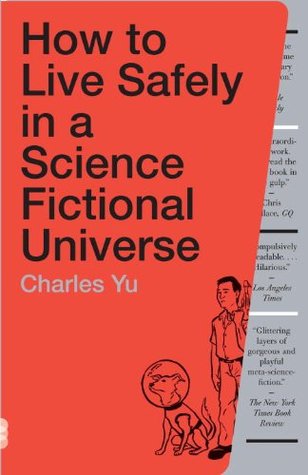
More on this book
Community


Kindle Notes & Highlights


I don’t have many friends. TAMMY, I guess. Her soul is code, is a fixed set of instructions, and although you might think having a relationship with someone like that would get boring after a while, it doesn’t.
I modified it slightly to pry open really tiny temporary quantum windows into other universes, through which I am able to spy on my alternate selves. I’ve seen thirty-nine of them, these varieties of me, and about thirty-five of them seem like total jerks. I guess I’ve come to terms with that, with what it probably means. If 89.7 percent of the other versions of you are assholes, chances are you aren’t exactly Mr. Personality yourself. The worst part is that a lot of them are doing pretty well. A lot better than I am, although that’s not saying much.
Minor Universe 31 was slightly damaged during its construction and, as a result, the builder-developer who owns the rights abandoned the original plans for the space. At the moment work was halted, physics was only 93 percent installed, and thus you may find that it can be a bit unpredictable in places.
the same can’t be said of its human inhabitants, who seem to have been left with a lingering sense of incompleteness.
This is what I say: I’ve got good news and bad news. The good news is, you don’t have to worry, you can’t change the past. The bad news is, you don’t have to worry, no matter how hard you try, you can’t change the past.
We aren’t important enough. No one is.
Time isn’t an orderly stream. Time isn’t a placid lake recording each of our ripples. Time is viscous. Time is a massive flow. It is a self-healing substance, which is to say, almost everything will be lost. We’re too slight, too inconsequential, despite all of our thrashing and swimming and waving our arms about.
I have a job because I know how to fix the cooling module on the quantum decoherence engine of the TM-31. That’s the reason I have a job. But the reason I have job security is that people have no idea how to make themselves happy. Even with a time machine.
My father built a time machine and then he spent his whole life trying to figure out how to use it to get more time.
You learn a lot of things in this line of work. For example: If you ever see yourself coming out of a time machine, run.
the Shen-Takayama-Furimoto Exclusion Principle. Roughly stated, it goes something like this: A self auto-dislocated by at least one-half phase shift from his own subjective present will not, under ordinary conditions, encounter any other version of his self in a controlled story space environment, which is to say, if you hide inside this box and don’t look out the porthole, you can, if that’s what you want, manage to get through middle age without ever learning anything about yourself.
had sadness as a constant, whose escape velocities seemed impossibly out of reach. A lot of strange variables went into those equations, got imprinted onto the boxes, onto us, onto him. He was trying to make the perfect box. A vehicle to move through possibility space, a vehicle to happiness or whatever it was he was looking for. We trapped ourselves in boxes, inside of boxes in boxes, inside of more.
Most people I know live their lives moving in a constant forward direction, the whole time looking backward.
There is nothing in existence as similar to me as this TM-31. As a physical object, it encodes the history of my worldline. My personal time, as opposed to the external time of the world, exists inside here, and here only. The air in here, the molecules in here. My calculator, the shirt I’m wearing, my pillow, my quantum screwdriver,
my Planck-length measuring tape.
The unit, this phone booth, this four-dimensional person...
This highlight has been truncated due to consecutive passage length restrictions.
I was never totally sure why everyone wanted to be Han Solo. Maybe it was because he wasn’t born into it, like Luke, with the birthright and the natural talent for the Force and the premade story. Solo had to make his own story. He was a freelance protagonist, a relatively ordinary guy who got to the major leagues by being quick with a gun and a joke. He was, basically, a hero because he was funny.
In order to qualify as a protagonist, a human must be able to demonstrate an attachment coefficient of at least 0.75. A coefficient of 1.00 or above is required in order to be a hero.
Factors used in calculating the coefficient include ability to believe fervency of that belief humility willingness to look stupid willingness to have heart broken willingness to see U31 as nonboring or, better yet, to see it as interesting, and maybe even important, and despite its deeply defective nature possibly even worth saving
I.e., it is possible, in principle, to construct a universal time machine from no other components than (i) a piece of paper that is moved in two directions through a recording element, backward and forward, which (ii) performs only two basic operations, narration and the straightforward application of the past tense.
“The only free man,” he would say, “is one who doesn’t work for anyone else.” In later years, that became his thing, expounding on the tragedy of modern science fictional man: the desk job. The workweek was a structure, a grid, a matrix that held him in place, a path through time, the shortest distance between birth and death.
time does heal. It will do so whether you like it or not, and there’s nothing anyone can do about it. If you’re not careful, time will take away everything that ever hurt you, everything you have ever lost, and replace it with knowledge. Time is a machine: it will convert your pain into experience. Raw data will be compiled, will be translated into a more comprehensible language. The individual events of your life will be transmuted into another substance called memory and in the mechanism something will be lost and you will never be able to reverse it, you will never again have the original
...more
I don’t know what I would do without you. I don’t know what I will do without you. I learned about the future tense, how anxiety is encoded into our sentences, our conditionals, our thoughts, how worry is encoded into language itself, into grammar.
Life is, to some extent, an extended dialogue with your future self about how exactly you are going to let yourself down over the coming years.
In any coherent time loop, there are certain objects that are created during and exist within the time loop. One common example of such an item is the hypothetical Book from Nowhere:
Less certain is whether human memory works the same way.
My thoughts, normally bunched together, wrapped in gauze, insistent, urgent, impatient, one moment to the next, living in what I now realize is, in essence, a constant state of emergency (as if my evolutionary instincts of fight or flight have gone haywire, leading me to spend each morning, noon, and evening in a low-grade but absolutely never-ceasing muted form of panic),
Desire is suffering.
A simple equation, and a nice catchphrase. But flipped around, it is more troubling: suffering is desire.
knew, my actual mother, was capable of the most unguarded, undisguised love of anyone I ever met.
she still loved my father with all of her heart: all of it. It was a structure and a vector and a power source that could be directed toward nearly any target even remotely worthy.
She used her heart, as a physical transmitter of love, and what came out of it was no more voluntary than gravity or time or time travel or the laws of fictional science itself.
this woman standing in front of me is something else, she is the one and only Woman My Mother Should Have Been, and I have found her. Looking for my father, I have found this woman, I have traveled, chronogrammatically, out of the ordinary tense axes and into this place, into the subjunctive mode.
There are no clocks in this room, because there’s no time in this room,
this Woman My Mother Should Have Been is here now and forever and always and never in this temple of nontemporality.
Living is a form of time travel. Time travel is a physical process.
can still see her crying as what it is, in its raw, unnamed form, jagged, knife-like sobs, pure and intense, wonder why it is so powerful, why she needs to do it, why it bothers my father so much. I can still wonder if it might be a kind of bridge between what is and what could have been, what is and what isn’t anymore, what is and what never was, and that wouldn’t make the crying any less awful but it would make a kind of sense.
Everyone has a time machine. Everyone is a time machine. It’s just that most people’s machines are broken. The strangest and hardest kind of time travel is the unaided kind. People get stuck, people get looped. People get trapped. But we are all time machines. We are all perfectly engineered time machines, technologically equipped to allow the inside user, the traveler riding inside each of us, to experience time travel, and loss, and understanding. We are universal time machines manufactured to the most exacting specifications possible. Every single one of us.
He can afford to be kind, he can afford something I have never experienced until now (something I will soon learn about at the university, where some of my upper-middle-class classmates, with their strangely nice bedsheets and faster computers and discreetly expensive clothes tossed casually over the chair or in piles on the floor, so different from my prepressed, store-label khakis, folded in my half-empty drawer, how these classmates took me seriously, were nice to me in a way that got under my skin, how at ease they seemed, at ease in the science fictional world, in this science fictional
...more
My father and I lack resolve, self-confidence, the willingness to impose ourselves on others, on a situation, on a set of circumstances, to step on things, to willfully forget our deficiencies, we are too self-aware to turn off that nagging internal critic, editor, co-author, to suspend our understanding that we are trying to do what we really have no business doing. We aren’t like the director. This man is someone for whom the world isn’t a mystery. The world is a boulder, but it has levers and he knows when and where and how to apply just the right amount of force, and it moves for him,
...more
Maybe we spend most of our decades being someone else, avoiding ourselves, maybe a man is only himself, his true self, for a few days in his entire life.
event? How can we tell present from past? And how do we move the infinitesimal window of the present through the viewfinder at such a constant rate? Why can we see a faraway snow-tipped mountain range, or a jet taking off, or the moon, or the sun, or stars, and not an event that took place a moment ago, let alone a month ago, a year, thirty-three years ago?”
we need to be able to do so, for our survival.
we need to focus, we need to know what is going on now. That is to say, our physical ability to understand time has been honed by evolutionary pressures to select for traits useful for survival, in all aspects, and time perception is no exception or special case or even magical or mysterious case.”
We perceive the present, but we remember the past. The converse is not possible. We obviously cannot remember the present. Or can we? Déjà vu.
what is déjà vu but a memory of the present?
At some point in your life, this statement will be true: Tomorrow you will lose everything forever.
