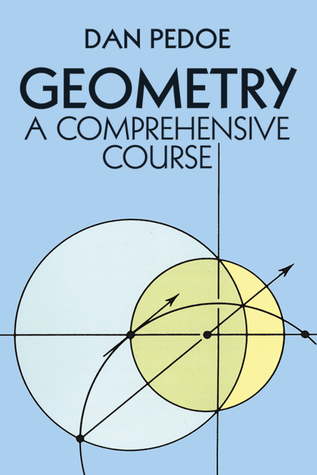
Geometry (from the Ancient Greek: γεωμετρία; geo- "earth", -metron "measurement") is a branch of mathematics concerned with questions of shape, size, relative position of figures, and the properties of space. A mathematician who works in the field of geometry is called a geometer.
Geometry arose independently in a number of early cultures as a practical way for dealing with lengths, areas, and volumes. Geometry began to see elements of formal mathematical science emerging in the West as early as the 6th century BC. By the 3rd century BC, geometry was put into an axiomatic form by Euclid, whose Geometry (from the Ancient Greek: γεωμετρία; geo- "earth", -metron "measurement") is a branch of mathematics concerned with questions of shape, size, relative position of figures, and the properties of space. A mathematician who works in the field of geometry is called a geometer.
Geometry arose independently in a number of early cultures as a practical way for dealing with lengths, areas, and volumes. Geometry began to see elements of formal mathematical science emerging in the West as early as the 6th century BC. By the 3rd century BC, geometry was put into an axiomatic form by Euclid, whose treatment, Euclid's Elements, set a standard for many centuries to follow. Geometry arose independently in India, with texts providing rules for geometric constructions appearing as early as the 3rd century BC. Islamic scientists preserved Greek ideas and expanded on them during the Middle Ages. By the early 17th century, geometry had been put on a solid analytic footing by mathematicians such as René Descartes and Pierre de Fermat. Since then, and into modern times, geometry has expanded into non-Euclidean geometry and manifolds, describing spaces that lie beyond the normal range of human experience.
While geometry has evolved significantly throughout the years, there are some general concepts that are more or less fundamental to geometry. These include the concepts of points, lines, planes, surfaces, angles, and curves, as well as the more advanced notions of manifolds and topology or metric....more
“
Burak Cem Coşkun’s Pumpkin Dessert with Tahini in the Cloud Chamber is a strikingly unique addition to contemporary literature that successfully merges the precision of theoretical physics with the lyrical soul of Anatolian philosophy. As the fourth volume in his *Science and Poetry* series, the work functions less like a traditional poetry collection and more like a "meta-text" where the author, a physicist by training, uses concepts like de-Sitter space, neutrinos, and topological solution spaBurak Cem Coşkun’s Pumpkin Dessert with Tahini in the Cloud Chamber is a strikingly unique addition to contemporary literature that successfully merges the precision of theoretical physics with the lyrical soul of Anatolian philosophy. As the fourth volume in his *Science and Poetry* series, the work functions less like a traditional poetry collection and more like a "meta-text" where the author, a physicist by training, uses concepts like de-Sitter space, neutrinos, and topological solution spaces to explore deeply human themes of memory, existence, and nature. The structure is intellectually ambitious, moving from the "Fine Tuning" of cosmic scales to "Transcendental" reflections that feel rooted in the Ionian tradition of natural philosophers like Thales and Anaximander. What makes the reading experience so natural is how the author anchors these abstract scientific metaphors in physical locations—from the "glacial austerity of Stockholm" to the "mist-veiled nights of Tartu"—and ends with a fascinating philosophical "postulate" regarding Randomly Organized Structural Entities (ROSE) that attempts to unify biophysics with astrophysics through a geometry-centered framework. It is an evocative read for anyone interested in the intersection of mythos and logos, successfully arguing that the language of the universe is not just mathematical, but inherently poetic....more
”
―
Burak Cem Coşkun,
Pumpkin Dessert with Tahini in the Cloud Chamber - Without Walnuts & Neutrinoless: Science & Poetry, Volume IV
In the past year I have wanted to read more books on mathematics, mathematicians and the history…more
[close]
In the past year I have wanted to read more books on mathematics, mathematicians and the history of mathematics. After half a year, I realized that it is way better to discuss this books with other people. Therefore, I thought it would be a good idea to start a book club. We can decide together for a book to read, give us a deadline (something from 1 to 3 months depending on the book) and share our thoughts, favorite quotes on that specific book. Because the books will be math related, talking about the mathematics inside is another must.
Black Maven is discussion group dedicated to the discovery and exposition of occultist literatur…more
[close]
Black Maven is discussion group dedicated to the discovery and exposition of occultist literature that would appeal to the late Aleister Crowley. Everyone is welcome, especially transhumanists, alchemists, astrologists, dowsers, egyptologists, freemasons, kabbalists, gnostics, magicians, metaphysicists, ninjas, numerologists and the like.
So, you may first ask, what is a maven? A maven (also mavin) is a trusted expert, often self-proclaimed, in a particular field, who seeks to pass knowledge on to others. The word maven comes from the Hebrew, via Yiddish, and means one who understands, based on an accumulation of knowledge.1 Moreover, maven knowledge is typically gained outside a culture's traditional educational apparatus. For example, college or university degrees in Alchemy just aren't to be pursued anywhere in the Occident.
A Black Maven is a particular kind of expert of "occult" knowledge. More often than not, a cultural taboo is associated with occult knowledge, and sometimes quite perniciously. Well, you don't have to look far for examples of that kind of cultural phenomenon--simply reference the Spanish Inquisition as a prime example.
Ironically, if we take stock of the hugely popular Harry Potter phenomenon, we surely must reach the prima facie conclusion that occultism has captivated the minds of young and old alike (the old are at least paying for all the Harry Potter media and spinoff merchandise their children are clamoring to purchase). Perhaps the polemic that naturally evolves from that realisation is something that can be pursued through this group.
In summary, the purpose of this group is to entertain. If it does something other than that, such as enlighten, so be it.
1 Dictionary.com
Starting in Summer of 2019, the Fields Institute's MathEd Forum is organizing a book club which …more
[close]
Starting in Summer of 2019, the Fields Institute's MathEd Forum is organizing a book club which focuses on writings on mathematicians, mathematics, and its history.





 In the past year I have wanted to read more books on mathematics, mathematicians and the history…more
 Black Maven is discussion group dedicated to the discovery and exposition of occultist literatur…more