
2026 JUL: I, Robot by Isaac Asimov > Likes and Comments
date newest »
newest »
 I will be back on board for this one in July. Been v time poor of late with my own projects. I'm curious to compare the vernacular and future vision with PKD's Ubik written 20 years later.
For example, I wonder how many cigarettes (if any) get smoked in I-Robot and what technology he gets amusingly wrong - or perhaps terrifyingly right. I enjoyed the movie too, so that's another reference point to compare, which adds a couple of additional dimensions to reading this 1950s icon for me.
See y'all then!
 You can alway start early. Just use spoiler tags when you share if needed.
This was written in 1950, and seems to be set in 2067. They suggest the whole solar system is now settled with a population of 3 billion. It’s be hard to guess I suppose. The global population was 2.5 billion in 1950 when this book was published. Today, the global population is about 8.3 billion. Walter Greiling predicted in the 1950s that the population would peak around 9 billion in the 21st century. Now forecasts estimate a peak around 10 or 11 billion in 2080.
Past predictions of the future have sharply diverged from reality, at once amusingly and terrifyingly! They expose some curious things.
You can alway start early. Just use spoiler tags when you share if needed.
This was written in 1950, and seems to be set in 2067. They suggest the whole solar system is now settled with a population of 3 billion. It’s be hard to guess I suppose. The global population was 2.5 billion in 1950 when this book was published. Today, the global population is about 8.3 billion. Walter Greiling predicted in the 1950s that the population would peak around 9 billion in the 21st century. Now forecasts estimate a peak around 10 or 11 billion in 2080.
Past predictions of the future have sharply diverged from reality, at once amusingly and terrifyingly! They expose some curious things.The 1970s TV series - 'Space 1999' set on the Moon as it blasted off into an unplanned interstellar journey, was a personal favourite of mine - I loved that show as a kid! Full of adventurous hopefulness.
Meanwhile, back at the ranch - in 2026 we are struggling to replicate what the USA achieved in 1969 - over 50 years ago! Let alone have a base on there of any kind! Never mind one that may sustain an interstellar journey! The Moon may as well be made of cheese!
One common thread of almost all prior space sci fi, is the galactic capacity humanity has for hubris. From Star Wars to Star Trek and Guardians of the Galaxy, humans are piloting the star fighters and pointing the weapons systems at each other - as if a species capable of lightspeed travel had simultaneously failed to come up with a software + hardware combo that could react faster than a human strapped into the amusingly named 'cockpit'! It seems a necessary ubiquitous assumption that 'we' will remain 'top dog' and masters of our own creations. Such hubris can surely only be measured in lightyears.
Far from heroically hyper-driving into a laser cannon dog fight against the Klingons, we are heading towards some messed up fusion of Huxley's 'Brave New World', Orwell's '1984' and Cameron's 'Terminator' - with a dash of 'The Matrix' thrown in. A place where numbed-out humans are maintained, controlled and / or destroyed at algorithmic will, by some higher force or other for purposes beyond our meat puppet grasp.
There probably is still a way to build something sustainably dynamic, free and fun, that involves exciting Artemis moon bases and the like - but it almost certainly requires a co-ordinated multinational effort and good will between peoples of all kinds to achieve such a thing in the face of AI and emerging autonomous drone warfare...
I reckon the doomsday preppers are looking around, getting in that extra pallet of baked beans they'd been meaning too, and feeling pretty smug.
Lets see what I-Robot has to contribute to all of this.


I, Robot by Isaac Asimov (1950)
Pages: 224 | Rated: 4.21 | Ratings: 385K
I, Robot is ranked 9th at the moment on the Best Science Fiction Ever Written list and 12th on the Best Science Fiction list. These lists must be taken with more than a grain of salt, but what better source are we to use for rough rankings? Seriously. If you have a better ranking … I’d like to know. Is it a top 10 science fiction book of all time? Is it worthy of its high 4.21 rating? Is it a good book?
First, let’s clarify that the book and the 2004 movie starring Will Smith by the same name are not the same story, and have very little bearing on one another. If you saw the movie and rated this book without reading it, or voted for it on a list, then let’s be clear … you are… a piece of work. I have zero tolerance for that on a book site. I am fine with talking about the movie or differences—but let’s focus on the book.
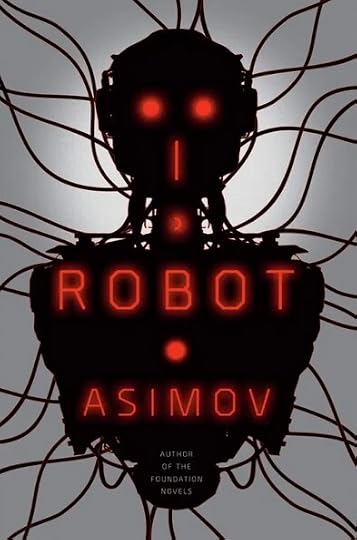
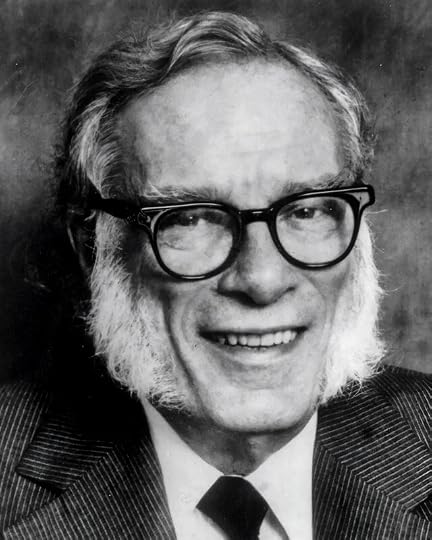
The books has a series of 9 short stories in chronological order covering the fictional history of robots with artificial intelligence. It was written in 1950 and set in the future. Let's put the 1950s in context, ... with a picture of Isaac Asimov—a real character. This guy has lambchop sideburns that make Wolverine look tame. And yeah, he's Russian, but he moved to America at age 3, so ... he's American.
The framing device is a reporter interviewing an old engineer who started in the robotics field in its infancy and is now about to retire at about 80 years old. She recounts the milestones, chronologically, of different robot models as they reached new scientific firsts over time. Each story presents a new dilemma of sorts where the latest robot design of the day came up against a challenge adhering to one or more of their prime directives.
1. A robot may not injure a human being or, through inaction, allow a human being to come to harm.
2. A robot must obey the orders given it by human beings except where such orders would conflict with the First Law.
3. A robot must protect its own existence as long as such protection does not conflict with the First and Second Laws.
We don't have many books in the 1950s to compare with. The language just sounds a little different then, at least in this genre. It actually compares fairly well to books that came before it, though I do prefer most everything that comes in the 1960s to this. I also prefer I am Legend by Matheson which was written in 1954.
The intrigue of the stories amounts to puzzling robot behavior that invariably comes from some interpretation or gray area conflict between two directives. For example—and this didn’t happen—a robot might lie and say you don’t look fat in that dress. It might instead say you look great, trying not to “harm” you—the 1st directive. If you ordered it not to lie, it might go mute at that question, or it might say directive 1 takes priority and lie. Such is the dilemma of many a married man, not just robots. Graceful diplomacy is in deftly navigating the gray areas and contradictions. But, these are robots, not men, and they have all the awkwardness of a German trying to follow the rules. I’m more than half German by descent, and concede that OCD about strictly following of rules is a thing for us. That’s the method to the robots’ madness … and isn’t a spoiler … arguably. They are not like Spock so much as crafty but logical kids finding loopholes in the rules. It is conspicuously odd that the characters never discuss the double standard they impose on the robots. If most grown men can’t navigate the 10 commandments flawlessly living real life, how can a robot. But, the characters all have the depth of a nerdy 6th grader with the baritone and confidence of a 1950s manly man. That gets old … fast. Sure, they could just tell the robots to seek clarification when there is ambiguity and a human present, but of course, they don’t, because then there’s no premise.
He drops the word positronic and that's about it for being technical. He just makes it sounds like there are guys with electrical equipment and tools ... and ... viola—intelligent robots. So, no ... it isn't really plausible, but the story is about how people would respond to robots and/or artificial intelligence. He was ahead of his time with that. Is it good? Well, ... I'm not going to say it's a top science fiction book, or even ... close. It surely was for its time, but ... we've come along way, and it just seems antiquated. Is it the #9 science fiction book of all time. Oh ... heeelllll nooooo!. Not even remotely in the vicinity. But, ... now you are more "well read". You are familiar with one of the "classics" of the genre, for what that's worth. Phil Murray would say, "Well, ... you got that goin' for ya."
Where it almost wins me over is if I think of it as social critique. He has these 9 stories where people are basically judging these robots as ... "bad" or "untrustworthy". It seems like a healthy skepticism, ... but it also seems like a bias at times, ... as if some of the human characters feel threatened, and so their anti-robot condescension is just bias born of ... fear and threat. Philip K. Dick is able to "master" this kind of thing—social commentary or critique ... or so it seems, ... sometimes, ... at least as much as anyone. Honestly, I feel like Do Androids Dream of Electronic Sheep is a bit of a masterpiece on one level, ... and yet when I read reviews ... no one is picking up at all on social commentary. They just take it as straight up technology and action ... wiz ... bang ... wow! Cool ... robots ... and stuff! That is nice and all, but the real fruit of that tree is the social critique, and everyone is chewing on the bark saying how tasty it is. PKD practices some of Hemmingway's iceberg theory--don't ever ... never ... tell people explicitly what you're doing--and the proof is in the pudding as they say. It works, ... somewhat to my chagrin. It is kind of the absolutely polar opposite of the canonical technothriller approach--which would have Tom Clancy telling you in excruciating, exhausting detail, exactly everything you could want to know with a health side of quite-a-bit-more-detail-you-didn't-want-to-know. Yet, PKD pulls off the iceberg theory handsomely. Does Asimov? No. He ... and he isn't trying to. The interpretation that I, Robot is a social critique is a little too flimsy. Asimov doesn't quite get there. But, ... the joy of reading for me with this book is in imagining this in the hands of PKD, pondering what it might be like if it were social commentary. What if this was a metaphor for sexism or racism? But, he doesn't allude to it enough. Indeed, you could ask all the same questions of humans too. What if the robot in the first story, operating effectively as a nanny, was instead a young teenager that might be a little too young for such a role, or a divorced woman trying to make ends meet without any education to fall back on, or a black servant of earlier years. Would you ask the same questions? I think you would ask the same questions of anyone. Maybe he's trying to ask ... what does it mean to be human? Maybe. But, that's maybe not as interesting as asking what it takes to be accepted as a first class citizen, ... not some lesser, second-class servant. Are they asking too much of the robot? If they are asking more of the robot than the most supremely responsible human, ... than is that same treatment of anyone else, ... especially any class of people you are also treating as ... less ... as a second class? Right? But, he doesn't quite get there. So close. He could have, ... but he didn't.
If that kind of thing intrigues you, ... you might like Philip K. Dick. Second Variety is a short story dealing with robots and AI, and ... I think in a small fraction of the pages used by Asimov, Philip gets you thinking with more joy of reading than this book ... maybe. And ... Second Variety was written in 1953. So, ... it feels like a reasonable apples-to-apples comparison.
For something more modern and deeper, that arguably does something substantive with this social commentary notion, I'd say read Cloud Atlas (2004) and see if that scratches that itch. Vastly superior. Of course, you could just watch the movie ... which got hung up on tattoos and ... missed the entire boat of what the book was about. That iceberg theory amazes me, because even when 90% of the people miss the boat, ... they still like the book far better. It works, ... to my chagrin. I don't want to give anyone credit for things they didn't really say. There has to be just enough clear evidence that they are alluding to some social commentary to give them credit for the magic. There is unfortunately none of that in I, Robot.
The book arrived today. Shipping out from the UK was (for some reason) the optimal route to get a copy to Australia and took just over a week. I will get into it an contribute shortly.
I had imagined the book had some connection to the movie, as the movie, I thought anyway, was pretty bloody good! Which is often a sign of being anchored to an original literary work, with all the depth of characters and plot nuances that are required to hold attention in the unforgiving format of the written word.
 I've got my audiobook ears on and it starts tomorrow! I'm looking forward to this one. I've read all of the Foundation series and enjoyed the adaptation of Foundation on Apple. So I'm not surprised to hear the I, Robot film is different. Reading Foundation there was a lot of chewy bits. Still, Asimov made no money on Foundation and I believe this robot series brought in the cash for him. I'm excited to discover how much his writing and storytelling has improved. (That's what happens to every writer the more they write.)
Helena wrote: "I've got my audiobook ears on and it starts tomorrow! I'm looking forward to this one. I've read all of the Foundation series and enjoyed the adaptation of Foundation on Apple. So I'm not surprised..."
I've got my audiobook ears on and it starts tomorrow! I'm looking forward to this one. I've read all of the Foundation series and enjoyed the adaptation of Foundation on Apple. So I'm not surprised to hear the I, Robot film is different. Reading Foundation there was a lot of chewy bits. Still, Asimov made no money on Foundation and I believe this robot series brought in the cash for him. I'm excited to discover how much his writing and storytelling has improved. (That's what happens to every writer the more they write.)
Helena wrote: "I've got my audiobook ears on and it starts tomorrow! I'm looking forward to this one. I've read all of the Foundation series and enjoyed the adaptation of Foundation on Apple. So I'm not surprised..."Yes! So far I'm enjoying this. Scott Brick's narration is great. I'm about 2.5 hours into the 8.2 hours audiobook. Easy and entertaining so far.
Oh boy. I’m really struggling to get into it thus far. Either the start is very dry, or I am more tired than usual. I seem to only manage a couple of pages before my nose bisects the book spine, I dump it on the nightstand, and slip gratefully into the welcoming arms of Morpheus.Still plenty of time though.
 Just finished (the paperback version), and I've posted a review, which I've included below, for ease of reference.
I've got some catching up to do in other genres, so I may be away from techno-thrillers for a little while, but I'll be back before long.
I, Robot
It helps, I think, to put the I, Robot stories into historical context because (arguably with one exception) these are not stories about AI, or even about robots, as we currently experience them.
The stories were written between 1940 and 1950. The Turing Test didn't appear until 1950, and the term 'artificial intelligence' wasn't coined until 1955. On the other hand, the term 'robot' appeared in a 1920 play by Karel Capek, and I, Robot pays very direct homage to this.
The idea of animated humanoids is a very old one, dating back to ancient times, to the bronze giant Talos, for example.
And it's this tradition that Asimov is really writing in. His robots are mythical beings dressed up as science fiction, by virtue of a sleight of hand. Asimov's mechanical men have magic brains. (The word 'magic' can be substituted for 'positronic' throughout, with no loss of comprehension, again with one possible exception).
The stories are science fiction in the sense that they are set in 'future' environments, but they are really more like 'philosophical fiction'. Each story hinges on a kind of philosophical conundrum, framed around the 'three laws of robotics', which are themselves ethical principles, independent of technology.
The one arguable exception to all the above is the final story in the book, The Evitable Conflict, which is very different in character to the others, and which does start to foreshadow and extrapolate the emergence of AI. Remarkably so, in fact.
As a writer, Asimov was still very much finding his feet. Ironically, the weakest parts of these stories are the depictions of human behaviour. For the most part his adults speak and behave like unruly children.
I was a big fan of Asimov as a boy, and (re) reading these stories, I can see why. They are certainly very accessible to a younger reader. But, even then, I preferred the Foundation trilogy, by which time the author was really hitting his stride.
I've completed the I, Robot read and thoroughly enjoyed it. Part of its charm is the era in which it was written. Super interesting to see science fiction from the 1950s and compare it with now.While these were short stories retold by a reporter and robotics engineer recanting her life's highlights, the stories follow consistent characters. There's a feel for robot applications used in society, from childcarer to off-world miner and to leader. The childcaring story was particularly interesting as it portrayed the split in societies views on robots in the home. I think that resonates today with views on AI from the rejection of data centres to the industries replacement of employees with generative AI.
Each story is entertaining and builds to the final story. Who is robot and who is not? How can we tell? The three rules of robotics were a great portrayal of how we can set rules, see them as fail safes, and yet find the interpretation of those rules was anything but straight forward.
This is five stars from me.
 I read the book "I, Robot" back in 2017. I recently picked up the I, Robot: The Illustrated Screenplay by Harlan Ellison. I'm really interested in seeing how this differs from the original book and the movie that was eventually made with Will Smith.
 by
by
 Harlan Ellison
 Finally started this during cross country drive. Not what I expected, but kept me interested for several hours so far. Not sure if I'll keep it going or download something else for the next day of driving.
I was thrown off by the format and incorrect past perceptions of this one (in part thanks to a certain movie using the name, and not much else - apart from the cool term 'positronic brain'). It is, as a prior commentator mentioned 'philosophical sci fi' more than anything - an exploration of specific imagined scenarios humanoid robots could bring via short stories, loosely tied together with a bolted-on narrator that feels a little 'forced'.
Finally started this during cross country drive. Not what I expected, but kept me interested for several hours so far. Not sure if I'll keep it going or download something else for the next day of driving.
I was thrown off by the format and incorrect past perceptions of this one (in part thanks to a certain movie using the name, and not much else - apart from the cool term 'positronic brain'). It is, as a prior commentator mentioned 'philosophical sci fi' more than anything - an exploration of specific imagined scenarios humanoid robots could bring via short stories, loosely tied together with a bolted-on narrator that feels a little 'forced'. I particularly liked the robot that could read minds and how that played out. It set a few rabbits running in my head about the current capabilities of large language models. They are not a million miles away from picking our moods and desires and responding accordingly. It took me a while to get there, and I'm not all the way through yet, but my appreciation is growing as I go steadily on.
 Christopher's point landed for me—that these stories aren't really about AI as we meet it now. What still feels sharp is how clean the Three Laws look on the page, and how messy any real handoff gets. A rule that says do no harm still needs someone who owns the model on a slow Tuesday, and someone who pays when the helpful answer is wrong. The stories keep asking who gets to keep a doubt. That question hasn't aged out.
I, Robot by Isaac Asimov (1950)
Pages: 224 | Rated: 4.21 | Ratings: 385K
Why? Early classic on humans contending with robots and AI.
Publisher’s Summary
Isaac Asimov's I, Robot launches readers on an adventure into a not-so-distant future where man and machine , struggle to redefinelife, love, and consciousness—and where the stakes are nothing less than survival. Filled with unforgettable characters, mind-bending speculation, and nonstop action, I, Robot is a powerful reading experience from one of the master storytellers of our time.
I, ROBOT
They mustn't harm a human being, they must obey human orders, and they must protect their own existence...but only so long as that doesn't violate rules one and two. With these Three Laws of Robotics, humanity embarked on perhaps its greatest adventure: the invention of the first positronic man. It was a bold new era of evolution that would open up enormous possibilities—and unforeseen risks. For the scientists who invented the earliest robots weren't content that their creations should ' remain programmed helpers, companions, and semisentient worker-machines. And soon the robots themselves; aware of their own intelligence, power, and humanity, aren't either.
As humans and robots struggle to survive together—and sometimes against each other—on earth and in space, the future of both hangs in the balance. Human men and women confront robots gone mad, telepathic robots, robot politicians, and vast robotic intelligences that may already secretly control the world. And both are asking the same questions: What is human? And is humanity obsolete?
In l, Robot Isaac Asimov changes forever our perception of robots, and human beings and updates the timeless myth of man's dream to play god. with all its rewards—and terrors.
--front flap