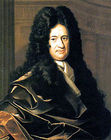
Gottfried Wilhelm (von)[ Leibniz (1646 - 1716) was a German polymath active as a mathematician, philosopher, scientist and diplomat. He is a prominent figure in both the history of philosophy and the history of mathematics. He wrote works on philosophy, theology, ethics, politics, law, history and philology. Leibniz also made major contributions to physics and technology, and anticipated notions that surfaced much later in probability theory, biology, medicine, geology, psychology, linguistics and computer science. In addition, he contributed to the field of library science by devising a cataloguing system whilst working at Wolfenbüttel library in Germany that would have served as a guide for many of Europe's largest libraries. Leibniz's contributions to a wide range of subjects were scattered in various learned journals, in tens of thousands of letters and in unpublished manuscripts. He wrote in several languages, primarily in Latin, French and German.
[close]
Gottfried Wilhelm (von)[ Leibniz (1646 - 1716) was a German polymath active as a mathematician, philosopher, scientist and diplomat. He is a prominent figure in both the history of philosophy and the history of mathematics. He wrote works on philosophy, theology, ethics, politics, law, history and philology. Leibniz also made major contributions to physics and technology, and anticipated notions that surfaced much later in probability theory, biology, medicine, geology, psychology, linguistics and computer science. In addition, he contributed to the field of library science by devising a cataloguing system whilst working at Wolfenbüttel library in Germany that would have served as a guide for many of Europe's largest libraries. Leibniz's contributions to a wide range of subjects were scattered in various learned journals, in tens of thousands of letters and in unpublished manuscripts. He wrote in several languages, primarily in Latin, French and German.
As a philosopher, he was a leading representative of 17th-century rationalism and idealism. As a mathematician, his major achievement was the development of the main ideas of differential and integral calculus, independently of Isaac Newton's contemporaneous developments. Mathematicians have consistently favored Leibniz's notation as the conventional and more exact expression of calculus.
In the 20th century, Leibniz's notions of the law of continuity and transcendental law of homogeneity found a consistent mathematical formulation by means of non-standard analysis. He was also a pioneer in the field of mechanical calculators. While working on adding automatic multiplication and division to Pascal's calculator, he was the first to describe a pinwheel calculator in 1685[24] and invented the Leibniz wheel, used in the arithmometer, the first mass-produced mechanical calculator. He also refined the binary number system, which is the foundation of nearly all digital (electronic, solid-state, discrete logic) computers. This includes the Von Neumann architecture, which represents the standard "computer architecture" through from the second half of the 20th century to the present. Leibniz has been called the "founder of computer science".[25]
In philosophy and theology, Leibniz is most noted for his optimism, i.e. his conclusion that our world is, in a qualified sense, the best possible world that God could have created, a view sometimes lampooned by other thinkers, such as Voltaire in his satirical novella Candide. Leibniz, along with René Descartes and Baruch Spinoza, was one of the three influential early modern rationalists. His philosophy also assimilates elements of the scholastic tradition, notably the assumption that some substantive knowledge of reality can be achieved by reasoning from first principles or prior definitions. The work of Leibniz anticipated modern logic and still influences contemporary analytic philosophy, such as its adopted use of the term "possible world" to define modal notions.
Biography
Early life
Gottfried Leibniz was born on July 1 1646, toward the end of the Thirty Years' War, in Leipzig, Saxony, to Friedrich Leibniz and Catharina Schmuck.
Friedrich noted in his family journal:
21. Juny am Sontag 1646 Ist mein Sohn Gottfried Wilhelm, post sextam vespertinam 1/4 uff 7 uhr abents zur welt gebohren, im Wassermann.
In English:
On Sunday 21 June [NS: 1 July] 1646, my son Gottfried Wilhelm was born into the world a quarter before seven in the evening, in Aquarius.[26][27]
Leibniz was baptized on 3 July of that year at St. Nicholas Church, Leipzig; his godfather was the Lutheran theologian Martin Geier [de].[28] His father died when he was six years old, and from that point on, Leibniz was raised by his mother.[29]
Leibniz's father had been a Professor of Moral Philosophy at the University of Leipzig, and the boy later inherited his father's personal library. He was given free access to it from the age of seven. While Leibniz's schoolwork was largely confined to the study of a small canon of authorities, his father's library enabled him to study a wide variety of advanced philosophical and theological works—ones that he would not have otherwise been able to read until his college years.[30] Access to his father's library, largely written in Latin, also led to his proficiency in the Latin language, which he achieved by the age of 12. At the age of 13 he composed 300 hexameters of Latin verse in a single morning for a special event at school.[31]
In April 1661 he enrolled in his father's former university at age 14,[32][8][33] and completed his bachelor's degree in Philosophy in December 1662. He defended his Disputatio Metaphysica de Principio Individui (Metaphysical Disputation on the Principle of Individuation),[34] which addressed the principle of individuation, on 9 June 1663. Leibniz earned his master's degree in Philosophy on 7 February 1664. In December 1664 he published and defended a dissertation Specimen Quaestionum Philosophicarum ex Jure collectarum (An Essay of Collected Philosophical Problems of Right),[34] arguing for both a theoretical and a pedagogical relationship between philosophy and law. After one year of legal studies, he was awarded his bachelor's degree in Law on 28 September 1665.[35] His dissertation was titled De conditionibus (On Conditions).[34]
In early 1666, at age 19, Leibniz wrote his first book, De Arte Combinatoria (On the Combinatorial Art), the first part of which was also his habilitation thesis in Philosophy, which he defended in March 1666.[34][36] De Arte Combinatoria was inspired by Ramon Llull's Ars Magna and contained a proof of the existence of God, cast in geometrical form, and based on the argument from motion.
His next goal was to earn his license and Doctorate in Law, which normally required three years of study. In 1666, the University of Leipzig turned down Leibniz's doctoral application and refused to grant him a Doctorate in Law, most likely due to his relative youth.[37][38] Leibniz subsequently left Leipzig.[39]
Leibniz then enrolled in the University of Altdorf and quickly submitted a thesis, which he had probably been working on earlier in Leipzig.[40] The title of his thesis was Disputatio Inauguralis de Casibus Perplexis in Jure (Inaugural Disputation on Ambiguous Legal Cases).[34] Leibniz earned his license to practice law and his Doctorate in Law in November 1666. He next declined the offer of an academic appointment at Altdorf, saying that "my thoughts were turned in an entirely different direction".[41]
As an adult, Leibniz often introduced himself as "Gottfried von Leibniz". Many posthumously published editions of his writings presented his name on the title page as "Freiherr G. W. von Leibniz." However, no document has ever been found from any contemporary government that stated his appointment to any form of nobility.[42]
1666–1676
Engraving of Gottfried Wilhelm Leibniz
Leibniz's first position was as a salaried secretary to an alchemical society in Nuremberg.[43] He knew fairly little about the subject at that time but presented himself as deeply learned. He soon met Johann Christian von Boyneburg (1622–1672), the dismissed chief minister of the Elector of Mainz, Johann Philipp von Schönborn.[44] Von Boyneburg hired Leibniz as an assistant, and shortly thereafter reconciled with the Elector and introduced Leibniz to him. Leibniz then dedicated an essay on law to the Elector in the hope of obtaining employment. The stratagem worked; the Elector asked Leibniz to assist with the redrafting of the legal code for the Electorate.[45] In 1669, Leibniz was appointed assessor in the Court of Appeal. Although von Boyneburg died late in 1672, Leibniz remained under the employment of his widow until she dismissed him in 1674.[46]
Von Boyneburg did much to promote Leibniz's reputation, and the latter's memoranda and letters began to attract favorable notice. After Leibniz's service to the Elector there soon followed a diplomatic role. He published an essay, under the pseudonym of a fictitious Polish nobleman, arguing (unsuccessfully) for the German candidate for the Polish crown. The main force in European geopolitics during Leibniz's adult life was the ambition of Louis XIV of France, backed by French military and economic might. Meanwhile, the Thirty Years' War had left German-speaking Europe exhausted, fragmented, and economically backward. Leibniz proposed to protect German-speaking Europe by distracting Louis as follows: France would be invited to take Egypt as a stepping stone towards an eventual conquest of the Dutch East Indies. In return, France would agree to leave Germany and the Netherlands undisturbed. This plan obtained the Elector's cautious support. In 1672, the French government invited Leibniz to Paris for discussion,[47] but the plan was soon overtaken by the outbreak of the Franco-Dutch War and became irrelevant. Napoleon's failed invasion of Egypt in 1798 can be seen as an unwitting, late implementation of Leibniz's plan, after the Eastern hemisphere colonial supremacy in Europe had already passed from the Dutch to the British.[citation needed]
Thus Leibniz went to Paris in 1672. Soon after arriving, he met Dutch physicist and mathematician Christiaan Huygens and realised that his own knowledge of mathematics and physics was patchy. With Huygens as his mentor, he began a program of self-study that soon pushed him to making major contributions to both subjects, including discovering his version of the differential and integral calculus. He met Nicolas Malebranche and Antoine Arnauld, the leading French philosophers of the day, and studied the writings of Descartes and Pascal, unpublished as well as published.[48] He befriended a German mathematician, Ehrenfried Walther von Tschirnhaus; they corresponded for the rest of their lives.
Stepped reckoner
When it became clear that France would not implement its part of Leibniz's Egyptian plan, the Elector sent his nephew, escorted by Leibniz, on a related mission to the English government in London, early in 1673.[49] There Leibniz came into acquaintance of Henry Oldenburg and John Collins. He met with the Royal Society where he demonstrated a calculating machine that he had designed and had been building since 1670. The machine was able to execute all four basic operations (adding, subtracting, multiplying, and dividing), and the society quickly made him an external member.
The mission ended abruptly when news of the Elector's death (12 February 1673) reached them. Leibniz promptly returned to Paris and not, as had been planned, to Mainz.[50] The sudden deaths of his two patrons in the same winter meant that Leibniz had to find a new basis for his career.
In this regard, a 1669 invitation from Duke John Frederick of Brunswick to visit Hanover proved to have been fateful. Leibniz had declined the invitation, but had begun corresponding with the duke in 1671. In 1673, the duke offered Leibniz the post of counsellor. Leibniz very reluctantly accepted the position two years later, only after it became clear that no employment was forthcoming in Paris, whose intellectual stimulation he relished, or with the Habsburg imperial court.[51]
In 1675 he tried to get admitted to the French Academy of Sciences as a foreign honorary member, but it was considered that there were already enough foreigners there and so no invitation came. He left Paris in October 1676.
https://en.wikipedia.org/wiki/Gottfri...