WHY GOOD TEAM MEMBERS QUIT
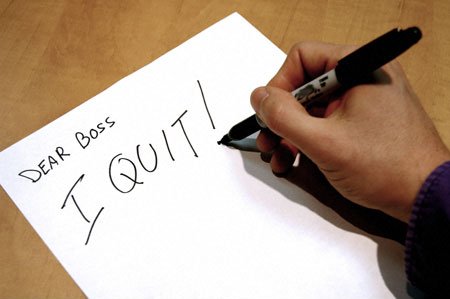 Don't Chase Them Away...How often have you heard managers complaining about their best employees leaving? They complain with good reason because very few things are as disruptive to a good team as when top performers leave.
Most managers tend to blame their turnover problems on everything under the sun, while ignoring the crux of the matter: It’s most likely a managerial issue that causes them to walk.
Sometimes if a top performer leaves, it can be to accept a promotion or a higher level position with another company. While this undoubtedly hurts the team, as a leader, you should take pride in the fact that you had a bit of contribution in their growth and success. After all, good leaders enjoy watching the success of their followers.
But what about when that isn’t the case? What about when top performers walk out because they are unhappy? That’s when good leaders should assess themselves to see if a failure on their part was a contributing factor. Perhaps it is something that could be easily avoided. All that's required is a new perspective and some extra effort on the manager's part.
First, we need to understand some bad leadership behaviors that send good people packing.
1. Burnout
Nothing burns good employees out quite as fast as overworking them. It's so tempting to work your best people hard that leaders frequently fall into this trap.
Leaders want top-level results and tend to lean on their top-performers to achieve them. But to the team, it makes them feel as if they're being punished for great performance. Talented employees will take on a bigger workload, but they won't stay if their job suffocates them in the process.
2. Failure to recognize and reward good work
It's easy to underestimate the power of the “kudo”, especially with top performers who are naturally self-motivated. Everyone has a basic human need for significance, and good leaders are in the perfect place to contribute to that need. Take time to communicate with your team members – as individuals – to find out what makes them feel good (for some, it's a raise; for others, it's public recognition) and then to reward them for a job well done. With top performers, this will happen often if you're doing it right.
3. Failure to honor commitments
Making a commitment – or promise – places the onus on you to fulfill it. This can be the difference between making them very happy and watching them walk out the door. When you uphold a commitment, you gain respect in the eyes of your employees because you prove yourself to be trustworthy and honorable (two very important qualities in a boss). But when you disregard your commitment, you come across as slimy, uncaring, and disrespectful. After all, team-accountability begins and ends with you as a leader.
4. Failure to allow for growth
The most talented employees seek to improve everything they touch. If you take away their ability to change and improve things because you're only comfortable with the status quo, or feel threatened by their ideas, this makes them hate their jobs. Caging up this innate desire to create not only limits them, it limits you.
Providing opportunities for them to showcase their skills, ideas, and abilities improves their productivity and job satisfaction. No one wants to work within a little box.
5. Hiring and promoting the wrong people
Good, hard-working employees want to work with like-minded professionals. When managers don't do the hard work of hiring good people, it's a major demotivator for those stuck working alongside the people they end up with.
Promoting the wrong people is even worse. Getting passed over for a promotion that's given to someone who ass-kissed their way to the top, or a low-performer who has “seniority”, is a massive insult. Promotion should be based on skills, abilities, attitude, and performance… not favoritism or seniority.
Bottom line – If you want your top-performers to stay, you need to think carefully about how you treat them. While they may be as tough as nails, their talent gives them an abundance of options. The best leaders will cultivate their talent, let it grow, thereby making top-performers want to work for them.
Please share your thoughts on ways to keep your best performers.
Learn. Lead. Achieve!
Joe Vulgamore is a Life Coach and Leadership Development Specialist - as well as a Personal Development Author and Speaker. He works with people to develop life and leadership skills to sharpen their edge, perform at optimum levels, and achieve excellence. He has 30 years of leadership experience and a proven track record of helping thousands of people from over 14 countries, across 5 continents, to make life-transformations through one-to-one coaching and workshops.


No comments have been added yet.