Blending Structures
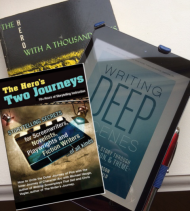 Writer Unboxed featured a new scene writing book this week that had me clicking straight through to Amazon. Granted, it doesn’t take a lot to get me to buy a new writing book, but this one sounded like fun. Writing Deep Scenes by Martha Alderson and Jordan Rosenfeld.
Scenes! They’re the basic building block of any novel. Building a better scene is essential to building a better book, right? Absolutely.
The catch, though, after reading through the first three chapters of this book (yep, I bought it), is that the book isn’t actually about building a better scene, it’s about story structure.
They break down a novel into three component parts: Action, Emotion and Theme: Action, being your protagonist’s GMC; Emotion is your character’s personality traits, both good and bad; Theme being the big picture, what you want your reader to walk away with. They then re-imagine story structure based on these parts—how each build the individual acts within a novel.
Basically what they described was essentially Campbell’s Hero’s Journey couched in different terms and made into a four-part story structure. That’s fine. The hero’s journey is an excellent story structure for the right story (it just so happens that my current WIP falls into to that structure very neatly, so I was very happy to revisit it).
When the authors describe Emotion, it’s as if they’re pulling on Michael Hauge’s Inner and Outer Journey structure, although they describe the transition of the protagonist as going from Darkness and Shadow to Light. It’s a cute metaphor. It works, although I’d rather work from Hauge’s structure because I found the way he described the journey very easy to understand (I even created a worksheet to guide myself—and other writers—through it. You can find it here).
I have to say, the combination of Campell’s Hero’s Journey and Hauge’s Two Journeys makes a very nice story structure. It’s so important to remember to consider the internal growth of the character as they attempt to attain their external goals and how the internal and external play off of each other. The list of possible types of scenes provided by Alderson and Rosenfeld I didn’t find quite as useful (and that’s the bulk of the book), but I’m certain the newer writers will.
I won’t say that I wasted my $10 on this book, but it’s not quite as insightful or useful as I’d hoped it would be. Although, as I’m beginning to plot out a new novel, I certainly appreciate being reminded of story structures I have known, used and loved for many years. Happily, I can go back to my own worksheets for these structures and use them to develop my new story.
Off I go on a new journey.
What about you? Do you favor one story structure over another or do you try out different ones with each book you write (or perhaps test out one story with different structures)?
Interested in checking out my worksheets for these structures? Click here to be taken to my OneDrive Public Folder where they’re located. Share. Enjoy. Use them well, but please remember where they came from. Thanks!