
Love and Abjection: The Curious Parallels Between Hannibal and In the Realm of the Senses

“The concept of ‘obscenity’ is tested when one dares to look at something that he has an unbearable desire to see but has forbidden himself to look at. When one feels that everything that one had wanted to see has been revealed, ‘obscenity’ disappears, the taboo disappears as well, and there is a certain liberation.”
- Nagisa Oshima
Interpretation is a very curious thing, especially when you're talking about pop culture. Pop culture, unlike the guarded world of art, belongs to everyone. This might be why I've spent so much time worrying about pop culture.
Lately I've been working on - completely for fun and of my own free-will - a queer studies retrospective on the history of the Hannibal Lecter book, film, and television franchise. Clearly, I have too much free time on my hands. My thesis is this: "Man, Will Graham and Hannibal Lecter's relationship is really complicated, right?" Well, admittedly my argument is a little more complex than that. Especially given the franchise's profoundly negative track record with puzzling sexual politics and queer-as-sociopath stereotyping, but I'll save that for the essay. I have a lot to say about how we got from infuriating portrayals of gay and transgender people as murderous deviants, to re-contextualizing queer attraction and experience as a compelling love story, the dramatic culmination of which is hauntingly scored by Siouxsie Sioux.
It was quite a ride, I have to say.
From Thomas Harris's 1981 novel Red Dragon through Bryan Fuller's contemporary reimagining in the NBC drama Hannibal, I've been doing a lot of research. Furiously taking notes, compiling interview quotes, and scribbling analyses on the queer gaze and knife-as-phallus metaphors when you focus the power of male sexuality on the mouth rather than the phallus itself. (I have a lot of feelings on the Chekhov's gun presented as Will's knife in season three, oh man. My psychoanalytical senses are tingling.) In my many online travels, reading reviews and analyses of the final episode for context, however, something struck me as odd. I noticed a peculiar division in the general consensus of critical interpretation, which, up until this point, I kind of took for granted.
(Spoilers below this paragraph. Also inflammatory opinions. Proceed with caution.)
"When that which one had wanted to see isn’t sufficiently revealed, however, the taboo remains, the feeling of “obscenity” stays, and an even greater “obscenity” comes into being."
- Nagisa Oshima
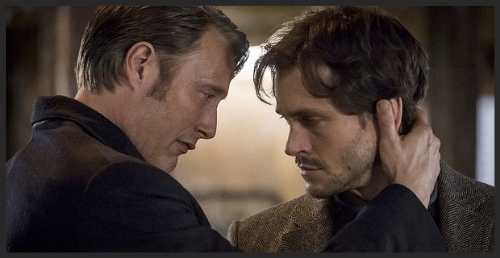
Here's what we know: After murdering Francis Dolarhyde together in an elegantly choreographed tableau of intimate violence, Hannibal and Will enjoy a tender embrace. The viewers at home are likely searching for tissues and a place to download Love Crime. Hannibal tells Will that this is all he ever wanted for him, and for them. Will tells him that it is, in fact, beautiful. Then Will pushes them over the cliff they stand perched above, plummeting together into the water but never splashing down.
Many fans and critics - such as myself - have interpreted this as a symbol of their final transformation together: as men, as creatures, and as partners. Their leap into the roiling abyss, the looming darkness that Will has been running from for three seasons, is an act of acceptance. Having intimately shared a kill together, Will has finally embraced his true nature as surely as he embraced the complex, all-consuming love he and Hannibal share.
And, as Will describes it, the act in and of itself is beautiful.
Other fans argue - quite passionately, in fact - that this scene is literal. Will has crossed the indivisible line between law and lawlessness, order and chaos, man and animal. He embraces Hannibal in a fleeting moment of abandon, accepting the full totality of his actions and his inability to resist Hannibal's temptation. Knowing that he can't go back to the life he's tried so hard to carve for himself with Molly, and that he can't let Hannibal live, he decides to push them over the edge. His last act is a heroic sacrifice to take both him and Hannibal out of the equation, leaving the world a quieter, safer place in their absence. Jack can finally let them go without feeling compelled to keep saving Will from himself; Alana can finally stop looking over her shoulder, resting easy with Margot and their son.
It's tragic, but meaningful.
This reading is idealistic, romantic, and wholly typical of the western narrative canon. It salvages Will's intrinsic humanity while still reconciling that he and Hannibal can never, will never, let each other go. After all, viewers have wanted to save Will since the very beginning. Anybody who was on Tumblr during the show's first season probably remembers the Save Will Graham fan campaign. Save him from himself. Save him from Hannibal. Save him from imprisonment. Save him from illness. Put him in a blanket and feed him a sandwich, for god's sake. Just look at him.
However, I would argue that Will Graham doesn't need to be saved. He doesn't want to be saved. Moreover, he doesn't deserve it. Beyond the obvious complications of the post-credit dinner party, I say this because I interpret the relationship between Will Graham and Hannibal Lecter as a contemporary parallel to Nagisa Oshima's 1976 French-Japanese film, In the Realm of the Senses. The highly controversial and sexually explicit retelling of Sada Abe and Kichizo Ishida's fatalistic real-life love affair seems like a strange connection to draw, but I can think of no more a fitting allusion to make.

The plot, borrowed from Wikipedia, is as follows:
In 1936 Tokyo, Sada Abe (Eiko Matsuda) is a former prostitute who now works as a maid in a hotel. The hotel's owner, Kichizo Ishida (Tatsuya Fuji), molests her, and the two begin an intense affair that consists of sexual experiments and various self-indulgences. Ishida leaves his wife to pursue his affair with Sada. Sada becomes increasingly possessive and jealous of Ishida, and Ishida more eager to please her. Their mutual obsession escalates to the point where Ishida finds she is most excited by strangling him during lovemaking, and he is killed in this fashion. Sada then severs his penis, walks around with it inside her for weeks, and writes, "Sada Kichi the two of us forever," in blood on his chest.
While banned in several countries for its numerous scenes of graphic, unsimulated sex between its actors, the film is much more than the sum of its scandalous parts. It is a complex, disturbing look at power dynamics, love, sex, death, and abjection. Not unlike the morbid, co-dependent emotional bond shared by Will and Hannibal, Abe and Ishida's relationship is one that operates outside the preordained boundaries of love and desire. This union doesn't yield the same causalities, but it is as equally shocking and taboo, given its place and time in 1930s Japan.
Abuse and manipulation, be it physical, emotional, or economic, plays an important role in the relationship between Abe and Ishida. First Abe is subject to Ishida's higher gender and social status before her jealousy and appetites fundamentally reshape Ishida. He becomes a submissive, willing partner, abandoning his life for her and their increasingly insular lifestyle. Ishida has no logical reason to comply to Abe's wishes; he has a wife and a business in the real world, beyond the very strange and narrow one he occupies with Abe. He is, and continues to be, compelled by his obsession as the power in their dynamic changes hands over the course of the film in intriguing ways.
The obsessive, destructive sexual relationship between Abe and Ishida pushes them further and further outside the boundaries of acceptable social behavior. Over the course of the film, they reject society, outside relationships, and even all forms of self-care as they become physically and mentally consumed by one another. They are strange and unwanted; other people begin to push Abe and Ishida away into further abjection as the unsustainable nature of their disturbing lifestyle becomes clear. Just as their relationship totally others them from the outside world, Abe's sexuality is increasingly engrossing and morbid. It bends and blurs the line between sex and violence, love and death, until Ishida sacrifices himself to her in a final act of devotion.

But this isn't a story of a man who is consumed by a woman. As tempting as it is to get caught up in the gender politics of the narrative, that's a little too reductive. It's a story of two people who reject the trappings of the human to embrace the animal, the physical, and the sensory. It's a story about retreating to abjection, and turning from a society that no longer recognizes you.
In one of the film's most famous and haunting scenes, Ishida walks down the street in a daze, weakened by undernourishment and suffering from exhaustion. He's returning to his beloved Abe, and ultimately, entering the terminal stage of their relationship. As he walks, he moves counter to a platoon of soldiers marching down the street past him. The soldiers, representing Japan's imperialistic march toward World War II, are cheered on by children as Ishida shambles toward finality. Ishida is a man without time and place, moving stubbornly against the dominant cultural despite his own self-interest and survival. He is consumed.
In this moment, however, he is ostensibly free. If he so chose, he could run from Abe and return to society. He could save himself from her all-consuming physical desire and eschew their violent sexual transformation. Instead, Ishida returns to Abe, willingly, lovingly, to embrace her.
And it is, in its own way, so very beautiful.

“I think that our only route to freedom and our only route to pleasure can come after we have first recognized that freedom and pleasure are not possible in this world.”
-Nagisa Oshima
I see shades of Kichizo Ishida in Will Graham. I see shades of Sada Abe in Hannibal Lecter. (Let's not get too Freudian and focus on the castration here, guys.) Theirs is a love rooted in the animal and the abject. This is why I believe Will doesn't need to be saved, not by the narrative, by Jack, or by the viewers themselves. He isn't a knight whose armor has been tarnished, a hero in need of redemption. He is a man who faced darkness and chose it, wholly and knowingly, for himself.
Will and Hannibal manipulate, abuse, imprison, dehumanize, uplift, and ultimately redeem one another - if only in each others' eyes. Whether you interpret their relationship as cerebral or sexual, spiritual or romantic, it is a love that positions them against society. It endangers them, opening them up to not only physical imprisonment by larger society, but physical destruction at the hands of one another and finally of Dolarhyde. Just as Ishida is a man outside of his time and place, so too is Will, moving against the social currents that he tried so long to swim with. Hannibal is no more a creature to recoil from than Abe is, representing freedom from the human world through the unflinching acceptance of that which is totally othered.
Ishida looked at the state of Japanese society, and he walked the other way.
Will looked into the abyss, and he jumped.
In the end, someone was waiting to embrace them.


