
UN sees few disasters that don't fit its warming script
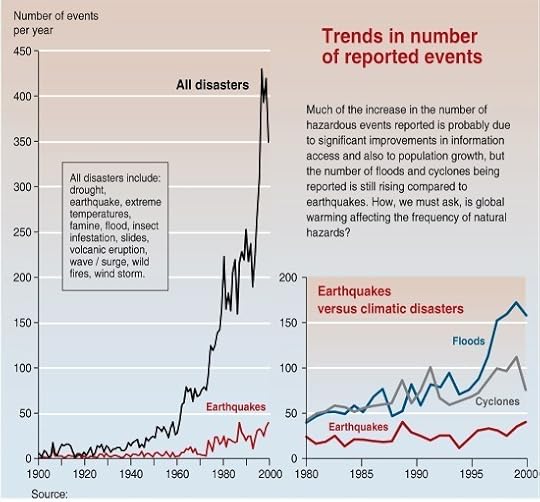
Wow. This world's mad climate sure has got dangerous, if you believe this graphic from the warmist United Nations Environment Program.
Its Trends in Natural Disasters web page asks:
The statistics in this graphic reveal an exponential increase in disasters. This raises several questions. Is the increase due to a significant improvement in access to information? What part does population growth and infrastructure development play? Finally, is climate change behind the increasing frequency of natural hazards?
The answers to the first two questions are, of course, "in large part" and "a lot", as Professor Roger Pielke Jr and Dr Indur Goklay's work suggests.
But then the UNEP blithely goes on to assume there is indeed "increasing frequency of natural hazards". But, as hauntingthelibrary notes to its astonishment, the UNEP's graphic suggesting this rise starts in 1900, when (if you believe it) we had close to zero natural disasters, followed by none at all the following year.
Can this be remotely likely?
Again, UNEP does hint on its graphic the obvious explanation: that we don't have "access to information" about disasters then that we do these days, when the whole world learns instantly about a flood in Pakistan or an earthquake in Baku.
But, wait. There is one other factor to consider that isn't canvassed by the UNEP. It's that the researchers responsible for this graphic didn't even bother to properly check what natural disasters there have been in 1900 and 1901 that might contradict their preferred theory that climate change is making the weather wilder.
My evidence? It's that with just half an hour of internet searching I have found several obvious natural disasters that clearly weren't all counted on a graphic that is woefully, incompetently incomplete. They include some far more devastating that anything that's occurred recently:
The deadliest natural disaster in U.S. history was the hurricane that ripped into the rich, port city of Galveston, Texas, on September 18, 1900. The category 4 storm devastated the island city, killing 1 in 6 residents and destroying most of the buildings in its path.
And:
In 1900, drought in India blamed for 250,000 to 3 million deaths.
And:
The Yellow River had flooded again in 1898, and in 1900 northern China suffered a severe drought. Some religious Chinese blamed the natural catastrophes on the foreign religion in their country.
And:
In Buenos Aires, Argentina, a heat wave [in 1900] continued into its second day. The New York Times reported that "There were 219 cases of sunstroke here Sunday, of which 124 cases were fatal. The thermometer on Saturday registered 120 degrees in the shade, with 93 of 120 cass fatal."
And:
1900: The early part of this year saw one of the most complete monsoon failures in the north of Australia, especially in normally wet Cape York Peninsula where the year proved the driest on record at many stations. In February, a major heatwave and dust-storms hit southeastern Australia.
And:
July 1901 saw high temperatures in the Middle West [of the US] that resulted in 9,508 heat deaths.
And:
Ukraine has experienced years of famine… Crop failures and hunger led to great unrest among the peasantry in 1901–7 and stimulated emigration.
And:
But we know that [Australia's] Federation Drought was especially wretched, wreaking some of its worst, most heartbreaking havoc between 1901 and 1902 .
And:
Minor flooding occurs in [Tasmania's] Huonville on a regular basis… Severe floods occurred in 1901...
And:
An almost 110-year-old record of river flow was broken when 1.034 million cusecs of water passed the Chashma barrage [in Pakistan] on Sunday afternoon. The flood has played havoc with lives and property in upstream Khyber Pakhtunkhwa and Punjab. An irrigation expert told Dawn that the highest flow recorded previously at the point was in 1901 when it reached about 900,000 cusecs. A large part of Khyber Pakhtunkhwa had been affected at that time as well.
And:
Kelut volcano has been the location of some of Indonesia's most deadly eruptions... In 1901 ash fell at Jakarta and Serang 650 km from the volcano.
And:
In 1901 and 1902, 'famine' is reported from [Papua New Guinea's] Rigo District and Goodenough Island, a 'complete crop failure' was reported from Milne Bay and the sago swamps at Cape Nelson burned.
More from hauntingthelibrary here.
(No comments until moderators on deck.)


Andrew Bolt's Blog

- Andrew Bolt's profile
- 5 followers


