
Bliki: PresentationDomainDataLayering
One of the most common ways to modularize an information-rich
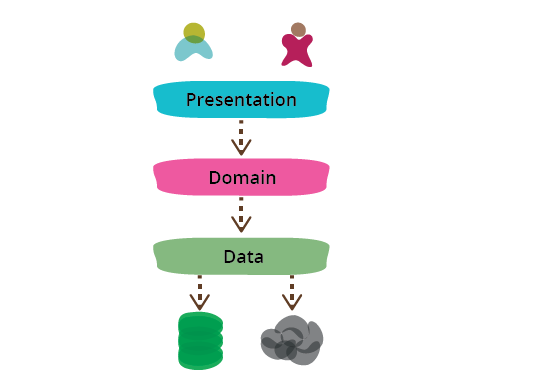
program is to separate it into three broad layers: presentation (UI), domain logic
(aka business logic), and data access. So you often see web
applications divided into a web layer that knows about handling http
requests and rendering HTML, a business logic layer that contains
validations and calculations, and a data access layer that
sorts out how to manage persistant data in a database or remote
services.
On the whole I've found this to be an effective form of
modularization for many applications and one that I regularly use
and encourage. It's biggest advantage (for me) is that it allows me
to reduce the scope of my attention by allowing me to think about the
three topics relatively independently. When I'm working on domain
logic code I can mostly ignore the UI and treat any interaction with
data sources as an abstract set of functions that give me the data I
need and update it as I wish. When I'm working on the data access
layer I focus on the details of wrangling the data into the form
required by my interface. When I'm working on the presentation I can
focus on the UI behavior, treating any data to display or update as
magically appearing by function calls. By separating these elements
I narrow the scope of my thinking in each piece, which makes it
easier for me to follow what I need to do.
This narrowing of scope doesn't imply any sequence to programming them - I usually find I need to
iterate between the layers. I might build the data and domain layers
off my initial understanding of the UX, but when refining the UX I
need to change the domain which necessitates a change to the data
layer. But even with that kind of cross-layer iteration, I find it
easier to focus on one layer at a time as I make changes. It's
similar to the switching of thinking modes you get with
refactoring's two hats.
Another reason to modularize is to allow me to substitute
different implementations of modules. This separation
allows me to build multiple presentations on top of the same domain
logic without duplicating it. Multiple presentations could be
separate pages in a web app, having a web app plus mobile native
apps, an API for scripting purposes, or even an old fashioned
command line interface. Modularizing the data source allows me to
cope gracefully with a change in database technology, or to support
services for persistance that may change with little notice. However
I have to mention that while I often hear about data access
substitution being a driver for separating the data source layer, I
rarely hear of someone actually doing it.
Modularity also supports testability, which naturally appeals to
me as a big fan of SelfTestingCode. Module boundaries
expose seams that are good affordance for testing. UI code is
often tricky to test, so it's good to get as much logic as you can
into a domain layer which is easily tested without having to do
gymnastics to access the program through a UI [1]. Data access is often slow and awkward, so using
TestDoubles around the data layer often makes domain logic
testing much easier and responsive.
While substitutability and
testability are certainly benefits of this layering, I must stress that even
without either of these reasons I would still divide into layers
like this. The
reduced scope of attention reason is sufficient on its own.
When talking about this we can either look at it as one pattern
(presentation-domain-data) or split it into two patterns
(presentation-domain, and domain-data). Both points of view are
useful - I think of presentation-domain-data as a composite of
presentation-domain and domain-data.
I consider these layers to be a form of module, which is a
generic word I use for how we clump our software into relatively
independent pieces. Exactly how this corresponds to code depends on
the programming environment we're in. Usually the lowest level is
some form of subroutine or function. An object-oriented language
will have a notion of class that collects functions and data
structure. Most languages have some form of higher level called
packages or namespaces, which often can be formed into a hierarchy.
Modules may correspond to separately deployable units: libraries,
or services, but they don't have to.
Layering can occur at any of these levels. A small program may
just put separate functions for the layers into different files. A
larger system may have layers corresponding to namespaces with many
classes in each.
I've mentioned three layers here, but it's common to see
architectures with more than three layers. A common variation is to
put a service layer between the domain and presentation, or to
split the presentation layer into separate layers with something like
Presentation Model. I don't
find that more layers breaks the essential pattern, since the core
separations still remain.
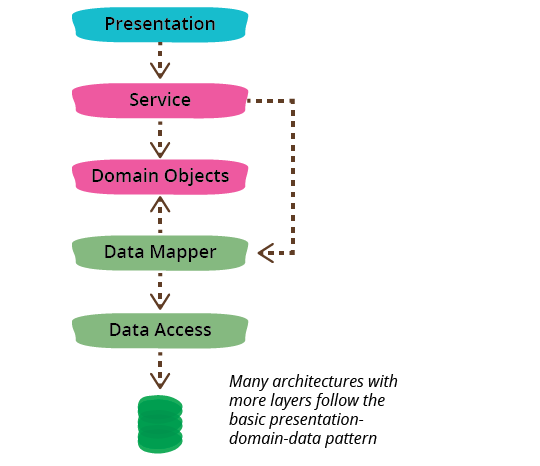
The dependencies generally run from top to bottom through the
layer stack: presentation depends on the domain, which then depends
on the data source. A common variation is to arrange things so that
the domain does not depend on its data sources by introducing a mapper between the domain and
data source layers. This approach is often referred to as a Hexagonal
Architecture.
Although presentation-domain-data separation is a common
approach, it should only be applied at a relatively small granularity.
As an application grows, each layer can get sufficiently complex on
its own that you need to modularize further. When this happens it's
usually not best to use presentation-domain-data as the higher
level of modules. Often frameworks encourage you to have
something like view-model-data as the top level namespaces; that's
ok for smaller systems, but once any of these layers gets too big
you should split your top level into domain oriented modules which
are internally layered.

Developers don't have to be full-stack but teams should be.
One common way I've seen this layering lead organizations astray
is the AntiPattern of separating development teams by
these layers. This looks appealing because front-end and back-end
development require different frameworks (or even languages) making
it easy for developers to specialize in one or the other. Putting
those people with common skills together supports skill
sharing and allows the organization to treat the team as a provider
of a single, well-delineated type
of work. In the same way, putting all the database specialists
together fits in with the common centralization of databases and
schemas.
But the rich interplay between these layers
necessitates frequent swapping between them. This isn't too hard
when you have specialists in the same team who can casually
collaborate, but team boundaries add considerable friction, as well
as reducing an individual's motivation to develop the important cross-layer
understanding of a system.
Worse, separating the layers into teams adds distance between developers and users.
Developers don't have to be full-stack (although that is
laudable) but teams should be.
Further Reading
I've written about this separation from a number of different
angles elsewhere. This layering drives the structure of P of EAA and chapter 1 of that book talks
more about this layering. I didn't make this layering a pattern in
its own right in that book but have toyed with that territory with
Separated
Presentation and PresentationDomainSeparation.
For more on why presentation-domain-data shouldn't be the
highest level modules in a larger system, take a look at the
writing and speaking of Simon Brown. I also
agree with him that software architecture should be embedded in
code.
I had a fascinating
discussion with my colleague Badri Janakiraman about the
nature of hexagonal architectures. The context was mostly around
applications using Ruby on Rails, but much of the thinking applies
to other cases when you may be considering this approach.
Acknowledgements
James Lewis, Jeroen Soeters, Marcos Brizeno, Rouan Wilsenach, and
Sean Newham
discussed drafts of this post with me.
Notes
1:
A PageObject is also an important tool to help
testing around UIs.
Share:


if you found this article useful, please share it. I appreciate the feedback and encouragement


Martin Fowler's Blog

- Martin Fowler's profile
- 1104 followers

