Struggling With Our Martians
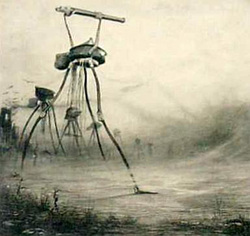 I mentioned in my last journal entry that I intended to read again, H. G. Wells'
The War of the Worlds
. I have done so and was amazed to see not only how well the classic remains an engrossing read, but how it is so much a picture of the world here at the start of the 21st century.
I mentioned in my last journal entry that I intended to read again, H. G. Wells'
The War of the Worlds
. I have done so and was amazed to see not only how well the classic remains an engrossing read, but how it is so much a picture of the world here at the start of the 21st century.If you haven't read Mr. Wells' book but have only seen movies made from it, I recommend you do read the book. I think the story is best appreciated as Mr. Wells wrote it, but it seems all the movie versions felt the need to "update" it. I think much is lost in doing that (note that Jeff Wayne's musical version holds pretty true to the spirit of the book and retains the nineteenth century setting).
The War of the Worlds is the story of an invasion of the earth by Martians in the late nineteenth century (the book was first published in 1898). The Martian technology as described is, of course, dated by current standards although Mr. Wells was amazingly prescient in some regards (such as in describing Martian machines that function under no apparent control).
But the main power of the book, to me, is its depiction of a vast, "unsympathetic" evil's assault of the ordinary world. This assault is preceded by a buildup of events--cylinders (Martian "spaceships") falling to earth, Martian technology seen killing humans--yet people resist recognizing the danger. Even when the Martians are on the march, people hold onto their normalcy bias and refuse to believe what is happening. To Mr. Wells' journalist narrator (today we would call him a freelance writer), this steadfast resistance by people to accepting the reality of their perilous situation was the most remarkable aspect of the story he relates. In his words:
The most extraordinary thing to my mind...was the dovetailing of the commonplace habits of our social order with the first beginnings of the series of events that was to topple that social order headlong.
In other words, while the Martians fortified the pits created by their landing, prepared their war machines and killed anybody that got too close, people not far away looked around themselves and noted: they were still employed, their gardens produced food, the trains still ran, the theatre was still open. To anybody that warned, "The Martians have landed!" they would likely say: "Nothing's happened yet," and go about their business.
One passage, I must quote at length, is a beautiful picture of this attitude. The Martians were advancing on the little town of Weybridge. The journalist observed that a lot of people there were resisting the imperative to flee:
The soldiers were having the greatest difficulty in making them realise the gravity of their position. We saw one shrivelled old fellow with a huge box and a score or more of flower pots containing orchids, angrily expostulating with the corporal who would leave them behind. I stopped and gripped his arm.
"Do you know what's over there?" I said, pointing at the pine tops that hid the Martians.
"Eh?" said he, turning. "I was explainin' these is vallyble."
"Death!" I shouted. "Death is coming! Death!" and leaving him to digest that if he could...The soldier had left him, and he was still standing by his box, with the pots of orchids on the lid of it, and staring vaguely over the trees.
This normacly bias is very strong and it probably has some survival value. For instance, I think it was a major reason people didn't panic in the run-up to the Y2K crisis, in addition to the vested interest of the corporate power structure in keeping things operating by computer. But it can also lead to people behaving like lemmings running over a cliff when a crisis finally hits. In Mr. Wells' story, many people died by not fleeing until they saw the Martians coming--flashing their heat rays spreading poisoned gas over the countryside. Those that did get away caused a refugee crisis that only added to the suffering.
Mr. Wells was a student of history and so must have had some insight into the mechanics of calamity falling upon large human populations. Those mechanics must be classic, because I was struck with how the book foreshadowed our situation today--not in the application of technology, but in people's reactions to conditions that are becoming more and more apocalyptic.
I see the cold, unsympathetic Martians as metaphors for our world's ruling oligarchs (the Rothchilds, the Rockefellers, the Bushes, the Clintons, the Bilderberger membership, etc). Their quest for world domination is just as relentless as the Martians and just as brutal to the human masses. The most active battlegrounds right now are in the Greek fight against the European Union banks, the resistance in Donbass to Ukrainian aggression , and in the skies over our heads. The "fighting machines" they use are neoliberal policies of austerity, "Free Trade" agreements, militarized police, and Fox "News."
Many voices of scientists and activists are raised in warnings about the unprecedented dangers of global warming, climate change, and Statospheric Aerosol Geoengineering (SAG). Their cry to all of humanity is nothing less than "Death is coming!" It seems most people ignore them as they make Facebook entries with their smartphones about their "valuable orchids."
In his novel, Mr. Wells made a comment about the designs of the invading Martians that also applies (so far) to our Martians (oligarchs):
They do not seem to have aimed at extermination so much as at complete demoralisation and the destruction of any opposition.
The "destruction of any opposition" sounds like an aim of the Project for the New American Century --a think tank that informed, and provided personnel to, the last Bush administration. I think demoralization is also a chief aim of propaganda concerning the unending war on "terror," the need for draconian security measures, the Russian-and-China "threat," and such.
This is difficult material to deal with, but it is so pervasive that I am compelled to deal with it in this journal. If I didn't, I'd be like the man worrying over the value of his potted flowers when he is in imminent danger of being burned to a crisp by psychopaths with high-tech weapons.
And so this is where we stand at this point in human history. We are under assault by forces whose powers seem God-like. When you get past the delusion and the denial, and you are fully aware of the reality and gravity of the situation, there comes to you a visceral change. It is partially a success of the "Martians'" demoralization plan and partially a consequence of seeing things as they are. Mr. Wells also understood this. His protagonist says:
I felt the first inkling of a thing that presently grew quite clear in my mind, that oppressed me for many days, a sense of dethronement, a persuasion that I was no longer a master, but an animal among the animals, under the Martian heel.
I see this disillusionment in the writings of so many activists. It is particularly egregious when you understand the reality of SAG, and are aware of the constant spraying, the other-worldly sky, and you spot the SAG trails in movie scenes. You become grieved that our Martians have taken from us the very inspiration of a sunny, temperate day.
In The War of the Worlds, the salvation for humankind comes from the earth herself. At this point, I don't see how that can happen in the real world, but I don't discount the possibility. Things could turn around over some presently-unsuspected factor. If it does, and humanity survives the apocalypse, I wonder if it will be for our betterment on the other side of calamity.
Mr. Wells chose to end his story on the upbeat, with his protagonist and his family surviving, and humanity rebuilding. But that ending is with the recognition that humanity's survival was pretty much a matter of luck, with no assurances that the disaster won't repeat--the Martians could return, better prepared. Even so, his narrator believes humankind has learned from the experience of its near-demise:
It may be that in the larger design of the universe this invasion from Mars is not without its ultimate benefit for men; it has robbed us of that serene confidence in the future, which the most fruitful source of decadence...and it has done much to promote the conception of the commonweal of mankind.
The price people paid for this education is their loss of confidence in the future, but they are also more appreciative of the importance of the common good. I hope humanity in the real world can reach that same place. If we can do so and finally throw off the bounds of the dominator culture with its endless competition and exploitations, then it may be we can get our confidence back as a species. But that would be a boon for succeeding generations. Meanwhile, we have to struggle with our Martians.


No comments have been added yet.