Calling the Command Center
Being an umpire, I’m always interested while watching a Major League game, when an appeal is made regarding a call. Umpires are human and humans are prone to error—but umpires may be less prone to error than many people assume.
If you’ve been living under a rock, MLB now allows certain plays to be reviewed upon request by one of the two teams. This change occurred when the powers that be initiated expanded instant replay during the 2014 season, thinking that it would improve the game. And interestingly, over the first season of reviewing a plethora of calls, the umpires made the right call almost all of the time. For all the ins and outs of instant replay and what calls can be reviewed, the Wikipedia entry on instant replay is really good and gives a great overview.
Fans and players have always had an adversarial relationship with officials. Both of them are far from being objective about whether the right call is being made. They have inherent bias built into their reaction to close calls, especially if that call goes against their teams, or them personally.
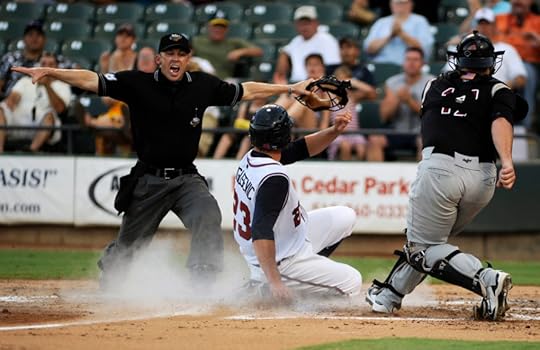
(Photo by James Brosher/AMERICAN-STATESMAN – Home base umpire Mike Lusky signals safe as Express first baseman Brian Bogusevic slides into home plate.
It appears that over the first season, umpires got the call right almost all the time.
Here’s what Doug Glanville, a former player (and a damn smart guy), writing for MLB.com, said about umpires and instant replay.
Last season [2014] there was only one reversible call every 6.5 games. So if you are playing for any team, once a week you would see a call that was blatantly incorrect. Could it have been a game-changing call? Sure. Could it have cost you a hit? Sure. But make no mistake about it, umpires get it right — and they get it right a lot.
If umpires were getting things right so often, why expand instant replay, which MLB did for the 2015 season? I thought baseball’s higher-ups wanted to speed up the games. Requiring replay reviews, which get examined by an umpire at the league’s Replay Command Center in New York City, where the final decision is made to uphold or overturn the call is made, only increase the length of games.
On Sunday, I umpired a 25+ adult league game. Amateur umpires don’t have to deal with instant replay. Probably at some point, technology will rear its ubiquitous head and allow an app for this. I’m hoping I’m long gone when that happens.
On a close play at the play, I got an “out” call (I was the plate umpire). The runner didn’t like the call, claiming the opposition player had “blocked the plate” and began quoting the rule back to me. Unbeknownst to him, I had read the SMMBL rules and I was well aware of this rule. Two things were working against his appeal. 1) In my opinion, the receiving catcher had allowed him access to the plate and wasn’t blocking it; 2) The rule pertains to blocking of the plate “without the ball,” which didn’t apply. There was one additional factor working against the aggrieved player—he was a jerk! After bitching and complaining on his way to the bench, letting me know this was the “second play I had missed,” I forcefully and professionally informed him he needed to cease and desist, or he could take the rest of the afternoon off. He was fine after that.
Umpires get the calls right most of the time. We’re a heck of a lot less biased. We are able to keep our “distance” from the emotion and hullabaloo of the call that makes fans and players crazy. You can say that we’re “less biased” than you are about the call. And even when you are a total ass, we don’t hold it against you and make the right call the next time. Another mark of being professional.
I liked what Glanville had to say about players, fans, (and even mascots)—they get things wrong a lot more than umpires do. This would be true at the amateur level, too. Ask a fan about a particular rule, and none of them have a clue about the rules. They’ll yell, “a tie goes to the runner.” Where the hell is that in print? The runner has to beat the throw, the rulebook has nothing to say about ties.
And don’t get me started about 25+ beer league players who can’t play. I’ve played a lot of baseball from four-team Podunk leagues to college-level semi-pro—I’m onto your shenanigans!