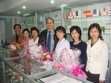
AUTOMATONS, SLAVES OR MEMBERS OF THE 1% ELITEThat’s the...
AUTOMATONS, SLAVES OR MEMBERS OF THE 1% ELITE
That’s the stereotypical portrayal of North Koreans by foreign media and authors of books on the country. My personal experience of the people of
the DPRK was very different.
I recruited
staff from universities, commercial enterprises and other organizations
in North Korea and had a good mix of ages and backgrounds. Initially
around half were women, but this was increased substantially over time
as women were generally found to be more diligent and dedicated to tasks
than their male counterparts. In my experience, this seems to be true
throughout Asia. Just a small proportion belonged to the
Korean Labor Party.
Most were slim when they started with us,
but many added a little padding the longer they stayed. Older members of
staff were usually married, younger staff often in love and some even
showing symptoms of lovesickness. A few displayed signs of, or confided
to, difficult relationships and a small number were divorced. There were
rumors that some married staff members were not entirely faithful. Some
colleagues liked one another better than others and sometimes there
were misunderstandings and arguments. In other words, it was just like
any of the companies I had worked in around the world.
All of my
staff were hard workers, and if they weren’t they didn’t stay long.
Exceptionally, the harder working staff asked for better training or the
replacement of lazy or incompetent ones. Some always seemed to wear a
serious face, others were often smiling. Some were introvert, others
garrulous and fun-loving, telling jokes and enjoying a laugh. North
Koreans love to joke and tell funny stories, as I experienced in
numerous encounters with not only the employees, but also suppliers and
customers. Some of the jokes would merit a xxx-rating in other
countries!
Without exception the staff loved their children and
were bursting with pride over their achievements. If a child
successfully passed the entrance exam to a good school there was
jubilation. Conversely, a child underperforming was the cause of huge
anguish and could result in tearful scenes. I had great pleasure in
meeting children of my staff on various occasions and found them just
like kids anywhere else: some were shy and reticent, others were curious
and bursting with questions for me. That the staff’s adult children
married well was a very important topic, and so were grandchildren.
There was none so proud among the staff as a contented grandparent.
Though
media in the West claim most North Korean adults use meth and other
drugs, I saw no signs of it among the workforce. I believe I am well
aware of the signs and what to look for and knew that users of such
drugs would typically display the symptoms after a while. On the other
hand, most men were heavy smokers and loved to drink Soju and other hard
alcoholic drinks. However, the latter was generally restricted to
special occasions such as holidays or birthday parties.
As we
jointly had to achieve some really tough objectives in a very demanding
environment a close bond developed between my staff and me. They trusted
me that I wouldn’t betray them and so I learned more about their
families, friends, interests and hobbies than was usual for a westerner.
We became even closer as we organized outings, sport days and Karaoke
evenings and often played volleyball or table tennis together after
work.
My video above
shows one of my female staff members in the company canteen giving a
short performance of ‘Tul’ (also teul or 틀 in Korean), which is as
rigorous and precise as a Swiss clock, on the way to mastering North
Korea’s favorite national sport Taekwondo, the equivalent to the ‘kata’
in karate.
This, then, is just one example of the individualistic
nature of the North Korean staff I was honored to work with: people with
distinct personalities, fears, foibles and idiosyncrasies; as
individual as any other people in any other country. A far cry from the
convenient, prejudiced stereotype the western media love to depict.
☆☆☆☆☆
Q&As with Felix Abt, author of the book A Capitalist in North Korea: My Seven Years in the Hermit Kingdom.
“North Korea Needs A Bold Vision”
Korea Observer: If
you were asked to advise the North Korean government on how to create a
brighter future for its citizens what would you tell them?
Felix Abt:
I would recommend they strive to develop a long-term vision with an
unequivocal strategy and clearly stated goals. They’d need to start
implementing it without delay. The country could, and should, achieve an
annual growth rate of 10 – 15 % over the next 10 to 20 years. To
accomplish this the government would have to rethink previous approaches
and look to widely liberalizing its economy. This is not without
precedent and proven efficacy: China, starting from an economic base
performing at a similarly low level to North Korea’s, introduced
sweeping reforms and subsequently achieved consistent 2-digit growth
rates over a period of many years; resulting in hundreds of millions of
its citizens being lifted out of poverty.
Korea Observer: But that would mean the economy becomes free while there is no political freedom.
Felix Abt:
Political liberalization is much more intractable as the North has a
strong rival system in the South, not something China and Vietnam had to
contend with when they opened up. The solution, I believe, is for the
North’s vision to encompass a “Scandinavian” approach that includes a
highly competitive element, evolving into a market economy while
building up a strong social safety net for all those citizens who would
otherwise struggle under such a system.
To
realize a sustainable growth model, the country would, of course, also
have to reform institutions, for example developing a law-based state
and not incarcerating people for political reasons. Since the vast
majority of North Korean refugees have left the country for economic
reasons, implementing the outlined vision would become a strong
disincentive to abscond, and would certainly be far more effective than a
coercive approach.
☆☆☆☆☆
Published by The Korea Observer here: http://www.koreaobserver.com/automations-slaves-or-members-of-the-1-elite-27211