the war of the damned continues
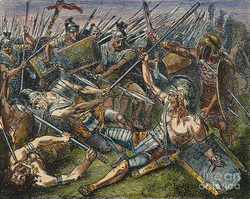 I recently watched the final season of the Starz series,
Spartacus: War of the Damned
. My wife and I had become fans of the series back in 2011 and we watched them all except for the last one (moving and cable changes lost us our Starz subscription). When it finally became available for streaming on Netflix, we jumped on it.
I recently watched the final season of the Starz series,
Spartacus: War of the Damned
. My wife and I had become fans of the series back in 2011 and we watched them all except for the last one (moving and cable changes lost us our Starz subscription). When it finally became available for streaming on Netflix, we jumped on it.Overall, it was a fitting finish to the series and included those elements that impressed me from the beginning: subtleties of character (including the young Julius Caesar), setting and costuming realism (mostly), pseudo-shakespearean dialogue, some solid nods to history and legend, and some capable actors (but a shame Andy Whitfield succumbed to cancer after the first season, although Liam McIntyre did well in taking over the lead role). I wrote of my thoughts on the series in a 2011 journal entry .
The series prompted me to thoughts about its socialist theme. Indeed, the legend of Spartacus became a socialist (populist) inspiration over the centuries and cannot be understood outside of that theme. So I was pleased to see it expressed in dialogue by the character, Crixius, shortly before his heroic death scene:
We built their mighty republic, with our hands and our blood and our lives. And we can see it fall, at equal cost. You opened my eyes to this, Spartacus, do not ask me now to close them.
That's the realization of awakened slaves (both chattel and wage) to the way things really are. They understand that their labor is being used (until the laborers are used up) for the enrichment and gratification of monstrous rulers (basically, the 1%) in a hierarchical system that favors monsters (psychopaths). And when the slaves resist, they fight oppressors that do not value human life and so will only fight to the death. This fight is often referred to as "class warfare." The "all or nothing" nature of it is what motivated Spartacus' army. Once they set on the path of rebellion, there was no other alternative for them.
This conflict is at the heart of all conflicts among nations and has been going on for some ten thousand years--ever since humans quit hunting-gathering, became farmers, and built cities, since Cain slew Abel, since we cast ourselves out of Eden. Some smart people have identified this change in human society as the Agricultural Revolution. I put some study into that and wrote this journal entry about it.
Though this class warfare has been going on constantly since the beginning of civilization, it seems to me that it has only come to actual, head-to-head, fighting on a very few occasions. That is, when the struggle was between the oppressors and the oppressed and both sides recognized it for what it was.
Spartacus' rebellion was the first such fight (at least that we have record of). Though there had been other slave rebellions, his was the biggest and the knowledge of it has persisted to our time. And though it was put down after years of fighting at great cost to the Roman empire, it had the result of easing the institution of slavery in Rome a tiny bit. I believe share-cropping was introduced to work the empire's fields rather than sheer slave labor. I think our rulers have been seeking ever since to find that sweet-spot of maximum labor exploitation short of armed rebellion.
Another point of conflict in this war may have been the Paris Commune of 1871. This seems to have been a time when workers were able to use the distraction of the Franco-Prussian war (the French army suffered some defeats and the French government had fled Paris) to establish a government ("commune") in Paris based on cooperation and democracy (i.e., socialist). It only existed for a few months before the French government was able to reassert control of Paris in a week of bloody fighting with the communards.
Of course there was the Russian revolution of 1917 but I think that revolution fared little better than the Paris Commune. Though it was certainly a battle between workers and rulers, it was soon coopted by a state-run capitalism that degenerated further into a totalitarian system that only paid lip-service to being a workers' state.
Then there was the Spanish Civil War (1936-1939). This fight was very obviously a struggle against slaveholders (called "fascists" by that time) and freedom-loving people from around the world joined in the fight against them (but not their governments; western governments favored Franco and his fascists). Probably not since Spartacus' time have slaves fought against masters as they did in the Spanish Civil War. Once again, the slaves lost, though the memory of what they tried to accomplish has persisted, and is commemorated in Ernest Hemingway's classic novel, For Whom the Bell Tolls .
You may have noted that in these ruminations I've left out the American Civil War. That's because I don't see that war as being oppressed against oppressor, but rather a conflict between two oppressors over who and how to exploit.
What about today? Are there any points of conflict today that continue the War of the Damned? I believe there are two notable ones.
The first is Ukraine. This conflict began as an attempt by US/NATO to capture a place of rich resources and further encroach on Russian borders (and punish Russia for stopping western plans for escalating the fighting in Syria; see this article by Prof John McMurtry writing for Global Research). Using provocateur agents, US/NATO toppled the elected president of the Ukraine and installed a puppet with a cadre of neo-nazis who promptly began a cleansing (murder) of the eastern Ukraine (aka, Donbass) of ethnic Russians.
Seeing what was happening in Donbass, the province of Crimea overwhelmingly voted to solicit annexation by Russia (actually a return to being part of Russia) which was granted them. This is the only thing that stopped the western Ukraine government (based in Kiev) from letting their ethnic cleansing extend into Crimea.
The Donbass region of Ukraine also wanted to be taken into Russia, but the Russians declined in the apparent belief that such an action would be seen as a provocative encroachment giving NATO an excuse to attack. So the people of Donbass began to resist. With their only choice being to fight or be killed, they took up arms against the army of Kiev and began to steadily beat them (no doubt supported by Russian volunteers offering expertise and weapons; shades of the Spanish Civil War). There were mass defections in the Ukrainian army to the point that Kiev gave orders to shoot deserters. They also started conscripting children. And it seems the nazi units were better at lobbing bombs from a distance than fighting face-to-face.
Now the western corporate press had gone to great lengths to vilify Russia and President Putin in all this, with exaggerated (at best!) claims of "Russian aggression." In fact, they have generally accused Russia of doing everything that NATO has done. Still, I don't see Russia as representing the oppressed in this conflict. Instead, I see the people spontaneously rising up against the (corporate, fascist) oppressors (wannabe slaveholders) as being the people of Donbass (also refered to as "rebels" in the media). Their "no other choice" determination to fight to defend their lives, families, and homes puts them in Spartacus' army.
I pray the Donbass "rebels" don't suffer the same fate as Spartacus' army. I'm sure, though, that they will fight on, even in the face of US military aid aid to Ukraine.
I believe the other current battle in the War of the Damned (perhaps even more so than Ukraine) is the fight of the people of Greece against the European Union banks.
Greece was on the edge of bankruptcy in 2010--people were out of work and the ATMs were empty. Being a member of the European Union (EU), Greece's neoliberal "solution" was loans from the Troika (i.e., the triumvirate of financial/political entities: the European Union (based in Brussels), the European Central Bank (ECB), and the International Monetary Fund (IMF)). Their multibillion Euro loans refloated the Greek banks, but with draconian strings attached to "ensure repayment."
Those strings were the neoliberal (functionally equivalent to "neoconservative") policies collectively referred to as "austerity." They are commonly imposed on countries who make IMF loans and include things like the privatization of public works (utilities, lands, prisons, schools, etc), slashing wages and pensions, workforce layoffs, cuts in social programs, and so on. These policies are defacto thieft as they effectively move a nation's wealth from its people to the loan sharks (banks, oligarchs).
The consequences of the austerity policies on the Greek people are described by C. J. Polychroniou in an article for Truthout:
Wages, salaries and pensions were slashed by as much as 40 percent; public services and social programs were stripped to their bare bones, which included hospitals running without adequate equipment and medicine and schools functioning without heating oil in the winter months, unemployment shot through the roof (currently standing at nearly 26 percent, and over 50 percent for those 15-24 years old), poverty became a reality for one out of three people, and suicides became endemic in the early years of the crisis.
People took to the streets to protest, but earned only police repression and no relief from the unsympathetic Troika. Finally, on January 25 of this year, they elected a political party into office that consists of a coalition of left-wing elements and goes by the name of Syriza. Syriza took power on a platform of opposing austerity (where previous governments only cooperated with it) and immediately went into a month long negotiation with agents of the Troika. Their goal was to establish a four month extension of the loan agreements (which required renewal, or reaffirmation--like a loyalty pledge, by the new Greek government) without the austerity measures and so provide time to work out a permanent agreement that would raise revenue to service the loans by prosecuting tax evaders (which would be a huge source), taxing the rich, etc, and also abandon austerity and privatization.
The Troika, however, rejected all of Syriza's proposals and threatened to fail the Greek banks by suspending loan payments. They also stopped accepting Greek state bonds as collateral for ECB loans. In effect, the Troika threatened to toss Greece out of the EU if they refused to cooperate in austerity. Syriza conceded to the pressure. Its leadership is far less radical than the Greek people and they have no desire to leave the EU or not repay the IMF loans. They simply want to abandon austerity as an irrational policy. They found, however, that EU bankers have no sympathy for the jobless and the starving, and will not negotiate.
All this has led to a backlash from the Greek people and the more left-leaning members of the Syriza coalition who feel their leaders should have taken a stronger stance against the hated Troika and been prepared to take Greece out of the EU (aka, "Grexit"). It even led to a national hero (and member of Syriza) to apologize for Syriza's performance and affirm that "...between slaves and occupiers the only solution is Freedom."
So what happens next with Greece? The factions within Syriza seem to be fighting over that question, but they need to stay together to have any chance at opposing the EU bankers. If Syriza fails, Greece would either return to a compliant government or, worse, to one led by extremists such as the New Dawn (basically, neo-nazis).
Prophecy scholar and seer, John Hogue, has predicted that the Grexit (Greece leaving the EU and returning to public banks using the drachma for currency) will happen:
Watch Russia and China come to Greece’s aid when it abandons the Euro Monetary Union between now and 2015. Russia will set up a naval base in Greece. Both Russia and China will shore up the Greek economy. (John Hogue, Predictions for 2013-2014)
I expect such a scenario would be the best one for Greece, but it would also be a firming of the line being drawn between east and west (BRICS vs NATO). And that line is a battle-line as much as it is cultural and political demarcation.
Most observers fear that a Grexit would be the spark that unravels the neoliberal financial system presided over by the world's oligarchs. That may be, but I believe that unraveling is inevitable. And there are other sparks glowing among people struggling under the heel of the oligarchs. Populist parties similar to Syriza are rising in Spain and Ireland. The question is: how far will these parties be able to go, working within the neoliberal political system, to truly represent the interests of the citizenry?
Actually, there are many places around the world where battles in this war are being fought. Venezuela, for example. But it looks to me like Ukraine/Greece is where the pressures are strongest that will lead to the inevitable fallout.
In the real world, the War of the Damned continues.


No comments have been added yet.