
The human element
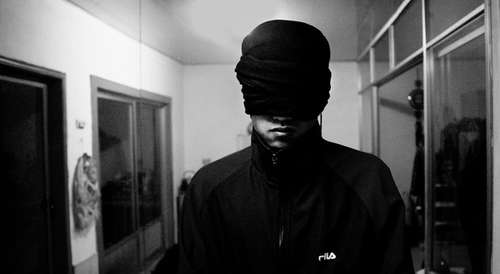
(Photo from a striking series of portraits, here.)
The North Korean soldier wasn’t what I expected. Hair combed to the side, he wore a polo shirt. He clasped his hands, nervous before the crowd of onlookers. Before speaking, he bowed low to a group of senior citizens who fanned themselves nearby. He appeared neither a buffoon—á la Team America—or cruel. He was flesh and bone. A man.
He bowed again as an interpreter made clear that he would soon be on the move. As one of the highest profile North Korean defectors in recent years, they had been unable to announce his appearance beforehand.
We were told we were about to see his story on screen, a story many North Korean defectors shared.
A projector flicked light onto the wall. The title rolled.
The documentary, 48m, was jarring, depicting the struggles of North Koreans sneaking across the North Korean/Chinese border. In any other scenario, I might have felt manipulated by the violence on screen. But this wasn’t mere emotional string-pulling.
For the North Koreans who attempt to cross the Tumen river, this was not an on-screen drama. This was reality.
We know from the UN, CIA, and Amnesty International, that there are about 200,000 men, women and children in North Korean concentration camps. Satellite photos have spotted them. Google Maps can trace the fences.
Studying the face of this North Korean soldier-turned- defector, I suddenly understood. The numbers of defectors are only symbols. What’s real and vital are the human stories they represent.
The former management chief of Camp 22 once testified about a family taken as test subjects for bio-chemical weapons. Pushed into a sealed plastic room, a father, mother, and two children choked on poisonous gas. Officials stood by with notepads to record the results.
The true result was unchartable. It was a picture of love, the father and mother stooping over their vomiting children, attempting mouth-to-mouth as they themselves fought to breathe. These are the human stories.
Other stories have surfaced in the news, but fail to gain more than fleeting press attention. Among them are reports on defectors who, after making the journey to Seoul, have been unable to assimilate and thrive. A survey conducted by the Chosun Ilbo found that 79% of North Korean defectors settled in South Korea feel “depressed,” and 20% have harbored suicidal thoughts.
Some of this may stem from the stigma faced by North Koreans, whose accents and disparate education experience sets them apart. Scholar Kim Hee-jin of Myungji University reported that while most South Koreans would accept North Korean defectors as friends, “only 10 percent of them would cooperate with defectors as their business partner, and only 7 percent of them would marry a defector.” (NK News)
Hyeonseo Lee, a prominent North Korean defector, wrote in her New York Times editorial: “[North Korean defectors in South Korea] struggle from a lack of education and job skills, discrimination, loneliness and emotional turmoil.”
But the option of remaining in North Korea, or living in China under threat of repatriation, is also odious. North Korean women in China are highly vulnerable to trafficking, and due to China’s deficit of women, are sold as wives to Chinese men.
And if defectors are found by Chinese authorities, they face “face internment or death… as punishment for their treasonous flight.” (Virginia Journal of International Law) There are reliable reports of North Korean defectors shot on sight, and of the Chinese government installing electronic sensors across the border to aid in capturing defectors.
These are the broad statements of fact. On paper, they easily blur into the swath of other compelling news stories.
But meeting defectors who speak of torture, or of the starvation of their family members, these reports become personal. Defectors are often caught between the paragraphs; their real struggles obscured by the clinical analysis of policymakers, and overshadowed by the threat of nuclear weapons in North Korea.
What is needed in the dialogue about North Korea is an acknowledgement of the human element. Though the Kim regime may not recognize the human rights of its people, nations that respect human rights ought not to ignore the real lives that hinge on the talking points in our diplomacy.
Because behind every news story is a human story. And for everyday North Koreans, it’s their future that’s being debated.


Hannah Farver's Blog

- Hannah Farver's profile
- 12 followers

