The Fastest Things In The Universe
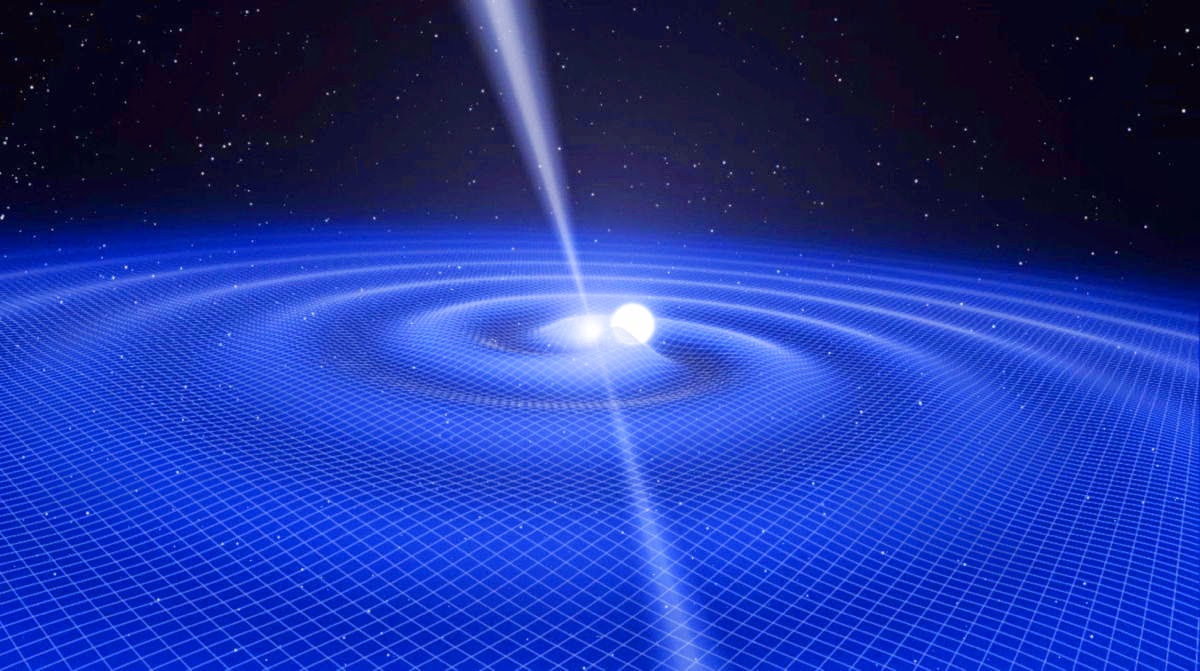 Gravitational waves can't actually be seen as in this simulation.When gazing at the night sky from here on Earth, it’s easy to picture the Universe as calm and unhurried. But in reality, out there in space, things move fast – really fast. Putting aside particle accelerators and the like, the fastest-moving man-made object was the Helios 2 spacecraft launched in the 1970s. It reached a top speed of 68.75 km/s (153,800 mph) on its mission to the Sun. But this was just a leisurely stroll compared to the fastest things in the Cosmos. So, where do we find the real speed freaks of the Universe? Here’s a run-down of the top five.
 1. Expansion of the Universe
Speed: Greater than the speed of light!
The Universe is expanding. But the Universe isn’t filling up ‘empty space’ as it expands because it is ‘space’ itself which is expanding. Although the laws of physics say that two objects can’t move faster than light speed with respect to each other, there is no such restriction on the actual expansion of the space through which they move.
In principle, the furthest we can see in the Universe is called the ‘cosmological horizon’, beyond which light cannot yet have reached us during the lifetime of the Universe. Although we can never see it, the Universe still exists beyond this limit, and those invisible parts of the Universe are receding from us at greater than the speed of light. Unfortunately, because we can never observe those parts of the Universe, we cannot be sure how fast they are receding from us. However, the entire Cosmos may be a trillion trillion times as big as our ‘observable’ Universe, so that its most distant parts could be moving away from us at many millions of times the speed of light!
2. Light
Speed: 299,792.458 km per second
Claiming that the expansion of empty space is the fastest thing in the Universe is cheating a bit. It’s more honest to say that the fastest ‘physical’ thing in the Universe is simply light itself (or in fact the whole electromagnetic spectrum).
Of course, the Universe has a self-imposed top speed limit - the speed of light at 299,792.458 km/s. Nothing moves faster than this. Why? Well, objects that have mass require energy to accelerate them and the laws of physics say that to accelerate a mass up to light speed would require infinite energy. More confusingly, objects traveling faster than light would have to be traveling backwards in time!
3. Gravitational Waves
Speed: 299,792.458 km per second
In fact, it’s not just light that travels at light speed. All mass-less particles do, as do the force fields such as the weak and strong nuclear forces and the gravitational force. So do ‘gravitational waves’, the ripples in the fabric of ‘space-time’ created by moving mass. Although we haven’t yet built instruments powerful enough to detect these gravitational waves, their existence has been proven by looking closely at the orbital decay of a binary pulsar system called PSR B1913+16.
4. Cosmic Rays
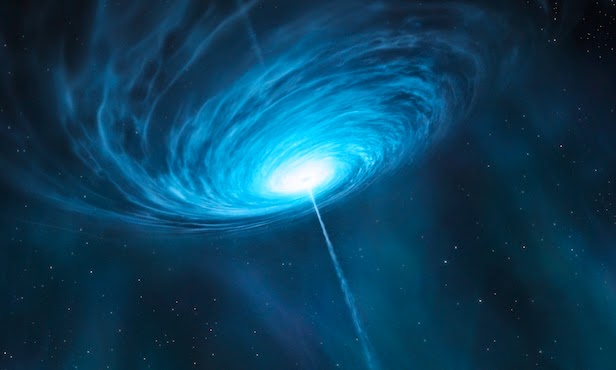 Artist's impression of a blazar.
Speed: 299,792.4579999 km per second
What about ordinary matter traveling at high speed? The record is held by cosmic rays. These aren’t ‘rays’ at all – they’re subatomic particles created in the most powerful events in the Universe such as galaxy mergers and ‘hypernovae’. The fastest cosmic ray yet detected was traveling so close to the speed of light that it had the same amount of energy as a medium-paced cricket ball, although it was a fraction of the size of a single atom! It had a thousand billion billion times the energy of protons that the Large Hadron Collider (LHC) can produce at maximum energy!
5. Blazar Jets
Speed: 299,492.666 km per second
For large chunks of matter (as opposed to subatomic particles) the speed record is held by the ‘jets’ seen in ‘blazars’. Cannibalistic black holes at the heart of these active galaxies release huge amounts of energy which is funneled into jets by a dense, highly-magnetic accretion disk. The jets in some blazars have been observed to move at about 99.9% the speed of light! These blobs of material are at least the size of the solar system!


No comments have been added yet.