Writing Scenes
I’ve been editing my novella Storm on the Horizon—trying to deepen the characters and make the story a little longer. As I was working on it, I needed to delve deeper into a scene, so I thought I’d look up scene worksheets and outlines on-line to see what other writers used and possibly update my own worksheet.
You wouldn’t believe what I found!
Yup. My own worksheet… on my critique partner’s website!
I was so certain that other writers used scene outlines or worksheets! Well, if they do, they aren’t sharing. So, since I thought it was silly that my worksheet didn’t even come up on my own website (I know it’s here, but buried under the “For Writers” section, I thought I’d do a series of blog posts on the various worksheets that I use when I write.
I’m a plotter. I need to think long and hard about what I’m going to write before I put fingers to keyboard. I need to consider my POV character’s goal for the scene and their goal overall for the book. I like to think about the conflict that stops them from getting what it is that they want. And, finally, I like to think about all everything that’s going to shape their reaction to what’s happening to them—that would include their background, their character and where they are emotionally at the start of the scene. To wrap my head around all these different things and get my mind thinking like this characters, I fill in this worksheet (if you click on the picture, it’ll take you to a PDF of the document):
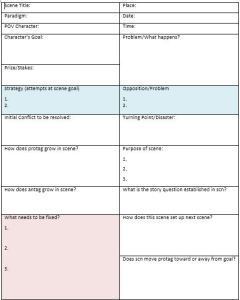
I’ll just quickly go over the details here:
Scene Title: That’s your title. What you call it. You don’t need to share that with anyone unless you want to title your chapters.
Paradigm: This is where this scene falls in your larger scale story structure: is it the initiating event? The crisis? The climax?
Place: Where the scene takes place
Date: If you need to keep track of time in your book—on which day things happen—this is the place to do so.
Time: If it’s relevant to the story
POV Character: Through whose eyes are we living this scene?
Character’s Goal: What is the character’s goal for this scene (not the whole book).
Prize/Stakes: There always needs to be something at stake or driving the scene forward. What is it?
Problem/What happens? Very briefly (a sentence or two), describe what happens in the scene.
Strategy: What is the POV going to do to try to attain their goal?
Opposition: What’s stopping them?
Initial Conflict: What is the character trying to do at the start of the scene? This can easily change during the course of the scene.
Turning Point/Disaster: What is the main turning point of the scene?
How does protag grow? In every scene the protagonist needs to learn something or grow in some way. How do they do that in this scene?
Purpose of Scene: This is your purpose, the authors. It can be something like showing the POV character’s growth in a particular direction or describing the world. There needs to be at least two, if not three purposes to the scene.
How does antag grow? Even the antagonist needs to grow (although, perhaps not in every scene), but if they do grow in this scene, how do they do so?
What is the story question? What question is posed (but not answered) in the scene. Ideally, you should answer the question not in the next scene but in one after that.
What needs to be fixed: If you’re editing this scene, what do you need to work on?
How does this scene set up the next scene? How do the characters move forward from this? What do they need to do in the next scene as a result of this one?
Does scene move protag away from or toward goal? This one is pretty obvious. J
Quick Scene Summary: Many scenes are not just a scene, but a scene and a sequel. This helps you design this and think about it a little more deeply.
Scene Goal: The character’s goal
Scene Obstacle: What’s stopping them
Scene Disaster: What happens—the turning point
Sequel Reaction: What’s the character’s reaction to what happened in the scene?
Sequel Dilemma: What problem does it create for them?
Sequel Decision: What are they going to do about it – this propels your story forward
I don’t fill out a worksheet for every scene, and I don’t always fill in every question on the worksheet. I play it by ear filling out what I need to work out in my head before I write. Sometimes I just go with the flow and write things as they happen and then go back afterwards to fill out the worksheet to be sure I covered everything that needed to be there.
So do you work out a scene worksheet when you’re writing? Do you find them helpful?