
When you live with a book
In four weeks I will be returning to Cyprus to live. My wife and I spent three weeks there earlier in October and found a nice place to settle. While there I managed to visit several places that I toured in 1974. Six months later, after the Turkish invasion, I became curious about the events that led up to the occupation. Delving into the recent history of Cyprus I found a story about British Colonialism, Greek claims of sovereignty and terrible acts of violence both Greeks and Turks visited on each other before the UN stepped in. This first visit later became a great influence on writing my first Enda Osin Mystery book, ‘ISIA’S SECRET.’
My first stop was the Paphos district where Enda and Jessica Du Rosse spend their first night on Cyprus. What they see is the modern Paphos.
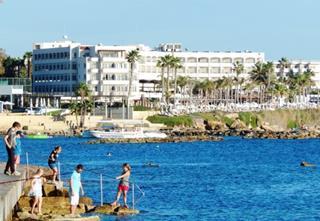
‘The shoreline boulevard of Paphos reminded me of other seaside towns I’d been to. Fast food franchises, souvenir kiosks, banks, estate agents, clothes shops and travel agents all cluttered together in uninteresting little strips. Whatever else happened on the island, nothing stood in the way of tourism.’
In 1955 the Chloraka coastline, part of the Paphos district, and it’s areas of Alyki, Rodalinia and Vrexi were remote and deserted. On the 10th November 1954 Colonel George Grivas landed secretly to lead an armed struggle to free Cyprus from the ‘yoke of English Colonial rule.’ After helping form a committee with Archbishop Makarios III and other Greeks and Cypriots, he had landed to organise a group of fighters for EOKA. (National Organisation for Cypriot Struggle). There followed a short period when propaganda sheets appeared spreading hatred for the Turks and the British army. It was not known until later that Grivas was on the island.
‘By day Koskotas worked for a newspaper. By night he printed The Cypriot Fight, an underground propaganda paper urging rebellion against the ‘occupying imperialistic army’, encouraging desecration of Turkish property and rallying support for the military junta in Athens who were at loggerheads with Makarios. Stevenson reminded us they were turbulent times with Greeks fighting each other as well as the British and Turks.
“Must have been very confusing,” I said. “Your point about Koskotas is what? That he took the picture?”
Stevenson nodded. Koskotas propaganda sheets were the only source for photos of EOKA action. His accounts often implied his presence on the scene. That also suggested he had a camera. There were often quotes from Grivas and Makarios that were more of a personal rather than military view of the campaign.
Jessica recalled Koskotas admitting he was a staunch supporter of The National Organization of Freedom Fighters at the time when he was young.’
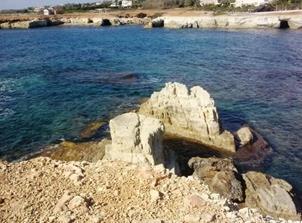
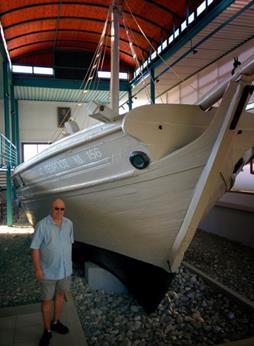
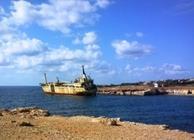
I wanted to find the cove featured in ‘Isia’s Secret’ where George Hrisacopolis lands men and arms and is caught by the British and dies after getting shot and leaving a photo of a young girl on the beach. It was the start of the book and the hook that set the rest of the story off to uncover George’s family’s dark secrets. The cove is situated north of the Ahyki coast and unfortunately I did not have time to find it. I did, however get to the Ahyki coast area where one of the most celebrated events of the struggle took place in at Rodafinia. As freedom fighters began ferrying arms and explosives by dinghy from an ocean going wooden fishing vessel, the ‘Saint George,’ a British warship, the ‘Comet,’ lay in wait out to sea having been warned by traitors to the EOKA cause. On the shore the police were also waiting. All the men were captured and the warship fired across the St George’s bows. Eventually all the men served between one and eleven years in jail.
‘Alexander ran back across the beach, breathing heavily.
“There’s a small motor boat coming in.”
“Right, get them off and send the boat back. How many are there?”
“Fifteen men. The fishing boat is laid off further toward the point.”
George’s heart thumped against his chest. “Good. Now lead them out of here as fast as you can, Alex. I’ll cover the rear with two of our men.”
Both men ran toward the boat. George could make out several figures jumping into the surf as they approached.
Then night suddenly turned into day. A bright searchlight at the top of the cliff cut through the night, illuminating the boat and all around it. “This is the British Army…. Stay where you are…. Lay down your arms and walk towards the light.” The megaphone voice repeated the order.
 “On top of the cliff.” shouted George. “The bastards are hidden, get the light.” He raised his pistol and aimed at the top of the cliffs.’
It has to be said that Winston Churchill shoulders much of the blame for the events that shook the island for two decades and ended with the infamous ‘Green Line’ that today divides Cyprus. Vague promises were made to the Greeks after Crete was invaded by the Nazis during WWII about the future of Cyprus in return for Greek resistance. When nothing happened at the war’s end, the Greeks started pressurizing the British government and fighting the minority of the population – the Turks, in order to support their claims. In the early fifties the British found themselves caught in a struggle that lasted for almost twenty years as all sides fought each other. After eighty-two years of British rule, Cyprus was granted independence in 1960 but the violence still flared on and off for another thirteen years. The invasion ended all that and for forty years the island has remained divided. Lacking recognition for a Turkish Republic of Northern Cyprus from any other country, the whole of Cyprus was granted EU status in 2003.
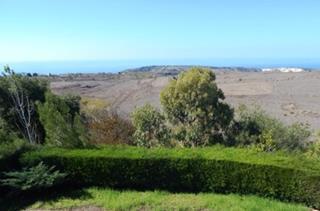
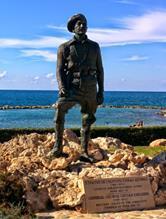 After two weeks on the island I found a villa that overlooks one of the valleys north of Kissonerga on the Paphos coast. Our village is a ten minute walk away and the local winery is even closer. What really sold me on living here is the peace and tranquility of living high up in the hill villages. The Cypriots are a warm hearted people and their homes and public places are well kept and clean. I love getting to know my new neighbors and look forward to writing in a new location and enjoying fresh air. It is hard to imagine this island experiencing a civil war. I saw all the EOKA signs daubed on walls and the tension in Turkish quarters as I last toured places in the north – Kyrenia and Bellapais. My wish is that the EU don’t spend another forty years dithering but grow some sharp teeth and get things sorted. Cyprus deserves to be its own master – and that sentiment is also shared by Enda Osin, political correspondent of the ‘Herald.‘
If you would like to read “ISIA’S SECRET” or listen to it please click on the following links. My work is available through Amazon and Smashwords.
Isia’s Secret is the first of a trilogy of Enda Osin Mystery’s and the second, Twisted Wire, is also available with an audio version coming in the new year. The third book, Glassfrogs and Chameleons will be available in the spring of 2005.
http://www.amazon.com/Isias-Secret-Enda-Osin-Mystery-ebook/dp/B00FCRGON8
https://www.smashwords.com/books/view/353047
https://www.smashwords.com/books/view/472901
Pictures by M. Harahan and I. Kimmel


A blog for everyone

- Ray Stone's profile
- 17 followers

