“Prisoners, Deserters, and an Age of Heroes” by Mike R. Underwood
I was a college freshman on 9/11. The events of that Tuesday morning kicked off the 21st century in the United States of America, and changed my life, as it changed the lives of so many young people of my generation in the USA and beyond.
9/11 started the “War on Terror,” two wars in the middle east, poured nitrous oxide into the burning engine of the United States’ national debt, and set the tone for the first decade of the 21st century in the USA, the first decade of my adulthood. I remember telling classmates that we needed to write to our representatives, ask that they not go and start a war over this, that we could do better.
I created an Individualized Major of Creative Mythology, with the aim of studying how myths and legends were structured, how the ur-stories of world cultures were formed.
When I arrived at Indiana University, I declared an East Asian Studies major. I wanted to learn more Japanese, study Japanese history, and go off and work for a video game company, or an anime company, or something involving that skill, and that interest. But after 9/11, I was flailing for meaning, desperate to find some way forward as the world very quickly spiralled away from the future I had expected. As members of my age cohort signed up for the armed services, to be analysts, anything to help, I looked back to Mythology, to hero legends, and in looking back, saw my path forward.
We make meaning out of stories – that’s what humans do. I needed to make meaning out of what was happening in my world, needed to imagine an alternative to the path that history was taking, to dream a brighter future. In spring of 2002, I created an Individualized Major of Creative Mythology, with the aim of studying how myths and legends were structured, how the ur-stories of world cultures were formed, so that I could make 21st century myths and legends to help point the way forward, to see through the cloud of ashes and confusion and anger left by the fall of the towers.
But 9/11 wasn’t the first time the WTC towers had loomed tall in my life, with their presence or their absence.
The 1993 World Trade Center bombing happened two days after my 10th birthday. My mom was walking me home from school, the two of us about to get on the subway, when I saw the smoke in the distance, all the way from Brooklyn. We had to take the subway because I’d been attending a private school next to prospect park after months of being bullied at public school, already the odd one out in second grade. The public school was under-funded, the curriculum elementary compared to the small private school I’d been attending before in Texas, and so I was both under-stimulated and ostracized. That school was like a prison for me. So like any good prisoner, I tried to escape.
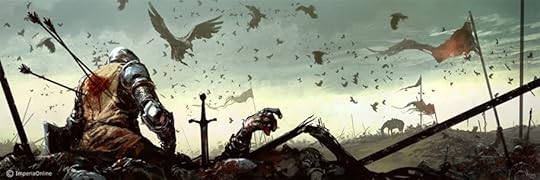
Art by Tomasz Jedruszek
And escape I did, to an infinitely better (and more expensive) school. I also escaped into reading, into superhero comics, into video games, and later, into role-playing games. I escaped to worlds with heroes, where the desire to learn about and participate in a larger world was rewarded. Where outcasts became heroes.
Escapism is still maligned in art and entertainment, nearly 80 years after J.R.R. Tolkein’s essay “On Fairy Stories,” which delineated the difference between the escape of the prisoner and the flight of the deserter.
“Why should a man be scorned, if, finding himself in prison, he tries to get out and go home? Or if, when he cannot do so, he thinks and talks about other topics than jailers and prison-walls? The world outside has not become less real because the prisoner cannot see it. In using Escape in this way the critics have chosen the wrong word, and, what is more, they are confusing, not always by sincere error, the Escape of the Prisoner with the Flight of the Deserter.”
Fantasy, for me, has always been about the Escape of the Prisoner. The novels, comics, games, and stories I grew up on were never about abandoning responsibility. They were about learning how to bear responsibility, they gave models of heroism, presented templates of possibility, showed me that it was possible to faced insurmountable odds and come out on top.
That spring afternoon as a 2nd grader, sneaking from table to table during lunch, and then running as fast as my seven-year-old legs could carry me, it was escape, not desertion. My duty was to myself.
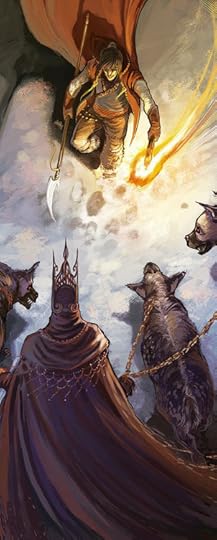
Art by Elvire De Cock
So what do I do?
I help prisoners escape.
When I was trapped in a school that offered me only abuse and boredom in intervals, I escaped.
When a terrible tragedy set my country on a drastically different path into the 21st century, I committed myself to learning how to dream up better futures.
Now, almost thirteen years later, the 21st century seems every bit as intimidating for me it did in late 2001: the rising threat of climate change, a gridlocked government, and a world that becomes more Cyberpunk day by day, and not in the cool way where we get flying cars or a technicolor VR internet.
So what do I do?
I help prisoners escape.
Is there any wonder why the superhero genre has had a huge upswing in popularity in the last decade? Superheroes are modern hero legends, well-known characters from a shared cultural tradition that are re-invented and re-imagined time and time again in new stories that speak to our current situation.
The newest run of hero legends on film frequently feature heroes trying to find a better path, to transcend or rehabilitate a compromised cultural inheritance and find a better path.
We put our heroes on the screen because we desperately believe that we can do better, that the world can do better.
In Iron Man, Tony Stark has an empire built on blood money and war profiteering and has to figue out how to build a better world using an inheritance built on weaponry and imperialism. In The Dark Knight, Batman creates a machine that can offer total surveillance of an entire city, a massive breach of privacy, but he can use it to save the city from the Joker. In Captain America: The Winter Soldier, Cap works for a government so motivated to protect everyone that it gave over to fear, let a secret terrorist organization turn them into the world’s police.
We put our heroes on the screen because we desperately believe that we can do better, that the world can do better. Because we need to escape the prison of our fear, of our doubt, and most of all, of our cynicism.
Thanks to two foreign wars, increasing income inequality, de-regulation leading to a housing crisis and a financial crash with a slow recovery, rampant political obstructionism, the last thirteen years in America have become a prison for many. A prison of doubt, of fear, of debt, and of cynicism. Hope rallied for some in 2008, and has been dragged through the mud of pragmatism, of compromise, and the disappointment of promises broken. And along the way, we simultaneously elevate hero narratives on one hand and drag our heroes through the grimdark dirt on the other.
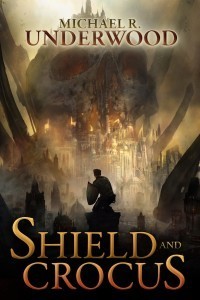
Buy Shield and Crocus by Michael R. Underwood: Book / eBook
If we can’t tell ourselves stories that things can get better, we will never rise to the challenge of making them better.
Step one in escaping is to believe it to be possible. Step two is making a plan, acquiring the tools needed to move from desire to action. We tell ourselves stories to believe that they can happen in the real world, and to give ourselves the emotional and social tools to make a difference, to break out of the world as it is. Too many of us are still prisoners in the world made in the wake of 9/11. But now it’s time to break out and build a new future.
So pick up a pen, a laptop, a camera, or whatever’s at hand.
Let’s tell ourselves a story of a better world and make it so.
The post “Prisoners, Deserters, and an Age of Heroes” by Mike R. Underwood appeared first on A Dribble of Ink.