Review: Darwin’s Doubt
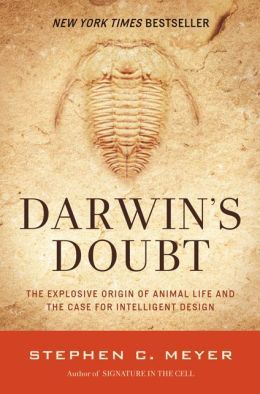
I start this review with an obligatory disclaimer: I am not one of those science-hating creationists. It’s a testament to the state of public discourse in this country that I have to include that preface. But admitting openly that I read a book with a title like Darwin’s Doubt carries certain risks. It’s the kind of publication that you have to wrap in a copy of Lady Chatterley’s Lover if you want to read it on the subway.
And yet, it’s not that bad. In fact, Darwin’s Doubt is a surprising book, one of those works that stirs in you those feelings and ideas that you had all along, but didn’t know how to articulate or even whether you should.
The book’s title comes from portions of Charles Darwin’s Origin of Species where he discusses possible problems and setbacks with his overall theory of descent from a common ancestor. Darwin was familiar with the Cambrian Explosion, a ten-million-year block of time approximately 540 million years ago that saw a rapid increase in the number and complexity of biological forms. The geologically sudden appearance of such diversity differed from Darwin’s view of gradual transition. In light of this apparent conflict, Darwin sought to assure his readers: “If my theory be true, it is indisputable that before the lowest Silurian [Cambrian] stratum was deposited, long periods elapsed, as long as, or probably far longer than, the whole interval from the Silurian age to the present day; and that during these vast, yet quite unknown, periods of time, the world swarmed with living creatures.”
Darwin, it turns out, was wrong. While the world did swarm with creatures before the Cambrian era, they weren’t that varied. More than a century of research has shown that the Cambrian Explosion is what it is: a blink of an eye that produced creatures at a rate that far exceeds Darwin’s estimates. How did life appear so rapidly? In the absence of a powerful deity, what would be needed to make this happen?
What is needed is information. According to Stephen C. Meyer, the book’s author, advancements in life are in reality advancements in digital information in the form of DNA and epigenetic content. “Building a fundamentally new form of life from a simpler form of life requires an immense amount of new information.” It’s as if a room full of monkeys started banging on typewriters and produced, not works of Shakespeare, but complex computer algorithms. Randomly generating this level of quality DNA seems unrealistic to Meyer. The heart of Darwin’s Doubt is an exploration of why an increase in functional DNA-based information could not come about through neo-Darwinian evolution alone.
Meyer addresses this possible impediment to materialistic evolution by looking at four key issues: (1) the likelihood of random processes generating beneficial and usable genetic material, (2) the time needed to generate this digital genetic information, (3) the window of time in a species’ development when DNA-generating mutations must occur, and (4) whether DNA alone is sufficient to build new life forms.
Darwin himself was not aware of DNA or of how genetics worked at the cellular level. In today’s neo-Darwinian world, it is well understood that genetic mutations must drive speciation. Cellular mutations are common, but generally deleterious; we call some of them “birth defects.” Even if a mutation could be considered neutral or beneficial, Meyer explains that there need to be enough coordinated mutations present to generate a new protein fold. “New protein folds represent the smallest unit of structural innovation that natural selection can select…. Therefore, mutations must generate new protein folds for natural selection to have an opportunity to preserve and accumulate structural innovations,” an action that is unlikely by Meyer’s calculations.
Meyer’s second point deals with the study of population genetics. Given the size of a population, its reproduction rate, its overall mutation rates, and the tendency for natural selection to weed out members with diminished genetic fitness, how much time is needed to generate new genetic information that would result in the transition to a new type of creature? Quite a lot, it turns out. “For the standard neo-Darwinian mechanism to generate just two coordinated mutations, it typically needed unreasonably long waiting times, times that exceeded the duration of life on earth, or it needed unreasonably large population sizes, populations exceeding the number of multicellular organisms that have ever lived.” Since the majority of genetic advancements would require more than two coordinated mutations, the numbers quickly become more severe.
Timing also plays a key role in genetic transmission. To have a development impact, Meyer notes that mutations must come early in the evolutionary lifetime of a species, when populations are still small and morphological changes have the best chance of taking hold. However, mutations at this stage also have the biggest probability of imparting damage, and similar changes in larger populations are more likely to be removed by natural selection.
Finally, Meyer discusses epigenetic information, the instructional content stored in cell structures but not in DNA sequences themselves. This information is essential in driving the overall body plan of an animal as it develops from a single cell to its full adult size. What is not clear is how it could be altered through genetic mutation, since specific epigenetic pressures are not coded directly by the DNA base pairs. There is also the issue of “junk DNA,” those coding blocks of the genome that were once thought to be useless castoffs of evolution, but are now understood to drive biological processes in living creatures.
In its more than 500 very accessible pages and its 100-plus pages of footnotes and bibliographical references, Darwin’s Doubt does at good job at expressing Meyer’s own doubts that “wholly blind and undirected” evolution could produce the variety of life we see on earth. As the director of the Discovery Institute’s Center for Science and Culture, Meyer is a strong advocate for Intelligent Design. “Our uniform experience of cause and effect shows that intelligent design is the only known cause of the origin of large amounts of functionally specified digital information. It follows that the great infusion of such information in the Cambrian explosion points decisively to an intelligent cause.” His book makes a strong case, although the appeal to non-materialistic explanations will always turn off some readers. As proof of the struggle, Meyer quotes Scott Todd, a biologist writing in Nature: “Even if all the data point to an intelligent designer, such a hypothesis is excluded from science because it is not naturalistic.”
So here you have the conundrum. Despite what you read in the news, the science surrounding biological evolution is still somewhat fluid, in part due to the issues raised in Darwin’s Doubt. Yet for those who have reasonable struggles with the evolution-is-settled narrative, it’s hard to shake the baggage carried by those on the religious fringe who insist that any non-literal interpretation of the creation story is blasphemy. Another book on my reading list is Mind and Cosmos, by Thomas Nagel, an atheist who rejects the standard neo-Darwinian view for some the same reasons as expressed by Meyer. (Anthony Flew, once known as “the world’s most notorious atheist,” later came to believe in a deity because of similar issues surrounding evolution.) A book like Darwin’s Doubt requires vigorous analysis to confirm that it is scientifically sound. But if it is, then the neo-Darwinian evolution model itself might turn out to be little more than an intelligently designed idea.