50 Stories & Snippets Extract 3
Here's the latest extract from my new ebook publication for speakers and trainers in the Almost Free series, available on Kindle and Nook:
50 Stories & Snippets for Conference & Workshop Presentations.
The Blind Men and the Elephant
It was six men of IndostanTo learning much inclinedWho went to see the Elephant(Though all of them were blind)That each by observationMight satisfy his mind. The Firstapproached the ElephantAnd happening to fallAgainst his broad and sturdy sideAt once began to bawl:'God bless me! but the ElephantIs very like a WALL!' The Second, feeling of the tusk,Cried, 'Ho, what have we here,So very round and smooth and sharp?To me 'tis mighty clearThis wonder of an ElephantIs very like a SPEAR!' The Thirdapproached the animalAnd happening to takeThe squirming trunk within his handsThus boldly up and spake:'I see,' quoth he, 'the ElephantIs very like a SNAKE!' The Fourthreached out an eager handAnd felt about the knee.'What most this wondrous beast is likeIs mighty plain,' quoth he:''Tis clear enough the ElephantIs very like a TREE!' The Fifth, who chanced to touch the ear,Said: 'E'en the blindest manCan tell what this resembles most;Deny the fact who can,This marvel of an ElephantIs very like a FAN!' The Sixthno sooner had begunAbout the beast to gropeThan seizing on the swinging tailThat fell within his scope,'I see,' quoth he, 'the ElephantIs very like a ROPE!' And so these men of IndostanDisputed loud and long,Each in his own opinionExceeding stiff and strong,Though each was partly in the rightAnd all were in the wrong! John Godfrey Saxe, US poet (1816-1887)
Using the poem
This classic poem and various prose adaptations of the underlying parable have been used metaphorically in a wide range of situations - from illustrating the difficulties presented in medical diagnosis to discussing comparative religion - but the common theme is a search for truth. Use this poem to show how limited observation, a particular experience, partial knowledge of a situation, or a conditioned perspective can all affect one's viewpoint and possibly lead to miscommunication, misunderstanding, misinterpretation or mistrust. Promote discussion among your group by asking what the blind men of Indostan might have done to resolve their dispute and reach a common understanding. What may come out is the importance of seeing the bigger picture, of weighing all the evidence before coming to a conclusion, and perhaps seeking objective advice from an expert witness. The discussion may even widen to an exploration of the nature of truth itself. Thus this simple witty verse lends itself both to modest ends and, if you should wish, profound philosophical debate.
The Boulder Noam in ancient times was a desperately poor kingdom. People there blamed the king, comparing him to his grandfather who, they said, ran everything so much more smoothly than this lax ruler. Everything, it seemed, was better in the old days. In truth the young king tried his best, but the day-to-day problems were more than he could handle alone. He could not command support, and so the kingdom became poorer year by year. One morning a huge boulder appeared in the middle of the road leading to the gates of the capital. Rich merchants and fashionable courtiers grumbled as they walked around the rock, cursing the king for failing to keep the roads clear and causing them to trail their cloaks in the ditch. A peasant came along on his way to market with a heavy sack of produce on his back. Seeing the boulder he set down his burden and tried to move the rock to the side of the road. He strained and struggled for over an hour under the hot midday sun. Townsfolk mocked as they squeezed by the sweating peasant. Finally he succeeded and his red face broke into a smile of relief and pride as the great rock rolled into the ditch. Stepping back into the road to retrieve his sack the peasant noticed a leather purse lying where the boulder had been. Inside the purse he found a dozen gold coins and a note from the king explaining that here was a reward for the person who cleared the rock from the roadway. As the peasant gazed in wonder the royal coach appeared, travelling towards the city gates. The coach stopped and the king himself opened the door. He invited the peasant to join him, and they rode through a throng of staring citizens to the palace where they talked into the night of ways to save the kingdom. 'The block of granite, which is an obstacle in the pathway of the weak, becomes a stepping-stone in the pathway of the strong.'Thomas Carlyle, Scottish essayist, historian (1795-1881) Using the story 'It was much better in the old days' is a common refrain in organizations and communities. The tendency to hark back to some mythical golden age goes hand in hand with the urge to blame someone for the present state of things, usually the people seen as running the show. Use this story to remind everyone listening that they need to take responsibility for problems and challenges if they are to make progress, rather than waiting for some higher authority to come along with a solution. The story works well when used together with the quotation from Thomas Carlyle as it reinforces the notion that every problem comes with a gift in its hand, the opportunity for transformation. More extracts to come, but if you can't wait or you want them all in one published collection you can download the book to your Kindle or Nook.
50 Stories & Snippets for Conference & Workshop Presentations.
The Blind Men and the Elephant
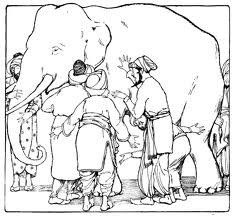
It was six men of IndostanTo learning much inclinedWho went to see the Elephant(Though all of them were blind)That each by observationMight satisfy his mind. The Firstapproached the ElephantAnd happening to fallAgainst his broad and sturdy sideAt once began to bawl:'God bless me! but the ElephantIs very like a WALL!' The Second, feeling of the tusk,Cried, 'Ho, what have we here,So very round and smooth and sharp?To me 'tis mighty clearThis wonder of an ElephantIs very like a SPEAR!' The Thirdapproached the animalAnd happening to takeThe squirming trunk within his handsThus boldly up and spake:'I see,' quoth he, 'the ElephantIs very like a SNAKE!' The Fourthreached out an eager handAnd felt about the knee.'What most this wondrous beast is likeIs mighty plain,' quoth he:''Tis clear enough the ElephantIs very like a TREE!' The Fifth, who chanced to touch the ear,Said: 'E'en the blindest manCan tell what this resembles most;Deny the fact who can,This marvel of an ElephantIs very like a FAN!' The Sixthno sooner had begunAbout the beast to gropeThan seizing on the swinging tailThat fell within his scope,'I see,' quoth he, 'the ElephantIs very like a ROPE!' And so these men of IndostanDisputed loud and long,Each in his own opinionExceeding stiff and strong,Though each was partly in the rightAnd all were in the wrong! John Godfrey Saxe, US poet (1816-1887)
Using the poem
This classic poem and various prose adaptations of the underlying parable have been used metaphorically in a wide range of situations - from illustrating the difficulties presented in medical diagnosis to discussing comparative religion - but the common theme is a search for truth. Use this poem to show how limited observation, a particular experience, partial knowledge of a situation, or a conditioned perspective can all affect one's viewpoint and possibly lead to miscommunication, misunderstanding, misinterpretation or mistrust. Promote discussion among your group by asking what the blind men of Indostan might have done to resolve their dispute and reach a common understanding. What may come out is the importance of seeing the bigger picture, of weighing all the evidence before coming to a conclusion, and perhaps seeking objective advice from an expert witness. The discussion may even widen to an exploration of the nature of truth itself. Thus this simple witty verse lends itself both to modest ends and, if you should wish, profound philosophical debate.
The Boulder
 Noam in ancient times was a desperately poor kingdom. People there blamed the king, comparing him to his grandfather who, they said, ran everything so much more smoothly than this lax ruler. Everything, it seemed, was better in the old days. In truth the young king tried his best, but the day-to-day problems were more than he could handle alone. He could not command support, and so the kingdom became poorer year by year. One morning a huge boulder appeared in the middle of the road leading to the gates of the capital. Rich merchants and fashionable courtiers grumbled as they walked around the rock, cursing the king for failing to keep the roads clear and causing them to trail their cloaks in the ditch. A peasant came along on his way to market with a heavy sack of produce on his back. Seeing the boulder he set down his burden and tried to move the rock to the side of the road. He strained and struggled for over an hour under the hot midday sun. Townsfolk mocked as they squeezed by the sweating peasant. Finally he succeeded and his red face broke into a smile of relief and pride as the great rock rolled into the ditch. Stepping back into the road to retrieve his sack the peasant noticed a leather purse lying where the boulder had been. Inside the purse he found a dozen gold coins and a note from the king explaining that here was a reward for the person who cleared the rock from the roadway. As the peasant gazed in wonder the royal coach appeared, travelling towards the city gates. The coach stopped and the king himself opened the door. He invited the peasant to join him, and they rode through a throng of staring citizens to the palace where they talked into the night of ways to save the kingdom. 'The block of granite, which is an obstacle in the pathway of the weak, becomes a stepping-stone in the pathway of the strong.'Thomas Carlyle, Scottish essayist, historian (1795-1881) Using the story 'It was much better in the old days' is a common refrain in organizations and communities. The tendency to hark back to some mythical golden age goes hand in hand with the urge to blame someone for the present state of things, usually the people seen as running the show. Use this story to remind everyone listening that they need to take responsibility for problems and challenges if they are to make progress, rather than waiting for some higher authority to come along with a solution. The story works well when used together with the quotation from Thomas Carlyle as it reinforces the notion that every problem comes with a gift in its hand, the opportunity for transformation. More extracts to come, but if you can't wait or you want them all in one published collection you can download the book to your Kindle or Nook.


No comments have been added yet.