Observations from Mark
Where does one post quotes and thoughts too long for Twitter when one doesn’t want to donate content to Facebook? Some say Tumblr, but I’m going to try simply keeping this single post as a running record of observations about the Gospel of Mark, which I’m currently reading through.
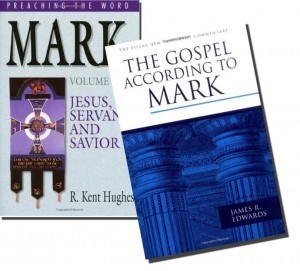 I’m using two commentaries primarily as I read:
The Gospel According to Mark by James Edwards
Mark: Jesus, Servant and Savior by R. Kent Hughes
So, here’s what I’ll do: I’m going to post the most recent reflections and quotes below, by date. If any of you have better thoughts as to how to do this, I’m certainly open.
August 18 – Mark 8.10-13
Two boat trips in these short verses, sandwiched between a direct confrontation with the Pharisees in which they demand of Jesus a “sign.” The Greek used here makes it clear that they weren’t asking so Jesus could display His glory. They were asking, hoping to discredit Him. In addition, this hostile request would not have resulted in their conversion if Jesus had given them what they wanted.
“…the demand for ‘signs’ is itself a sign of attempting to gain by empirical means what can only be gained by faith and trust… to ‘force the evidence upon one would make a faith response by its very nature impossible.’ Faith that depends on proof is not faith, but veiled doubt. (Edwards, 237)
Hughes noted:
“What a terrible thing it is to have Jesus turn his back on you and sail away.”
It’s a sobering and also joyful reminder that Jesus can be trusted. The heart that trusts is the heart that gets to see Jesus do amazing things. The heart that doubts will only be continually shown Jesus’ crucifixion. You must believe that before you see everything else. Isn’t that what we learned from the doubting disciple Thomas?
August 13
In Mark 7.1.23, we have Mark’s longest recorded conflict of Jesus with the Pharisees. It’s about what “religion” really represents. Is it about what we do – religious practice – or is true religion about how we do it?
It’s clear that Jesus condemned the empty-hearted observance of religion by the Pharisees. In a summary statement, he says,
“What comes out of a person is what defiles him.”
He then goes on to list an abhorrent amount of evil that actually comes out of us. The list in v21-23 should concern anyone who wants to live a life pleasing to God. Why? Because evil is within. Contrary to the secular view, we are not inherently good. We are inherently bad, every person being capable of great evil.
This is why Jesus’ coming and crucifixion are so central. He offers us good news (gospel) as a balm to such bad news (that we can’t escape from inner evil). The good news is that for the person who gives their life in faith to Jesus, He transforms us from the inside out.
That was what the Pharisees were unwilling to hear. They thought man was in charge of his own personal path to heaven through a rigorous observance of religion (thus their concern with hand washing in v2-5, or outside in).
It would be a mistake to assume in calling the Pharisees “hypocrites” that Jesus accuses them of lack of dedication… They were not.. either superficial or uncommitted. On the contrary, it was their commitment to the oral tradition – and Jesus’ equal commitment to recovering the intent of the written law – that made their differences so earnest. (Edwards)
Jesus going head to head with the Pharisees is important because their brand of religion was actually promoting sin’s bondage rather than spiritual freedom. They were using scripture as a weapon for behavioral conformity rather than as a light for spiritual transformation. Even today, people familiar with the Bible twist it to justify religious behavior like the Pharisees did and miss the intent and truth of scripture.
Those who try to justify themselves by the Law end up modifying it in order to escape from its authority. In the same way, those who handle God’s Word without submitting to it are in the constant process of conforming it to their self-complacency. (Hughes)
August 6
In Mark 6.51-52, we see Jesus climbing into a boat (from the water!) on the Sea of Galilee. The shocked disciples are recorded as being “astounded, for they did not understand about the loaves, but their hearts were hardened.”
Edwards says:
“..faith is not an inevitable result of knowing about Jesus , or even being with Jesus. Faith is not something that happens automatically or evolves inevitably; it is a personal decision that must be made in the face of struggle and trepidation. Discipleship is more endangered by lack of faith and hardness of heart than by external dangers.”
(Visited 28 times, 1 visits today)