
Interview with Jennifer Lee of Building Your Business the Right-Brain Way
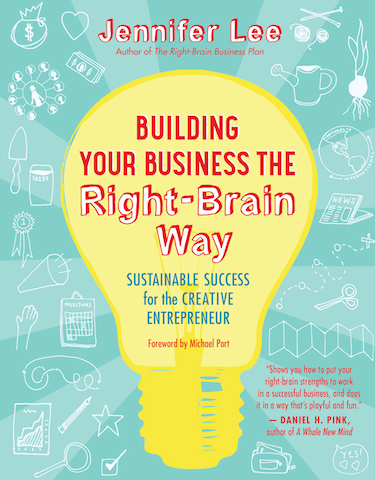
I love Jennifer Lee’s work that helps creative entrepreneurs get their business sense on. Her new book, Building Your Business the Right-Brain Way continues where The Right-Brain Business Plan leaves off. Full of practical, actionable advice for how to build a business that works in all ways, this book is a great asset for creative people.
 I had the chance to interview Jenn, fellow CTI coach and author. I had a million questions, but decided to focus on what helped her write the book and how she wants the book to change the world. Plus one question about money.
Jennifer, thank you for your work helping creative people feel healthy and happy both in the creative and the business realms. I love your books and am happy to share it with my readers. Thanks for taking the time to answer a few questions about your process.
First, why do you say moola instead of money?
Well, it’s just more fun to say moola!  When I wrote my first book The Right-Brain Business Plan, I gave all of the traditional “left-brain” sections of a business plan more creative and friendly names for my peeps. I know many creatives cringe when they think of finances or money, but when they think of or say even moola, they can’t help but have a hint of a smile and I think that helps make looking at the numbers more approachable.
What has surprised you about writing this book?
The creative process is always full of surprises! I share below in another response how I was struggling with the structure of the second book. But the cool thing is things totally came together in the end. I love when that happens. There were two elements of the book that helped to anchor the structure. One was the Entrepreneurial Ecosystem exercise that helps you assess the different parts that make up your business and the other is the Embracing Ease play sheet.
Both of those concepts came to me organically as ideas and models I tested during a couple of video classes I led earlier that year. I didn’t realize that they would be a part of the book or help to confirm the book’s structure.
The Entrepreneurial Ecosystem helps readers assess which parts of their business might need more attention and helps point them to specific chapters in the book. And the Embracing Ease play sheet just so happened to align perfectly with the chapters that make up Part IV “Sustaining Your Success.”
I remember feeling so frustrated because I couldn’t “figure out” the flow and then I had those light-bulb moments of “Oh! The structure has actually been here all along.” I just needed to loosen my grip and take a step back to see it.
What helped you focus enough to write the book? What did you have to set aside?
 I wrote the book during an especially tumultuous time (including 2 family members being sent to the emergency room and my husband and I moving, not once, but twice!) so I really had to make conscious choices to stay focused enough to finish writing.
Fortunately, I had some stable moola-making methods in place already and I was able to have those sustain me while I scaled back on taking on new clients or new opportunities.
I also learned to delegate more and started to look for someone to help me with business development for my licensing program since we were getting requests that I couldn’t handle myself. I kept my life pretty simple during what I called my “urban writing retreat” – I did most of my writing while we were living temporarily in a condo in San Francisco.
Even though I would’ve loved to just hang out and explore the city, I hunkered down and blocked out stretches of days for just writing (and had days designated for coaching calls). I also cut out a lot of social activities. I’m not terribly social anyway, but the only people I saw during that time where friends or family who happened to be visiting from out of town (it’s funny how many people travel to the city in the summer!).
The other cool thing about being in the city while I was writing was that things were very convenient – like getting groceries delivered or being able to just head out the door with my dog and walk along the water to clear my head.
You have a great chapter about launches that shares a lot about how to manage a launch. What helps you post-launch? How do you manage and respond to all the emotions that come after a launch?
I love that you’re asking this question and pointing to the post-launch emotions that can come up (did you spy me hiding out under my covers the other day??!! Haha!). After you put your offer out there it can feel very vulnerable because you’ve shared a part of yourself.
There are several things that are helpful to me post-launch. One is I know I do a lot better when I actually have things already in place for any of the follow-up tasks or communications that need to happen. There’s nothing worse than feeling tired or drained and then having to write up more e-mails or marketing from scratch. So, it definitely helps to have those kinds of things set up ahead of time as part of the overall launch planning.
I also like to give myself a buffer in my schedule so I can refuel my tank. That means blocking off my calendar at least a day or two after a big event and maybe just hanging out in my PJs. And also having an out-of-office reply set for before, during, and a few days after a big launch so I don’t feel the guilty about not responding to all of my e-mails right away.
I keep a “Kudos and Feel Good” folder in my e-mail and file all the lovely messages we receive from folks who were positively impacted by my work or message and that helps me remember that I am making a difference.
I debrief with my team to talk about what went well and what we could do differently next time. And I also have my coach who helps me reflect on my accomplishments and also what to do moving forward. Having support is so important!
Dreaming of a more colorful, authentic world
Your book is so practical and focused for creative people. If readers took action on the exercises in Building Your Business the Right-Brain Way, what do you imagine will be different in the world? What is your vision for a world with empowered right-brainers?
What a cool question. I imagine that we would have more creative souls out there confidently sharing their gifts with the world and making a good living from doing what they love. And when we have more empowered right-brainers like that who are contributing their gifts in significant and sustainable ways, I believe that the world will be filled with more beauty, color, creativity, joy, self-expression, and meaning.
I envision more heart-centered connection, soulful communication, and authentic leadership. And all that sounds pretty amazing (and much needed) to me!
Anything else you want to share about the book or your process writing it?
One of the most challenging parts of the process for me with writing this book was figuring out the structure and flow. With the first book it felt easier because I was able to mirror the structure of a business plan. With this one, I had to find my own way and that took a lot of trial and error.
What was super-helpful during that process though was asking for feedback and help. I reached out to the participants in my mentorship program and asked for their insights and perspectives since they had been working with early versions of the material already. It was great because they were my “beta testers” and were able to offer valuable suggestions. I also had a small group of reviewers who provided feedback on the draft manuscript, and I relied on my husband and assistant to bounce ideas off of.
Also, I used all of the “right-brain tools for idea generation” that I shared on page 97 of the book to help me get my thoughts on paper and in a rough draft. Gotta practice what I preach! 
Thanks, Jennifer! What a rich conversation. I loved hearing about your process and how this book is part of your own Entrepreneurial Ecosystem!
Find out more about Jenn’s books and work here.
The post Interview with Jennifer Lee of Building Your Business the Right-Brain Way appeared first on Original Impulse Blog.


