The Way of Kings is paved with peril and many pages
Just one look at the cover of Brandon Sanderson’s The Way of Kings tells you everything you need to know about it. If you’re a fantasy virgin, a passerby in the grocery store, you can tell that it’s about knights and vivid fantastical set pieces. If you’re a long entrenched fantasy reader, you can see that, for all of publisher Tor Books’ will to make it so, the first volume of Brandon Sanderon’s The Stormlight Archives is the “next big fantasy, ” the heir apparent to Robert Jordan’s legendary and flawed opus, the Wheel of Time.
The Way of Kings is big. Thunderously huge. Sanderson might be best known for his work completing the late Robert Jordan’s series, but before that he was known to fantasy fans as one of the more exciting upcoming epic fantasists. His most popular work up to that point was the Mistborn trilogy, a self-contained series that, while applaudable for Sanderson’s eagerness to develop fascinating magic systems, suffered from poor pacing and bloat in both the second and third volumes. The longest of those volumes was two-thirds the length of The Way of Kings, the shortest about half.
Most writers are expected to write an epic fantasy in less than 200,000 words, The Way of Kings flirts with 400,000.
Since then, Sanderson’s star has risen to heights reached by few other working fantasy authors, and as a result the editorial department at Tor has slackened their reins, hoping to nurture the novelist as he attempts to fill the enormous hole left by Jordan’s passing. Even in the early pages The Way of Kings, while Sanderson is busy introducing readers to fallen gods, it’s easy to recognize his excitement at being given the reins to write an epic fantasy in the vein of Jordan, et al. Most writers are expected to write an epic fantasy in less than 200,000 words, yet The Way of Kings flirts with 400,000. Though this immense privilege and freedom for Sanderson’s ambitions hurts the novel, it also allows for a refreshing boldness and scope that the genre has been missing since the completion of the Wheel of Time and Steven Erikson’s Malazan Book of the Fallen.

‘Before the Storm’ by Nickolas Russell
I found myself eagerly looking forward to every opportunity I had to crack open its many pages, to immerse myself in Roshar.
It’s difficult to argue that any novel requires 400,000 words to tell its story. It’s an even tougher road to expect a series to need ten such volumes to reach its conclusion. On the surface, The Way of Kings should be enough in-and-of-itself to solidify any chance of anyone arguing successfully for behemoth-sized novels: it’s slow, plodding, over-complicated, and, even at the end of it’s final page, feels more like a prologue to a larger story than one of the longest published novels of the last decade. There’s a lot wrong with The Way of Kings, by all means, it’s a slog of a novel, but despite all of this, I found myself eagerly looking forward to every opportunity I had to crack open its many pages, to immerse myself in Roshar.
Why is that?
There’s a certain piece of every reviewer’s mind that likes to observe and cast a cold pall over fannish excitement, like an objective peanut gallery whose purpose isn’t to amuse with clever jokes, but to carefully cut into the author’s craft and lay it out bare—the novel’s triumphs all the more sweet and pronounced because its failures are exposed for all to see. And so that critic rears its head throughout most of this review. However, over the pitch of its screaming voice, also rises the tempestuous whispers of an unabashed, shameless fan of big, fat, hopelessly labyrinthine fantasy. That voice that has been around in this reviewer’s head since first picking up J.R.R. Tolkien and falling into the wonderful, limitless world of fantasy.
And if The Way of Kings lacks anything, it’s a respect for limitations.
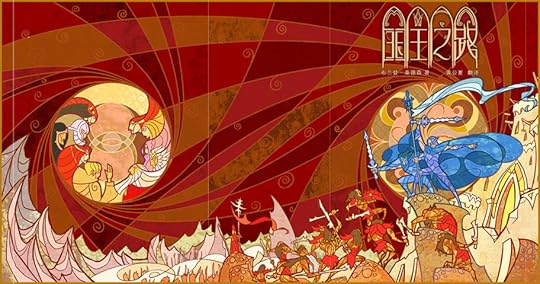
The Way of Kings (Chinese Edition) by Jian Guo
It’s difficult to read The Way of Kings and not be washed over by the love that the author has imbued in his work.
Sanderson is so earnest, so effusively enamoured with his fictional creations, that it’s difficult to read The Way of Kings and not be washed over by the love that the author has imbued in his work. It’s a love of his own creation, but also of the epic fantasy’s lauded history: the enormous scale of Robert Jordan; the worldbuilding and ethnic diversity of Ursula K. Le Guin; the clashing armies of Terry Brooks; the otherworldliness and humour of Jack Vance. The Way of Kings is an homage to ’80s and ’90s fantasy, and, for anyone who grew up reading the great authors of those eras, there’s an almost irresistible desire to forget the novel’s flaws and just enjoy the ride.
The Way of Kings has that same obsessive, addictive quality that makes all of Sanderson’s other works so effective. It’s not so much about what it offers readers, but about what it can offer readers. Promises abound, hints of world-changing events, and mind-bending character developments to come. Nobody does foreshadowing in epic fantasy as well as Brandon Sanderson, and, if his previous work is any indication, every small detail in this early book will have a ripple-like effect on the volumes that follow. Every chapter is full of questions, full of the type of plot developments and world building that fills chatter around water coolers or playgrounds.
“Oh my god, could you believe when Kaladin…”
“Man, I just can’t wait until Dalinar finally gets his revenge on…”
“Ten heartbeats? That character? Whaaaaat?”
It’s immensely easy to sink into Roshar, to feel the slow momentum of a diverse world on the edge of utter chaos. As Shallan feels slow goosebumps spread on her arms at a terrifying revelation, so do you. As Dalniar ponders the sociological, political, and ethical impacts on the slow genocide of his enemies, you feel his frustration flushing your cheeks. As Kaladin struggles against his own inner voice, you scream at him to push through, to live.
It’s so easy to give everything to the novel, to concede everything as a reader that epic fantasy asks for. To become invested in the fate of this new world.
But, then, with a sigh, the reviewer sits down to write a review, and that little critical voice in his head is just a little louder, a little more eloquent, than the fanboy.
While everyone agrees that Sanderson is among the best conceptual epic fantasy writers, crafting some of the genre’s most intricate and methodically developed magic systems, opinion on his characterization is split. As a reader who remembers Vin, Kelsier, Sazed, and the other characters from his Mistborn trilogy fondly, I was initially disappointed to find myself somewhat less attached to the three main protagonists of The Way of Kings: Kaladin, Dalinar, and Shallan.
Pinpointing the exact source of this detachment is difficult, but a major contributing factor is that the novel, for all of its pages, as mentioned above, feels more like a prologue to a larger series, an attempt by Sanderson to introduce readers to his world and his characters, without introducing them to the series’ overarching plotline until the very final pages. Even by the 1,000 page mark, it is difficult to recognize how each of the protagonists fits together into the large, puzzle-like plot of the series. Individually, each character struggles with intensely personal challenges, but Epic Fantasy is about the bigger picture, and in The Way of Kings it can sometimes be difficult to see the forest for the trees.
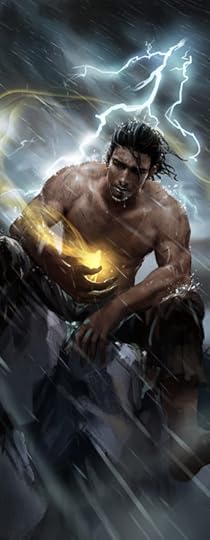
“Kaladin” by Kay Huang
Central to all plot lines in The Way of Kings is the social and civic relationship between the “darkeyes” and the “lighteyes”
Individually, each of the three protagonists is likeable in their own way, and their storylines, each of which crossover only slightly, are intriguing enough that you don’t mind spending so long at their side (notably, each of the three protagonist storylines, if the others were removed, would still be longer than many other novels.) Sanderson’s not subtle in the way he establishes the main characteristics that define Dalinar (patriotism), Kaladin (perseverance), and Shallan (naivety), or, the trait that ties them all together: obsession. By casting the three characters in such different life situations, with vastly different backgrounds, and levels of life experience and world-weariness, Sanderson does an effective, if surface-level, job of exposing readers to the idea that the truth of the world world is changes based on the perceptions of those whose eyes you’re looking through.
Central to all plot lines in The Way of Kings is the social and civic relationship between the “darkeyes” (slaves and poor working class) and the “lighteyes” (privileged nobles) of Alethkar. Presented as a fairly obvious analogue to slavery in post-Revolutionary War America, this exploration of institutionalized racism is present on nearly every page in the novel, used as a mechanism for separating the “good guys” from the “bad guys.” Dalinar is good, for instance, because he treats the darkeyes with slightly more respect than the other lighteyes, despite being viciously racist towards the Parshendi that he fights. Shallan, in all her naive charm, recognizes and acknowledges these issues very rarely, proving her innocence. Kaladin’s very existence and obsessions revolve around a violent past experience with a lighteyed noble, and results in drowning anger towards the noble class.
Add to this, Kaladin is not only a darkeyes, he’s a slave and sold into the Alethi army as a “bridgeman,” a team of humans whose sole purpose in the army is to run enormous, army-bearing bridges ahead of the army’s main forces to enable them to cross the enormous chasms that split the Shattered Plains, a contested zone that has seen war between the Alethi and the mysterious Parshendi. Kaladin is cast in a role that would not be out-of-place in the relentlessly grim work of authors like Joe Abercrombie or Mark Lawrence, but Sanderson’s slightly juvenile writing style is a somewhat uncomfortable partner for Kaladin’s hopeless situation.
However, despite their direct impact all of the novel’s various storylines, Sanderson never graduates past surface-level examinations of these themes. So, while they do a nice job of framing the narrative, and exposing readers to the high level concept that Alethkar is dominated by institutionalized racism, The Way of Kings never achieves the intellectual depth of Ursula K. Le Guin, the satirical elegance of Terry Pratchett, or the raw emotion of Nnedi Okorafor. Those are lofty names to place Sanderson beside, but Sanderson’s taken a big bite of a very serious matter, and if you join a hot dog eating competition, you’re going to be compared to Kobayashi.
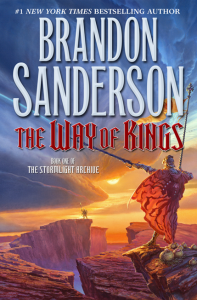
Buy The Way of Kings by Brandon Sanderson: Book/eBook
The Way of Kings is very clearly the first chapter of a much larger tale.
One of The Way of Kings‘ greatest oddities, something I’m still contemplating midway through the second novel, is that, despite being 1,200 pages long, there are only four real distinct set pieces in the novel: the Palanaeum (a large library) where Jasnah and Shallan study, the Alethi war camps on the Shattered Plains, the bridgeman camps on the Shattered Plains, and the battlefields of the Shattered Plains. Epic fantasy often finds strength in its ability to offer enormous variety and opportunity to introduce readers to a large number of interesting locations and people. Throughout The Way of Kings, Sanderson hints at many other lands, and briefly exposes readers to these wonderful places in the novel’s various interludes, where they succeed in illustrate that Alethi culture is only one small corner of a diverse and thriving world, but each of the main storylines has a radius of only a few dozen kilometers. Whether this is a flaw or an interesting twist on convention is subjective, but this illustrates some unusual restraint for a novel that otherwise embraces self-indulgence.
The Way of Kings is very clearly the first chapter of a much larger tale. Despite its flaws, The Way of Kings proves that Sanderson has the ambition to fill the hole left after the conclusion of Robert Jordan’s Wheel of Time, and continue establish himself as one of the most successful and prolific young fantasy novelists. Like many opening volumes before it, The Way of Kings convinces readers that the best is yet to come.