
INTERPRETING HISTORY
Susan Vaughan here, rejuvenated and refreshed after a step back in time at Old Sturbridge Village in Massachusetts. When the hubby and I returned, I was surprised to find that many people didn’t know about this living museum of early New England life. So in case you don’t know OSV, here’s a little of what we experienced.
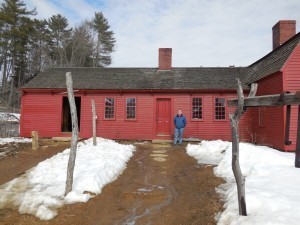
Buildings collected from all New England states create a rural community and small village of 1790-1840. Think a smaller, earlier version of Williamsburg, but somehow it seems to me more authentic. Costumed historians share what life was like in those times and demonstrate trades and crafts. We saw—and petted—the first lamb of the season, unusually early because, as the farmer said, “a ram jumped the fence.”

We also saw cattle, oxen, twin calves (I petted one), and chickens, all of breeds typical in those times but rare now.
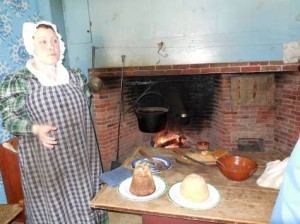
In the Small House, the historian showed us how an early Massachusetts wife made sugar from maple sap. Unlike in northern New England, in Massachusetts, they didn’t make syrup but purified the sap into an almost white sugar for sweetening. The woman was also frying doughnuts in a kettle hanging in the large fireplace. Not today’s ring shapes, but more like what we call donut holes, these are “nuts” made of flour dough (yes, thus the name!), deep fried in lard then rolled in sugar. No crowds early in March, so we were lucky to sample more than one of these tasty treats.
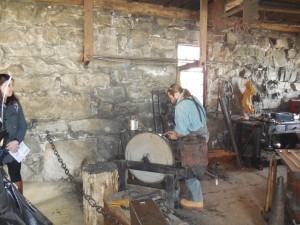
In the blacksmith shop, the smithy demonstrated how he gauged the temperature of the fire without a thermometer. He was forging a knife and first had to sharpen a tool.
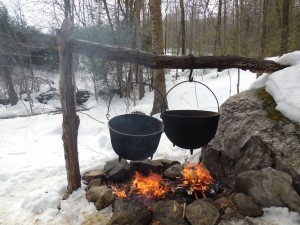
Sap wasn’t running yet, but the interpreter showed us how they gathered the sap and cooked it over open fires.
In warmer weather, OSV offers wagon and stagecoach rides, but with snow on the ground, people were enjoying a sleight ride around the green. In the background, you can see a small yellow house, and behind it the bank, the only brick building.

Two houses of worship dominated one end of the green. The Society of Friends, or Quakers, were a minority in New England but influential in ending slavery. The blue building was a Friends Meeting House. The worshippers in the Center Meeting House, the white, spired church, would have been Congregationalists, descendants of the Puritans.

 .
.
We thoroughly enjoyed our day and a half without modern technology. I was impressed with the interpreters’ depth of knowledge and how they were so immersed in their activity or subject, they seemed to have stepped out of 1800. The experience still has me pondering how difficult life was back then and how hard people worked from dawn to dusk. You can find more about the shops, houses, and businesses of Old Sturbridge Village at www.osv.org.
*** My newest release is Primal Obsession. You can find an excerpt and buy links at www.susanvaughan.com.


Lea Wait's Blog

- Lea Wait's profile
- 508 followers

