
Taste the Sugar Cane - Interview with E.E.Fry
By Maggie James
 The beautiful cover of 'Sugar Cane' In the second of my series of author interviews, I talk with author E.E. Fry, who wrote the wonderful novel Sugar Cane, set in the beautiful island of Mauritius. Sugar Cane has been described as a thriller, a murder mystery, a love story and a travelogue.
To quote Benjamin Zephaniah, an English poet included in The Times list of Britain's top 50 post-war writers:
"I read this book in one sitting, something I haven't done since I fell in love with the girl in the sweet shop. This is a page-turner... I loved the mystery, I loved the characters, I loved the setting, I loved the writing, I loved the sugar cane."
A ringing endorsement from a man who knows something about writing!
So what is Sugar Cane about? It starts when Beth Stephens's life is turned upside down after her father, George Labelle, passes away, leading her to travel to Mauritius to spread his ashes. Set between England and Mauritius during the sixties to the present day, Sugar Cane follows the stories of Beth and George, with father and daughter discovering more than they bargained for. The book takes you on a journey to a faraway place, examining the effects of slavery, Empire and indentured labour.
So who is E.E. Fry?
E. E. Fry grew up in Hampshire, the daughter of an English policeman and a Mauritian nurse. She wrote Sugar Cane while working in a bed shop that had no customers. She lives in Bristol and walks a lot with her husband and dog.
I spend an evening talking with her about her writing and how Sugar Cane came into being.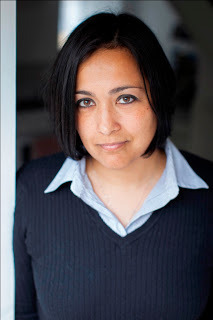 Author E.E.Fry
Tell me about the importance of writing to you.
Author E.E.Fry
Tell me about the importance of writing to you.
With writing, when you discover you have a talent, you're bound to feel at your happiest when you use it. With me, any form of writing is good, whether it's poetry, writing letters, whatever.
And reading? Surely fiction writers are also keen readers.
My mother was an avid reader and I've followed in her footsteps. She was Mauritian and reading was deeming socially unacceptable in her culture when she was growing up. She'd hide in a wardrobe with a book in order to read, can you believe that? As a result, she decided her children would read as much and as widely as possible, without censorship.
When did you start writing?
Writing has been important in my life from a very young age. I was a precocious child, starting a school newsletter when aged seven. I wrote short stories and always had a notebook at the ready.
How did the idea for Sugar Cane come about?
I had the idea in my head for years before I actually wrote the book. Through my mother, I have a strong connection with Mauritius. I go there every three to four years with my husband. All my novels will be based there; I can't conceive of anything else. Mauritius, such a beautiful island
When did you write the novel?
Mauritius, such a beautiful island
When did you write the novel?
I finished writing Sugar Cane in 2006. I sent it off to an agent in London, who wanted to see a second book, which I didn't have, so that fizzled out. Things remained dormant with the novel for a while, although I continued to write short stories in the meantime. In 2011, I sent it out to some more agents and ended up securing a publishing deal. I wasn't happy with the terms, though, so I turned it down and decided to self-publish Sugar Cane.
It seems more and more authors are spurning traditional publishing.
I see self-publishing as a tool. With Internet use now everywhere, and with Amazon and print-on-demand books now commonplace, everything is far more accessible than it ever was. With traditional publishing, you surrender control over your books and receive very little percentage-wise in terms of royalties, whilst still having to do a lot of your own promotion. Not so with the self-published model. Amazon pay 70% royalties, the author retains full control over their work, and the time to get a book into the marketplace is hours, rather than months or years.
I can't disagree with you there! Self-publishing has clearly worked well for you.
Yes. It's not necessarily about being famous or selling a million copies; it's about doing what pleases you.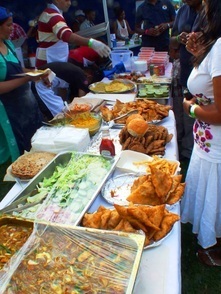 Mauritian street food - delicious! When I read Sugar Cane, I could almost taste and smell the rich Mauritian life you invoke. Especially the street food!
Everyone loves food in Mauritius. It's a cultural thing; it's how Mauritians define themselves. Including me - I'm a total foodie!
The novel uses Creole in parts of the narrative. Are you a Creole speaker?
I can't speak Creole, but I can understand it perfectly. I needed to comprehend what my mother was saying when she was annoyed with me! I was brought up bilingual, speaking French and English. Everyone who's educated in Mauritius speaks French.
Tell us about your second novel, The Earring Tree. I gather it's not about jewellery?
Trochetia boutoniana (known as boucle d'oreille - the Earring Tree), is a flower so rare that it can only be found on the very top of one mountain on Mauritius, the same one that witnessed a terrible tragedy in the history of the British Empire and slavery. Now the trochetia boutoniana wants to tell that story...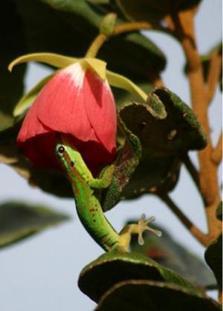 Trochetia Boutoniana
Going to give us any hints?
Trochetia Boutoniana
Going to give us any hints?
The Earring Tree is a courtroom drama based in Mauritius during the years 1830-1835. It centres around a real case when a freed slave's children were stolen back into plantation slavery when their parent suddenly died. It's hard to say more without spoiling the plot!
Lastly, please introduce us to your muse!
Of course! (At this point in our interview, a large yellow Labrador thumps his tail enthusiastically on the floor). Meet Sandy! He likes to think he's the muse for my writing, and who am I to disagree?
I wouldn't either - he's a gorgeous boy! Thank you for letting me interview you. Purchase Sugar Cane!
U.K. readers can buy Sugar Cane from Amazon by clicking the link to the left.
Find out more about E.E. Fry...
The website for E.E. Fry can be found here. You can discover more about Mauritius, read reviews of the novel, and find out more about Sandy. He has his own blog!
Subscribe to my blog and newsletter!
If you enjoy my blog, you can subscribe via the RSS feeds in the sidebar. Or, if you'd like to be kept informed about my future novels, enter your email address in the sign-up box, also in the sidebar.
The beautiful cover of 'Sugar Cane' In the second of my series of author interviews, I talk with author E.E. Fry, who wrote the wonderful novel Sugar Cane, set in the beautiful island of Mauritius. Sugar Cane has been described as a thriller, a murder mystery, a love story and a travelogue. To quote Benjamin Zephaniah, an English poet included in The Times list of Britain's top 50 post-war writers:
"I read this book in one sitting, something I haven't done since I fell in love with the girl in the sweet shop. This is a page-turner... I loved the mystery, I loved the characters, I loved the setting, I loved the writing, I loved the sugar cane."
A ringing endorsement from a man who knows something about writing!
So what is Sugar Cane about? It starts when Beth Stephens's life is turned upside down after her father, George Labelle, passes away, leading her to travel to Mauritius to spread his ashes. Set between England and Mauritius during the sixties to the present day, Sugar Cane follows the stories of Beth and George, with father and daughter discovering more than they bargained for. The book takes you on a journey to a faraway place, examining the effects of slavery, Empire and indentured labour.
So who is E.E. Fry?
E. E. Fry grew up in Hampshire, the daughter of an English policeman and a Mauritian nurse. She wrote Sugar Cane while working in a bed shop that had no customers. She lives in Bristol and walks a lot with her husband and dog.
I spend an evening talking with her about her writing and how Sugar Cane came into being.
Author E.E.Fry
Tell me about the importance of writing to you.
With writing, when you discover you have a talent, you're bound to feel at your happiest when you use it. With me, any form of writing is good, whether it's poetry, writing letters, whatever.
And reading? Surely fiction writers are also keen readers.
My mother was an avid reader and I've followed in her footsteps. She was Mauritian and reading was deeming socially unacceptable in her culture when she was growing up. She'd hide in a wardrobe with a book in order to read, can you believe that? As a result, she decided her children would read as much and as widely as possible, without censorship.
When did you start writing?
Writing has been important in my life from a very young age. I was a precocious child, starting a school newsletter when aged seven. I wrote short stories and always had a notebook at the ready.
How did the idea for Sugar Cane come about?
I had the idea in my head for years before I actually wrote the book. Through my mother, I have a strong connection with Mauritius. I go there every three to four years with my husband. All my novels will be based there; I can't conceive of anything else.
Mauritius, such a beautiful island
When did you write the novel?
I finished writing Sugar Cane in 2006. I sent it off to an agent in London, who wanted to see a second book, which I didn't have, so that fizzled out. Things remained dormant with the novel for a while, although I continued to write short stories in the meantime. In 2011, I sent it out to some more agents and ended up securing a publishing deal. I wasn't happy with the terms, though, so I turned it down and decided to self-publish Sugar Cane.
It seems more and more authors are spurning traditional publishing.
I see self-publishing as a tool. With Internet use now everywhere, and with Amazon and print-on-demand books now commonplace, everything is far more accessible than it ever was. With traditional publishing, you surrender control over your books and receive very little percentage-wise in terms of royalties, whilst still having to do a lot of your own promotion. Not so with the self-published model. Amazon pay 70% royalties, the author retains full control over their work, and the time to get a book into the marketplace is hours, rather than months or years.
I can't disagree with you there! Self-publishing has clearly worked well for you.
Yes. It's not necessarily about being famous or selling a million copies; it's about doing what pleases you.
Mauritian street food - delicious! When I read Sugar Cane, I could almost taste and smell the rich Mauritian life you invoke. Especially the street food!Everyone loves food in Mauritius. It's a cultural thing; it's how Mauritians define themselves. Including me - I'm a total foodie!
The novel uses Creole in parts of the narrative. Are you a Creole speaker?
I can't speak Creole, but I can understand it perfectly. I needed to comprehend what my mother was saying when she was annoyed with me! I was brought up bilingual, speaking French and English. Everyone who's educated in Mauritius speaks French.
Tell us about your second novel, The Earring Tree. I gather it's not about jewellery?
Trochetia boutoniana (known as boucle d'oreille - the Earring Tree), is a flower so rare that it can only be found on the very top of one mountain on Mauritius, the same one that witnessed a terrible tragedy in the history of the British Empire and slavery. Now the trochetia boutoniana wants to tell that story...
Trochetia Boutoniana
Going to give us any hints?
The Earring Tree is a courtroom drama based in Mauritius during the years 1830-1835. It centres around a real case when a freed slave's children were stolen back into plantation slavery when their parent suddenly died. It's hard to say more without spoiling the plot!
Lastly, please introduce us to your muse!
Of course! (At this point in our interview, a large yellow Labrador thumps his tail enthusiastically on the floor). Meet Sandy! He likes to think he's the muse for my writing, and who am I to disagree?
I wouldn't either - he's a gorgeous boy! Thank you for letting me interview you. Purchase Sugar Cane!
U.K. readers can buy Sugar Cane from Amazon by clicking the link to the left.
Find out more about E.E. Fry...
The website for E.E. Fry can be found here. You can discover more about Mauritius, read reviews of the novel, and find out more about Sandy. He has his own blog!
Subscribe to my blog and newsletter!
If you enjoy my blog, you can subscribe via the RSS feeds in the sidebar. Or, if you'd like to be kept informed about my future novels, enter your email address in the sign-up box, also in the sidebar.


No comments have been added yet.


