Deconstructing The Road – Part 3
(Yeah, I missed a week, and I thought I would miss this week too, but no such luck for you!)
Unfortunately, I do not have time to delve too deeply in this next section of The Road by Cormac McCarthy, and I’m sort of veering away from the sections broken out by Cliff Notes, but hopefully a quick summary will bring you up to speed on where I’m at. You can also check out this and this post if you are completely confused.
Summary (Pages 1 to ~30)
A man and his son are traveling along a road in an post-apocalyptic United States. As they move south to warmer climes, they encounter dead people, raging forest fires, bitter cold weather, a man struck my lightning and sometimes food. Most of their gear is carried in a shopping cart that they push along the road through snow and rain.
When last I summarized the story, they were heading towards a mountain pass. In this section, they summit that pass, and are now making their way down and south out of the freezing weather. They found a waterfall off the highway and spent some time there, but move on because if the site is desirable to them, it will be for others. And the father doesn’t want to meet other people.
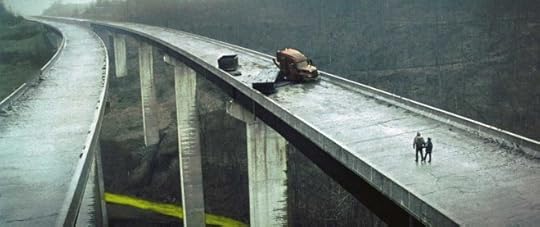
The road passes over a gorge and a semi-truck is jack-knifed across the bridge. The father and son spend a night in the cab only to find out the next morning that the trailer is filled with dead bodies. They move on.
Revelations
Up until now, the reader has not been given too many explanations about how these two have gotten where they are at nor why they are traveling south. Though on a basic level, we know that south means warmer and a better chance of surviving in the blackened world.
But the man is haunted by vague dreams and a decision that he made and up until this section, we really didn’t know what that is. We knew the man was struggling with his faith, but we really didn’t know why.
In this section, it is revealed why.
The boy’s mother* kills herself. And she would have killed their son, too, if the father had let her. She argues that life is not worth living the way it is:
Sooner or later they will catch us and they will kill us. They will rape me. They’ll rape him. They are going to rape us and kill us and eat us and you wont face it. You’d rather wait for it to happen.
Yikes!
The man’s memories and dreams hint at a chaotic end to the world where once the food supply has run low, people have taken to eating other people.
The man must come to terms with the fact that despite the world being a true living hell, he has decided to live in it along with his son. And it doesn’t help that the boy thinks much like his mother:
I wish I was with mom.
He didn’t answer. He sat beside the small figure wrapped in the quilts and blankets. After a while he said: You mean you wish that you were dead.
Yes.
You musnt say that.
But I do.
Don’t say it. It’s a bad thing to say.
I can’t help it.
I know. But you have to.
How do I do it?
I don’t know.
Reflections
I’d like to discuss in detail some of the passages in this section, but I’ll have to save that for later. For now, I’ll just say that this section bugged me as much as it did the first time I read it.
In this section of the book, the mother is painted as the unyielding and irrational partner. She’s given the most dialogue than anyone else in the book up until this point and her speeches sound more like sermons than anything else. Also, she damns herself repeatedly by saying she has a “whorish heart” and is a “faithless slut”.
Because she wants to kill herself?
The language the author uses to describe the mother is relentless and I really felt it was an attack not only on women but on folks who would consider suicide**. Coupled with the religious undertones of the previous sections, I’m beginning to wonder if McCarthy had a certain message he wanted to impart.
Join me next week and we’ll find out what that message might be.
*It is never stated whether the father and mother were married or not. It is possible that they didn’t get together until after the catastrophic event that destroyed civilization.
**Take note, the character, the man, is not so condemning of her, but she is of herself.