Deconstructing The Road – Section 2
Yikes! Is it Wednesday already? How did that happen?
For those who know my schedule (she has a schedule? yes, I have a schedule), my apologies. I should have had this post complete and posted at dawn. Such is life. Let’s get on with it.
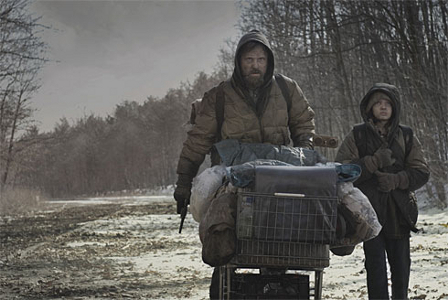
When we left our unnamed hero and his son wandering the blasted lands of America, the duo are traveling along a road. It so happens they are traveling south. The father had decided that going south to a possibly warmer clime is their only hope of surviving the winter.
In Section 2 of The Road by Cormac McCarthy, they do just that. Travel south until they reach a gap in the mountains. As far as plot goes, there’s not much going on here. However, we are treated to a deeper understanding of the man and we soon begin to realize that most of the places we visit are places he has been to as a boy with how own father.
The author is building a relentless portrait of a man losing his faith in his god (and thus humanity), while at the same time contrasting his past experiences with the boy’s current experiences. He sort of supplants his old faith with a new one. This is a theme I definitely did not pick up on during my first read and I am interested to see how it plays out.
Let’s look at how the author does this.
Faith and Fire
Throughout the first and second sections, the man refers to a god and the boy, equating the two, in two places and almost forsaking his old god in one. I’ll give you the lines:
Page 7 (in my digital edition):
He only knew that the child was his warrant. He said: If he is not the word of God God never spoke.
Here, I think McCarthy does an amazing thing. In two short sentences, he tells us exactly how the man feels about his son. The boy is his justification for living, without him, there’s not even a god. In his opinion, there might as well be no world if the boy is not in it.
Page 10:
He descended into a gryke in the stone and there he crouched and coughing and he coughed for a long time. Then he just knelt in the ashes. He raised his face to the paling day. Are you there? he whispered. Will I see you at the last? Have you a heart? Damn you eternally have you a soul? Oh God, he whispered. Oh God.
And in the passage above, the man is admitting to himself (and anyone else who may be around to hear) his doubts about his god.
Page 19:
He dozed in the wonderful warmth. The boy’s shadow crossed over him. Carrying an armload of wood. He watched him stoke the flames. God’s own firedrake. The sparks rushed upward and died in the starless dark. Not all dying words are true and this blessing is no less real for being shorn of its ground.
And here, he even calls the boy an agent of god. And not just any sort of agent, but a firedrake, evoking images of not only a powerful being, but something that burns eternal or at least will tend to a fire eternally. The boy is not only humanity’ s future, but the god’s future as well.
In addition, at several instances, in the language the man uses to describe what he see around him, the author supplants the idea that the world has been forsaken by the man’s god. Like this:
Page 7:
…walked out to the road and squatted and studied the country to the south. Barren, silent, godless.
Page 19:
On this road there are no godspoke men.
All taken together, we get a clear picture of a man losing his faith in his god and shifting that faith over to his son, who will carry the flame into the future.
Old/New
At the same time, the two are traveling through country that is the man’s homeland. They visit the man’s home, and the boy is frightened of the place. But not just of the place, but – it seems – of his father’s memories of the place.
While in the man’s childhood home, we get this:
The boy watched him. Watched shapes claiming him he could not see.
When I read that, I couldn’t help but imagine that the boy might even be jealous of his father’s memories. Maybe, like a jealous god?
Later in this scene, the boy tells his father he’s scared and the father admits that they shouldn’t have gone there. I can’t figure that one out, but I suppose it is because the boy doesn’t want to lose his father to a past that will never be again.
Story Mood
One thing that I admired in this section was the language the author used. Words like gryke and firedrake evoke very specific and powerful images.
Using gryke, natural limestone weathered into a patterns that looks like paved stone, reminded me of a natural altar, where the man has gone to talk to his god. And the firedrake, well, that’s a dragon! And we all know they are one of the post powerful symbols in fiction, often used to convey power, longevity, wisdom, and fire (in this case, fire would be life or life-giving).
Coupled with words associated with religion, the author very clearly sets an ominous, religious mood. And he does so very economically. Like this:
The flesh cloven along the bones, the ligaments dried to tug and taut as wires. Shriveled and drawn like latterday bogfolk, their faces of boiled sheeting, the yellowed palings of their teeth. They were discalced to a man like pilgrims of some common order for all their shoes were long since stolen.
When I first read this, I didn’t know what ‘discalced’ meant, but I knew it had to do with religion. It just sounded like it would and with all the other references, I got a stark picture of what was left of the god’s faithful. Not a pretty picture.
But what I enjoyed with this second reading was how well-chosen Mr. Carthy’s words are: cloven – usually associated with hooves and this made me think of the devil; latterday – coupled with bogfolk, it would seem it is a new faith of the dead; pilgrims and order convey (to me) that the dead have entered a cult of some sort.
However you read those pieces, combined they form a powerful picture of a god turning against his flock and given them up to the devil – in 52 words.
I’m sure it would have taken me a book to say all that.
So far, this section doesn’t really advance the story’s plot much (not that there’s much plot to begin with!), but we do get an overriding sense of how important saving his son is to this man. Humanity hinges on the boy’s survival.
Let’s see if he does.
Until next time, search for words that can efficiently be used to evoke a complex mood or setting.
RELATED ARTICLES:
Section 1 – Deconstructing The Road