
Schooling Ain't Learning, But It Is Money, by Bryan Caplan
Lant Pritchett is enjoying justified praise for his new
The Rebirth of Education: Schooling Ain't Learning
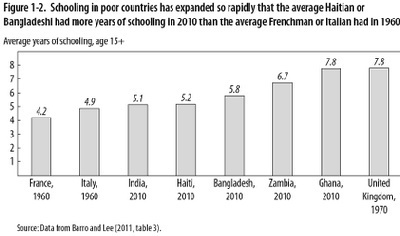
. His central thesis: schooling has exploded in the Third World, but literacy and numeracy remain wretched.
The average Haitian and Bangladeshi today have more schooling than the average Frenchman or Italian in 1960:
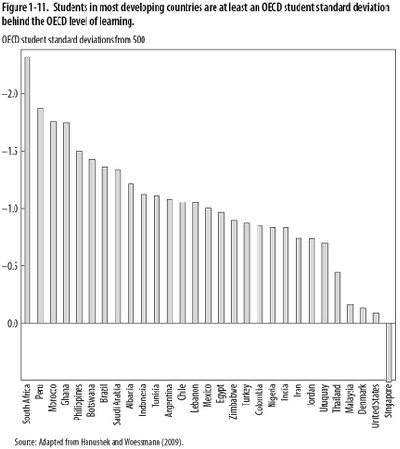
On international literacy and numeracy tests, however, the average student in the developing world still scores far below the average student in the developed world. Gaps of one standard deviation plus are typical:
Solid work. But there's an amazing fact that Pritchett largely ignores in this book. Despite the woeful failure of Third World schools to teach basic skills, Third World employers still greatly value educational attainment. In fact, credentials pay more in the developing world than they pay in the developed world! Psacharopoulos and Patrinos provide a thorough survey of the evidence. Quick (and conservative!) estimates say that the education premium averages 10.9% in low-income countries versus just 7.4% in high-income countries:

Pritchett's omission is striking because he's also famous for pointing out and trying to explain the fact that education is much more lucrative for individuals than nations. His leading explanations are (a) rent-seeking, and (b) signaling. My postcard version:
How does the signaling model better fit the facts? Simple. Although Third World schools fails to teach literacy and numeracy, they still rank students. Indeed, Pritchett emphasizes that one of the main problems with international test scores is that weaker students tend to drop out sooner, creating an illusion of learning in the data. What Pritchett doesn't emphasize, though, is that employers can profit from this selection attrition by preferring more educated workers. Signaling!
Prtichett earnestly wants to bring literacy and numeracy to the world's poor. It's a worthy aim. But his evidence teaches us much deeper and more general lessons about the economics of education. Once you grasp how little its schools teach and how much employers pay, the signaling story is hard to escape for the Third World. And if signaling matters enormously there, shouldn't we expect it to matter enormously everywhere?
(1 COMMENTS)
The average Haitian and Bangladeshi today have more schooling than the average Frenchman or Italian in 1960:
On international literacy and numeracy tests, however, the average student in the developing world still scores far below the average student in the developed world. Gaps of one standard deviation plus are typical:
Solid work. But there's an amazing fact that Pritchett largely ignores in this book. Despite the woeful failure of Third World schools to teach basic skills, Third World employers still greatly value educational attainment. In fact, credentials pay more in the developing world than they pay in the developed world! Psacharopoulos and Patrinos provide a thorough survey of the evidence. Quick (and conservative!) estimates say that the education premium averages 10.9% in low-income countries versus just 7.4% in high-income countries:
Pritchett's omission is striking because he's also famous for pointing out and trying to explain the fact that education is much more lucrative for individuals than nations. His leading explanations are (a) rent-seeking, and (b) signaling. My postcard version:
1. The rent-seeking story: Education successfully teaches socially wasteful job skills.Pritchett's latest evidence heavily tips the scales against rent-seeking. The rent-seeking story posits that Third World schools are teaching students to cleverly manipulate a corrupt, zero-sum political system. The reality, though, is that Third World schools don't even teach students how to read, write, add, or subtract - much less file a legal brief or sue a competitor.
2.
The signaling story: While education teaches few useful job skills,
strong academic performance convinces the labor market that you've got
the Right Stuff.
How does the signaling model better fit the facts? Simple. Although Third World schools fails to teach literacy and numeracy, they still rank students. Indeed, Pritchett emphasizes that one of the main problems with international test scores is that weaker students tend to drop out sooner, creating an illusion of learning in the data. What Pritchett doesn't emphasize, though, is that employers can profit from this selection attrition by preferring more educated workers. Signaling!
Prtichett earnestly wants to bring literacy and numeracy to the world's poor. It's a worthy aim. But his evidence teaches us much deeper and more general lessons about the economics of education. Once you grasp how little its schools teach and how much employers pay, the signaling story is hard to escape for the Third World. And if signaling matters enormously there, shouldn't we expect it to matter enormously everywhere?
(1 COMMENTS)


No comments have been added yet.
Bryan Caplan's Blog

- Bryan Caplan's profile
- 374 followers
Bryan Caplan isn't a Goodreads Author
(yet),
but they
do have a blog,
so here are some recent posts imported from
their feed.

