Q & A about Long Lessons and a New Direction in Writing
Several friends and family members have had questions about my new writing projects. Here are my answers to the most common ones.
Q: A lot of your training is in theology, biblical studies, and ancient Near Eastern literature. Why the sudden interest in writing things that have little to do with these topics?
A: It’s a long story I intend to tell someday, but here’s the gist. When I graduated with my Ph.D. in Old Testament, I had aspirations of becoming a professor at a Bible College, Seminary, or University. But these days, so many schools are only hiring adjunct professors for meager pay and no benefits. And since there is an overflow of qualified teachers in my field, one definitely has to know the right people to find full-time work. Well, that led to another problem: my views had shifted quite a bit which, sadly, burned several bridges. In the end, I had two graduate degrees from religiously conservative schools but held many core beliefs that most of my friends would describe as liberal. That led to some difficult encounters which left me without a home church and without work. All the while I continued to blog and publish my ideas.
At the beginning of 2013, I decided that I needed to blaze a new trail. I had several stories that I wanted to tell since high school, but never made the time to develop them. After reading Stephen King’s great memoir On Writing, I decided to pen some of the stories that I had stored in the attic of my mind for all those years. About six months later I published Long Lessons.
Q: A book about dogs written by a biblical scholar is very different, even strange. Why did you decide that would be your first project?

A: In my public speaking and teaching venues, audiences love it when I tell stories about my dogs. Even those who don’t particularly care for dogs chuckle when I describe Dixie’s crooked tail, Sparky’s obsession with tennis balls, and Reesie’s insatiable hunger for the most rancid things he can find. Their stories were fresh on my mind, and since they were well-received among my friends, I decided to write them down as sort of an experiment to determine how well I could tell such a story. I knew I could write research papers, but didn’t know how well I could tell a comical tale. I started with one chapter, and it was so much fun I just couldn’t stop. Soon I developed an outline and storyboard for the whole book. I set goals and deadlines, had other people read over it and give feedback, and published it myself.
Q: That leads to another question: Why did you self-publish instead of going through a publisher?
A: During the first two months I was pretty pleased with all that I had accomplished. I was nearing two hundred pages when I started researching how I could pitch the story to a publisher, but the more I researched, the more I saw how well some authors did publishing their own work via Amazon and other e-book platforms. At the very least, self-publishing is a great way to develop a fan base which helps get a publisher’s attention. Still, I thought I’d pitch the idea to a few publishers to see what would happen. I mean, who in the world would publish a book about lessons that they learned from their own three Dachshunds?
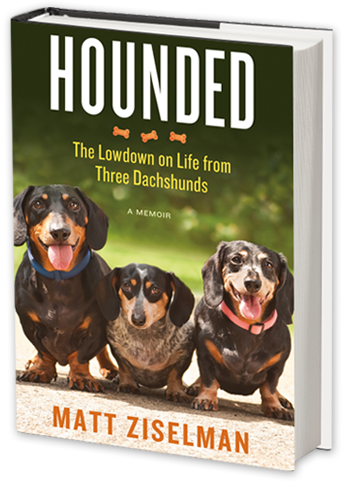
Matt Ziselman, that’s who. While perusing the bookstore around May of this year, I saw his new book on the shelves: Hounded: The Lowdown on Life from Three Dachshunds.
Crap, I thought. So much for my unique idea. But there was still hope. Maybe the book sucked, so I thumbed through it searching for some kind of fault. Double-Crap! It doesn’t suck. It’s great. And actually, it really is a good, fun book. Anyone who is a dog lover will enjoy it. But since my unique edge was now gone, I figured I’d just give the self-publishing route a try.
Q: How’s it going so far?
A: Slow. The people who have read my book enjoy it, but as a new writer, nobody knows who I am. And though there is a lot of freedom in self-publishing, people would rather buy a book from an established publisher than some Joe Schmo they’ve never heard of before. If a publisher invests in it, the book is at least somewhat decent, right? But there is an ocean of self-published work that really isn’t any good. So in a lot of ways, the odds aren’t in my favor.
Still, the response I’m getting so far is great. I’m taking steps to market Long Lessons and get the word out, but—you know—it’s just me. But I try to live by the most important rule for writers: write a great story. That’s what I’ve done. My plan is to continue writing great stuff and let the chips fall. Even if I never “make it” as a writer (whatever that means), I’m pretty happy that people find my work enlightening and entertaining. That’s the main thing that motivates me to write and write well.
In many ways I feel like a chef cooking for my friends. I want to prepare something delicious for the reader, and when they finally drop their napkin on the plate, I want them to smile big, maybe give a small belch, and tell me how great the meal tasted. I think that’s the true motivation of a writer: the reader’s gleeful satisfaction after devouring a story.
Q: In the preface of Long Lessons, you state that there is no “hidden agenda” in the book. What do you mean?
A: I wanted to set my readers at ease. Though I’m quite proud of my Christian heritage and theological education, I wanted to make it clear that there is no guilt trip, point of decision, “altar call,” or whatever you want to call it in the book. I’m not preaching anything. I just wanted to tell a fun story with no strings attached. Since Long Lessons is a memoir, you’ll still see a few glimpses of my time at school. More than once you’ll see me try to reconcile some things I’m learning with my new dog experiences. Even though I love dogs, the Bible has virtually nothing good to say about them. At one point I even wrestle with the idea that animals supposedly have no afterlife.
But these are only brief comments that I make along the way. In fact, I was really nervous about sounding preachy, so I made sure not to use any Bible references at all. But later I felt irresponsible for leaving them out—three humanities degrees will do that to you. So I decided to add a short “notes” section in the back for anyone who wants to know more about some of these topics. That way, you can choose to read the egghead stuff only if you want to.
Q: Any new projects on the horizon?
A: Several. I’m finishing up a novella which should be out before 2014 about two boys who explore an abandoned bike trail in a section of woods nobody has seen in years. It’s a creepy coming-of-age story inspired by my Stephen King readings. A few months ago, I started working on a Christmas story that I wanted to get out this year, but that one will have to wait. All these projects take longer than you expect, you know?
Early next year I’ll start pitching my next book idea which I think has real potential. It’s a dystopian sort of story that I’m pretty stoked about. Another book I’m cooking up deals with ghosts terrorizing different folks which should be a cool exploration of how people deal with fear. And then there’s the one about the flawless machine, and another one about an egomaniac. So I guess you’d say I have a few ideas to keep me busy for a while.
Q: So does that mean you’re done with your theological writings?
A: Not at all. I hope to continue wrestling with ideas at Scripture Views. Several people have asked me to expound on my new ideas. Those who know me are perplexed at how I could move from a biblicist position to one that is more liberal. So I might have to write that story too. I expect that’ll be a lot of fun.