Lessons from a Struggling Math Student
They don’t do their work, don’t show up for help, settle for memorizing facts instead of working to truly understand the material. Unlike many teachers, however, he knows better than to label his students as lazy and unmotivated—in part because he once walked in their shoes.
In an essay of compelling honesty and empathy, he writes about how he himself once struggled during a class on topology (the funky science of shapes and spaces), and took refuge in the very same procrastinating behaviors he sees in students.
His story demonstrates many features of perfectionism, including:
1) How Blindsiding Makes Things Worse

Orlin: “Thanks to a childhood of absurd privilege, I entered college well-prepared. As a sophomore in the weed-out class for Yale math majors, I earned the high score on the final exam. After that, it seemed plausible to me that I’d never fail at anything mathematical.”
When we’re blindsided our defenses are down, so any loss or struggle is extra shocking. Having too-high expectations for success is a classic prelude to blindsiding so it’s important to moderate your expectations even in situations, such as Orlin’s, where it would seem reasonable to expect a strong success. (Beware statements like: “I’m definitely going to ace this project because…”)
Thirty years later, I can still remember the utter shock of getting my first-ever poor grade. It was a D on a test in my freshman chemistry class in college; and I remember standing there in my dorm room, thinking, ‘How could this possibly be happening to me?” Then, I remember throwing the textbook across the room, which brings us to…
2) How Denial, Anger, and Blame Distract us From the Real Problem
Orlin: “I blamed others for my ordeal. Why had my girlfriend tricked me into taking this nightmare class? (She hadn’t.) Why did the professor just lurk in the back of the classroom, cackling at our incompetence, instead of teaching us? (He wasn’t cackling. Lurking, maybe, but not cackling.) Why did it need to be stupid topology, instead of something fun? (Topology is beautiful, the mathematics of lava lamps and pottery wheels.) And, when other excuses failed, that final line of defense: I hate this class! I hate topology!”
Actually, many of the people I work with overblame themselves—a classic example being a student who blames herself for poor grades caused by bad teaching, personal troubles, or other factors. Or, an employee blaming himself for a failure that was really caused by inept supervision and a chaotic workplace.
3) How Perfectionism Raises the Stakes on your Project to Almost Unbearable Levels
I call that “The Ahab Syndrome,” andOrlin helpfully illustrates it with this picture of “Moby-us-Dick:”
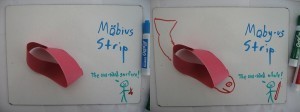
(From Ben’s blog, Math with Bad Drawings. A Mobius strip is a common topological device.)
And, finally,
4) How Shame is the Real Barrier to Growth and Success
Orlin sees himself, asking his professor for help, as, “An unbathed child asking for soup.” That’s a very ashamed–and, hence, powerfully disempowering–image.
And the shame from these kinds of incidents tends to persist, undermining your confidence. Orlin: “It’s surprisingly hard to write about this, even now. Mathematical failure – much like romantic failure – leaves us raw and vulnerable.” And, of course, I still remember that D! Unfortunately, there is no expiration date on traumatic memories: I once spoke to a 76 year old woman who started crying when she recalled the shame of having been held back in school in second grade.
Fortunately, Orlin overcame his shame enough to approach his teacher, who helped him.
Orlin: “Teachers have such power. He could have crushed me if he wanted. He didn’t, of course. Once he recognized my infantile state, he spoon-fed me just enough ideas so that I could survive the lecture. I begged him not to ask me any tough questions during the presentation – in effect, asking him not to do his job – and with a sigh he agreed. I made it through the lecture, graduated the next month, and buried the memory as quickly as I could.”
And drew the right conclusions:
Orlin: “Procrastination isn’t just about laziness. It’s about anxiety. To work on something you don’t understand means facing your doubts and confusions head-on. Procrastination pushes back that painful confrontation….
“I tell my story to illustrate that failure isn’t about a lack of “natural intelligence,” whatever that is. Instead, failure is born from a messy combination of bad circumstances: high anxiety, low motivation, gaps in background knowledge. Most of all, we fail because, when the moment comes to confront our shortcomings and open ourselves up to teachers and peers, we panic and deploy our defenses instead. For the same reason that I pushed away Topology, struggling students push me away now.
“Not understanding Topology doesn’t make me stupid. It makes me bad at Topology. That’s a difference worth remembering, whether you’re a math prodigy, a struggling student, or a teacher holding your students’ sense of self-worth in the palm of your hand. Failing at math ought to be like any failure, frustrating but ultimately instructive. In the end, I’m grateful for the experience.”
Orlin’s prescription for teachers:
“Just as therapists must undergo therapy as part of their training, no math teacher ought to set foot near human students until they’ve felt the sting of mathematical failure.”
My prescription for you:
Notice how little it really took to get Orlin back on track: a single conversation with a helpful teacher.
The moment you catch yourself procrastinating, or whenever you want to boost your productivity, reach out for help or support—from me, a teacher or other mentor, or a peer or colleague.
In fact, savvy people often round up mentors even before they actually need them.
My thanks to Orlin for permission to quote freely from his work, and reproduce the Moby-us image.