Common Core: Main Points & Key Ideas
Since
reading standards can be such a drag, I’ve come up with some easy-to-read
tables that make them seem almost friendly. Here’s an example:
Key
Ideas and Details #1
Kindergarten
Grade 1
Grade 2
With
prompting and support, ask and answer questions about key details in a text.
Ask and
answer questions about key details in a text.
Ask and
answer such questions to demonstrate understanding of key details in a text.
Grade 3
Grade 4
Grade 5
Ask and
answer questions to demonstrate understanding of a text, referring explicitly
to the text as the basis for the answers.
Refer
to details and examples in a text when explaining what the text says
explicitly and when drawing inferences from the text.
Quote
accurately from a text when explaining what the text says explicitly and when
drawing inferences from the text.
Key
Ideas and Details #2
Kindergarten
Grade 1
Grade 2
With
prompting and support, identify the main topic and retell key details of a
text.
Identify
the main topic and retell key details of a text.
Identify
the main topic of a multi-paragraph text as well as the focus of specific
paragraphs within the text.
Grade 3
Grade 4
Grade 5
Determine
the main idea of a text; recount the key details and explain how they support
the main idea.
Determine
the main idea of a text and explain how it is supported by key details;
summarize the text.
Determine
two or more main ideas of a text and explain how they are supported by key
details; summarize the text.
You can find similar tables for the other K-5 Reading
Informational Text (RI) standards on my pinterest page . I like them because they show how skills scaffold from one
grade level to the next.
The
tables above highlight the first two Common Core for ELA RI standards.
Basically, they say that after reading a nonfiction book, your kiddos should be
able to identify the main topic and key details in of the text.
This
certainly isn’t a new idea. In fact, it’s pretty basic. What’s the point of reading
if you don’t understand or remember the content? But as we know, this isn’t
always easy for kids, especially beginning readers.
One
great way to help students build their fluency and comprehension is Reading
Buddies. You can find a comprehensive article about the benefits of programs with multi-age reading partners here , but here's my special twist: Instead of using books at the
younger child’s reading level, use books with layered text.
The simpler text is
perfect for the young child, and the more complex text will challenge the older
child. So both students are learning. And after they finish reading a spread, they can discuss the art and
content—a practice that will certainly address CCSS for ELA RI #1
and #2.
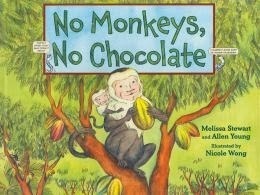
My new book No Monkeys, No Chocolate is perfect for this kind of Reading Buddies
program. Here are some other books with layered text. They are also good choices for a Reading Buddies program in which both students participate fully.
Actual Size by Steve Jenkins
Beaks by Sneed B. Collard (illus. by Robin Brickman)
The Bumblebee Queen by April Pulley Sayre (illus Patricia J. Wynne)
A Butterfly is
Patient by Diana Hutts Aston (illus. Sylvia Long)
An
Egg is Quiet by Diana Hutts Aston (illus.
Sylvia Long)
Here
Come the Humpbacks! by April Pulley Sayre (illus. Jamie Hogan)
Meet
the Howlers by April Pulley Sayre (illus. Woody Miller)
Move! by Steve Jenkins & Robin Page
My
First Day by Steve Jenkins & Robin Page
A
Place for Bats by Melissa Stewart (illus by
Higgins Bond)
A
Place for Birds by Melissa Stewart (illus by
Higgins Bond)
A
Place for Butterflies by Melissa
Stewart (illus by Higgins Bond)
A
Place for Fish by Melissa Stewart (illus by
Higgins Bond)
A
Place for Frogs by Melissa Stewart (illus by
Higgins Bond)
A
Place for Turtles by Melissa Stewart (illus by Higgins
Bond)
Prehistoric Actual Size by Steve Jenkins
A
Rock Is Lively by Diana Hutts Aston (illus.
Sylvia Long)
A
Seed is Sleepy by Diana Hutts Aston (illus.
Sylvia Long)
Snowflake Bentley by
Jacqueline Briggs Martin (illus. by Mary Azarian)
What
Do You Do with a Tail Like This? by
Steve Jenkins & Robin Page
When
the Wolves Returned by Dorothy Hinshaw
Patent (photos Dan and Cassie Hartman)
Wings by Sneed B. Collard (illus. by Robin Brickman)

reading standards can be such a drag, I’ve come up with some easy-to-read
tables that make them seem almost friendly. Here’s an example:
Key
Ideas and Details #1
Kindergarten
Grade 1
Grade 2
With
prompting and support, ask and answer questions about key details in a text.
Ask and
answer questions about key details in a text.
Ask and
answer such questions to demonstrate understanding of key details in a text.
Grade 3
Grade 4
Grade 5
Ask and
answer questions to demonstrate understanding of a text, referring explicitly
to the text as the basis for the answers.
Refer
to details and examples in a text when explaining what the text says
explicitly and when drawing inferences from the text.
Quote
accurately from a text when explaining what the text says explicitly and when
drawing inferences from the text.
Key
Ideas and Details #2
Kindergarten
Grade 1
Grade 2
With
prompting and support, identify the main topic and retell key details of a
text.
Identify
the main topic and retell key details of a text.
Identify
the main topic of a multi-paragraph text as well as the focus of specific
paragraphs within the text.
Grade 3
Grade 4
Grade 5
Determine
the main idea of a text; recount the key details and explain how they support
the main idea.
Determine
the main idea of a text and explain how it is supported by key details;
summarize the text.
Determine
two or more main ideas of a text and explain how they are supported by key
details; summarize the text.
You can find similar tables for the other K-5 Reading
Informational Text (RI) standards on my pinterest page . I like them because they show how skills scaffold from one
grade level to the next.
The
tables above highlight the first two Common Core for ELA RI standards.
Basically, they say that after reading a nonfiction book, your kiddos should be
able to identify the main topic and key details in of the text.
This
certainly isn’t a new idea. In fact, it’s pretty basic. What’s the point of reading
if you don’t understand or remember the content? But as we know, this isn’t
always easy for kids, especially beginning readers.
One
great way to help students build their fluency and comprehension is Reading
Buddies. You can find a comprehensive article about the benefits of programs with multi-age reading partners here , but here's my special twist: Instead of using books at the
younger child’s reading level, use books with layered text.
The simpler text is
perfect for the young child, and the more complex text will challenge the older
child. So both students are learning. And after they finish reading a spread, they can discuss the art and
content—a practice that will certainly address CCSS for ELA RI #1
and #2.

My new book No Monkeys, No Chocolate is perfect for this kind of Reading Buddies
program. Here are some other books with layered text. They are also good choices for a Reading Buddies program in which both students participate fully.
Actual Size by Steve Jenkins
Beaks by Sneed B. Collard (illus. by Robin Brickman)
The Bumblebee Queen by April Pulley Sayre (illus Patricia J. Wynne)
A Butterfly is
Patient by Diana Hutts Aston (illus. Sylvia Long)
An
Egg is Quiet by Diana Hutts Aston (illus.
Sylvia Long)
Here
Come the Humpbacks! by April Pulley Sayre (illus. Jamie Hogan)
Meet
the Howlers by April Pulley Sayre (illus. Woody Miller)
Move! by Steve Jenkins & Robin Page
My
First Day by Steve Jenkins & Robin Page
A
Place for Bats by Melissa Stewart (illus by
Higgins Bond)
A
Place for Birds by Melissa Stewart (illus by
Higgins Bond)
A
Place for Butterflies by Melissa
Stewart (illus by Higgins Bond)
A
Place for Fish by Melissa Stewart (illus by
Higgins Bond)
A
Place for Frogs by Melissa Stewart (illus by
Higgins Bond)
A
Place for Turtles by Melissa Stewart (illus by Higgins
Bond)
Prehistoric Actual Size by Steve Jenkins
A
Rock Is Lively by Diana Hutts Aston (illus.
Sylvia Long)
A
Seed is Sleepy by Diana Hutts Aston (illus.
Sylvia Long)
Snowflake Bentley by
Jacqueline Briggs Martin (illus. by Mary Azarian)
What
Do You Do with a Tail Like This? by
Steve Jenkins & Robin Page
When
the Wolves Returned by Dorothy Hinshaw
Patent (photos Dan and Cassie Hartman)
Wings by Sneed B. Collard (illus. by Robin Brickman)


No comments have been added yet.