Writing Process: Practical Application
My college freshmen comp class is writing a literary analysis on The Turn of the Screw. This is a challenging text for high schoolers (or anyone else)!
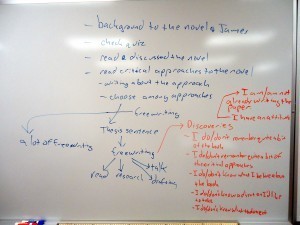
They're at the point where they have to start writing their papers, so I put the steps we'd already taken toward writing the paper on the board:
Studied the background to the novel and Henry James
Quiz and discussion
Read and discussed the novel (with writings along the way)
Read and discussed critical approaches to the novel (with writings along the way)
Chose among the approaches (the four approaches were Psychoanalytic, Gender, Marxist or Reader Response criticism)
The next step, I think, would be to do freewriting on their understanding of the book and what they want to say about the book. I didn't make this an assignment, so some kids did it but most did not.
Write a thesis. This might be something like, "The ghosts in The Turn of the Screw are illusions in the head of the sexually repressed governess."
Today I asked them to do a 10-minute freewriting on where they are in the writing of this essay. While they were doing that, I wrote on the board what I thought were the possibilities. I'm very interested in what is their real writing process rather than the idealized one where everyone is doing the same thing at the same time.
Here are what I thought were the possibilities about what was in their free writing:
I do/don't remember quite a bit of the book
I do/don't remember quite a bit of the critical approaches
I do/don't know what I believe about the book
I do/don't know a direction I'd like to take
I do/don't know what to do next
I am/am not already writing the paper
I have an attitude about the book or assignment that is blocking me
 Why this freewriting is important is because it will determine the student's next step. Many students wait until the last moment, and then plunge into what I've come to call the "desperation draft." This is a top-of-the-head, least-well-considered version of their response to the wriiting prompt. This kind of essay is so prevelant that it upsets the curve in the class. So many papers are written this way that the whole idea of what is an adequate response to the prompt is scewed downward.
What I want most of them to do is to do at least one more step before trying to draft. Possibilities include reading some more (particularly for students who say they don't remember or understand the book or the criticism), researching more, talking to other readers of the material, freewriting, and, in some cases, skipping all that and beginning the draft because trying to write the paper tells them what they need to go back to do to make the paper good.
In the meantime, I need to decide what is an appropriate deadline for the rough draft of the paper. The entire piece is only 1,000 words long, so I might want to see them on Friday.
They're at the point where they have to start writing their papers, so I put the steps we'd already taken toward writing the paper on the board:
Studied the background to the novel and Henry James
Quiz and discussion
Read and discussed the novel (with writings along the way)
Read and discussed critical approaches to the novel (with writings along the way)
Chose among the approaches (the four approaches were Psychoanalytic, Gender, Marxist or Reader Response criticism)
The next step, I think, would be to do freewriting on their understanding of the book and what they want to say about the book. I didn't make this an assignment, so some kids did it but most did not.
Write a thesis. This might be something like, "The ghosts in The Turn of the Screw are illusions in the head of the sexually repressed governess."
Today I asked them to do a 10-minute freewriting on where they are in the writing of this essay. While they were doing that, I wrote on the board what I thought were the possibilities. I'm very interested in what is their real writing process rather than the idealized one where everyone is doing the same thing at the same time.
Here are what I thought were the possibilities about what was in their free writing:
I do/don't remember quite a bit of the book
I do/don't remember quite a bit of the critical approaches
I do/don't know what I believe about the book
I do/don't know a direction I'd like to take
I do/don't know what to do next
I am/am not already writing the paper
I have an attitude about the book or assignment that is blocking me
Why this freewriting is important is because it will determine the student's next step. Many students wait until the last moment, and then plunge into what I've come to call the "desperation draft." This is a top-of-the-head, least-well-considered version of their response to the wriiting prompt. This kind of essay is so prevelant that it upsets the curve in the class. So many papers are written this way that the whole idea of what is an adequate response to the prompt is scewed downward.What I want most of them to do is to do at least one more step before trying to draft. Possibilities include reading some more (particularly for students who say they don't remember or understand the book or the criticism), researching more, talking to other readers of the material, freewriting, and, in some cases, skipping all that and beginning the draft because trying to write the paper tells them what they need to go back to do to make the paper good.
In the meantime, I need to decide what is an appropriate deadline for the rough draft of the paper. The entire piece is only 1,000 words long, so I might want to see them on Friday.


No comments have been added yet.